

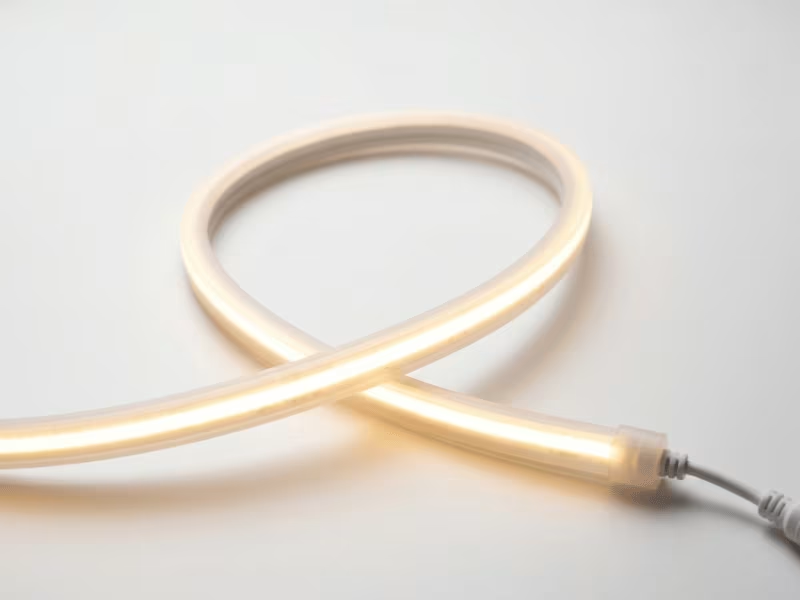
The main difference between a COB rope light and a hard strip light is how the product holds its shape. A COB rope light bends to follow curves and gives off a smooth, dotless line. A hard strip light stays straight and rigid, and it moves heat into the mounting surface.
That one difference affects how you mount the light, seal it, cool it, and service it later. This guide defines both products, compares them on engineering criteria, and matches each one to installation conditions. It ends with the mistakes that most often cause early failure.
Terminology Used in This Guide
Suppliers use these product names loosely, so here is how this guide uses them:
- COB rope light: flexible COB linear lighting enclosed in a protective silicone or PVC jacket. In this guide, “flexible COB strip” refers to the unjacketed version of a COB LED strip light.
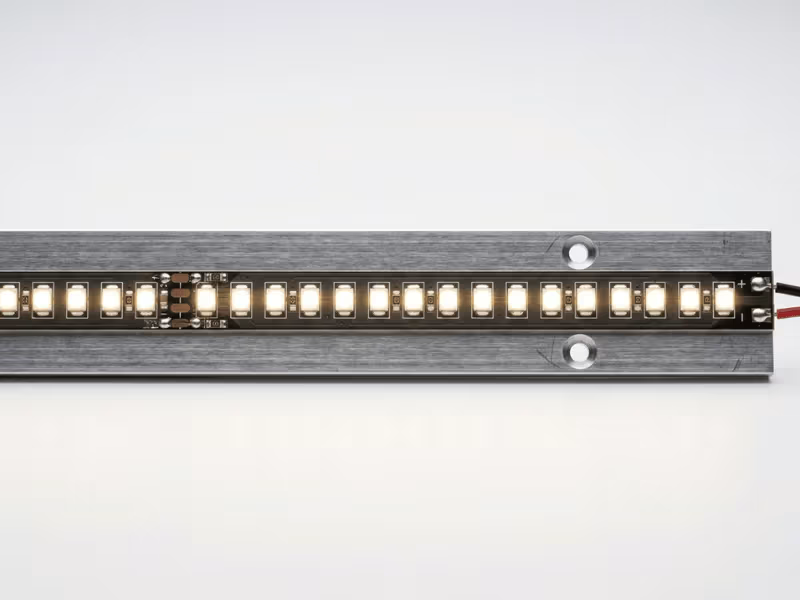
- Hard strip light: a rigid LED strip or LED light bar built on a solid PCB or an aluminum-backed board. It can carry either SMD or COB LEDs.
This guide compares form factor, which means flexible versus rigid. It does not compare LED packaging types. A rigid board can use COB chips, and a flexible strip can use SMD chips. When you request a quote, name both the form factor and the LED type.
How Each Product Is Built
COB Rope Light
- Physical structure: COB (chip-on-board) LEDs sit closely spaced on a flexible PCB. The PCB is then extruded or potted inside a silicone or PVC jacket.
- Mounting behavior: The light follows curves within a rated minimum bend radius. It mounts with clips, a channel, or adhesive tape on a smooth surface.
- Optical appearance: Because the chips are so close together, the light reads as one continuous line without a separate diffuser.
- IP protection: The jacket protects the circuit itself. Fully encapsulated versions often reach IP65 to IP67.
- Thermal path: Heat passes through the jacket, which insulates. For this reason, power density per meter is usually kept moderate.
Hard Strip Light
- Physical structure: LEDs sit on a rigid PCB or aluminum board, usually supplied in fixed lengths.
- Mounting behavior: The bar is screwed, clipped, or bracketed in place. Because it does not sag, spacing stays even along every run.
- Optical appearance: The look depends on LED pitch. Boards with widely spaced LEDs usually need an opal diffuser to produce a clean line.
- IP protection: Most boards are IP20 as supplied. For damp locations they need a sealed profile or a potted version.
- Thermal path: The aluminum backing pulls heat into the mounting surface. That helps the light hold its output at higher wattage.
COB Rope Light vs. Hard Strip Light: Key Differences
|
Feature |
COB rope light |
Hard strip light |
|---|---|---|
|
Form |
Flexible, jacketed, reel-supplied |
Rigid board or bar, fixed lengths |
|
Typical IP structure |
Jacket-sealed, often IP65–IP67 |
Open IP20; needs a sealed profile for damp areas |
|
Mounting method |
Clips, channel, or adhesive |
Screws, clips, brackets |
|
Diffuser dependency |
Low; dotless without a diffuser |
Depends on LED pitch; often needs a diffuser |
|
Minimum bend radius |
Rated per model; check the datasheet |
Not bendable |
|
Thermal management path |
Through the jacket to the air or channel |
Through the aluminum backing to the mounting surface |
|
Serviceability |
A section is usually cut out and re-spliced |
Individual bars unplug and swap out |
Two factors decide most projects: geometry and heat. Curves rule out a hard strip light. High output over long operating hours favors a rigid aluminum board. If energy efficiency matters as much as heat management, a high efficacy COB LED strip light may be worth evaluating for the project.
Matching Each Product to Installation Conditions
Choose a COB rope light when:
- The line follows a curved cove, arched ceiling, or architectural outline.
- The run is outdoors or in a damp area, and the light sits exposed without a sealed housing.
- The light source is directly visible and must look continuous without a diffuser. For decorative or color-changing installations, an RGB and RGBW COB LED strip light can provide the same dotless effect with added scene flexibility.
Choose a hard strip light when:
- The light is recessed in a straight channel, and the profile depth and width are fixed. In tight channels, an ultra narrow COB LED strip light may be easier to fit without losing the continuous line effect.
- You need cabinet or shelf task lighting with even, repeatable spacing under each shelf.
- You are lighting machines or equipment, where vibration, screw mounting, and fast replacement matter.
Many projects use both. A storefront canopy might use COB rope light along its curved edge. Inside, hard strip lights could mount under the display shelves. At sigostreetlight, we often split projects this way. We specify each zone by its geometry and environment rather than using one product throughout.
Installation Mistakes That Cause Early Failure
- Wrong adhesive surface. Tape will not hold on dusty, painted, or textured surfaces. Clean the surface first, or use clips or a channel instead.
- Overbending below the minimum radius. Tight bends crack PCB traces and solder joints, and the damage often shows up weeks later. Respect both the rated radius and the allowed bend direction.
- Sealing only the cut ends. Moisture often gets in at the power feed point, not the end cap. Seal every entry with the manufacturer’s specified caps and sealant.
- Controller and strip mismatch. A CCT adjustable COB strip can be built as a 2-wire or 3-wire design. If your project needs adjustable warm-to-cool white output, review the control requirements for a tunable white COB LED strip light before selecting the strip and driver. These designs use different control methods and are not interchangeable. Confirm the controller output before ordering any warm to cool LED strip.
- No heat path for hard strips. Mount rigid bars on aluminum profiles or metal surfaces. Avoid bare wood or plastic in enclosed spaces.
- Undersized driver. Size the power supply to about 120% of the connected load.
Frequently Asked Questions
Is COB rope light brighter than hard strip light?
Not by default. Brightness depends on wattage, LED efficacy, optics, and thermal design. Compare lumens per meter on each datasheet. The form factor alone does not tell you which is brighter.
Can rigid strip lights be used outdoors?
Yes, but only inside a sealed, IP-rated profile or as a potted version. A standard IP20 board will fail quickly once it gets wet.
Which is better for curved installations?
COB rope light. A rigid LED strip cannot bend. Segmenting it around a curve leaves visible joints.
When should I choose 24V instead of 12V?
Choose 24V for longer runs. At the same wattage, a 24V strip draws half the current of a 12V strip. Lower current means less voltage drop, so the far end stays as bright as the start. Use 12V mainly for short runs or when an existing 12V system requires it.
Our Recommendation
Use a COB rope light for curves, exposed outdoor runs, and visible lines that must look seamless. Use a hard strip light for straight recessed channels, task lighting, and fixtures that need a solid heat path. When a project has both conditions, specify each zone separately.
To get a recommendation, send sigostreetlight a drawing or installation photo. Include run lengths, indoor or outdoor location, mounting surface, voltage, CCT, IP rating, control system, and quantity. Our team will confirm the right form factor, wiring version, and profile for each zone before you order.