
Most solar street lights don’t fail because the LED burns out. They fail because the battery wears down first. I see it often: the panels still charge, but the lights go dark by 2 a.m.
A cheap battery can trim your upfront budget. But it often costs you far more later in replacements, truck visits, and dark streets.
I match batteries to real projects every day. This guide compares LiFePO4, lithium-ion, and gel batteries. It will help you pick the one that fits your climate, your budget, and your maintenance plan.
Why the Battery Matters More Than Many Buyers Expect
Most buyers compare panel wattage and LED lumens first. The battery often gets one line on the quote. Yet that line decides how the light performs after year two.
What the Battery Actually Does in a Solar Street Light
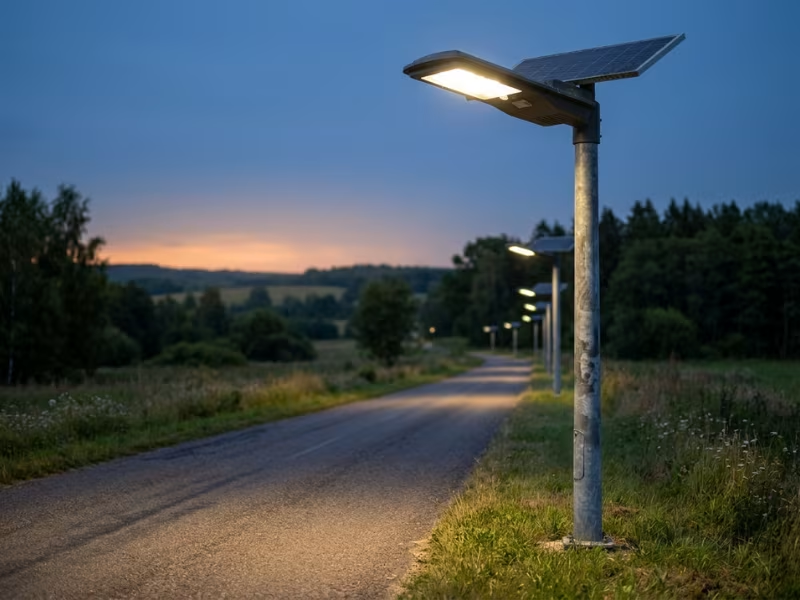
A solar street light system runs on a simple daily loop. The panel collects sunlight during the day. The controller sends that energy into the battery. At dusk, the battery takes over and powers the LED until dawn.
That means the battery carries the full load for 10 to 14 hours every night. No grid steps in when it runs low.
It also covers cloudy stretches. Most projects need two to three nights of backup, which engineers call autonomy days. The battery holds that reserve too.
So the battery isn’t a spare part. It’s the system’s fuel tank.
How Battery Choice Changes Runtime, Lifespan, and Maintenance Cost
Battery chemistry shapes the three things buyers care about most.
- Runtime. You should only draw about half the rated capacity from a gel battery. A LiFePO4 battery can safely deliver 80% to 90%. At the same rated size, LiFePO4 keeps the light on much longer.
- Lifespan. Gel batteries often last three to five years in the field. LiFePO4 batteries often run eight to ten years or more. Over a 10-year project, that can mean one battery or three.
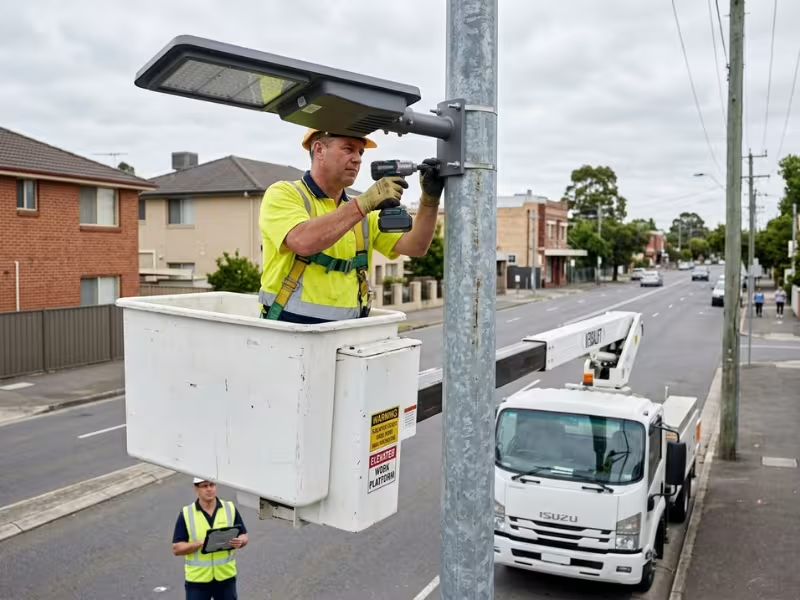
- Maintenance cost. Every replacement brings a lift truck, a crew, and a dark pole until they arrive. On a 200-light project, one extra swap cycle adds 200 truck stops.
The battery you pick today sets your maintenance calendar for the next decade.
Why Many Solar Street Light Failures Start with Battery Problems
When a light fails, I check the battery first.
Other mistakes tend to stay contained. An undersized panel means the light struggles after a few rainy days. Wrong controller settings speed up aging, but you can fix them on site.
A wrong battery choice hits four things at once:
- Autonomy: the light can’t ride out cloudy nights
- Usable capacity: less energy reaches the LED each night
- Replacement cycle: packs wear out years early
- Maintenance frequency: crews return again and again
You can’t adjust your way out of that. You have to replace the battery. That’s why I treat battery selection as the core decision in any solar lighting project.
The Three Battery Types Most Commonly Used in Solar Street Lights
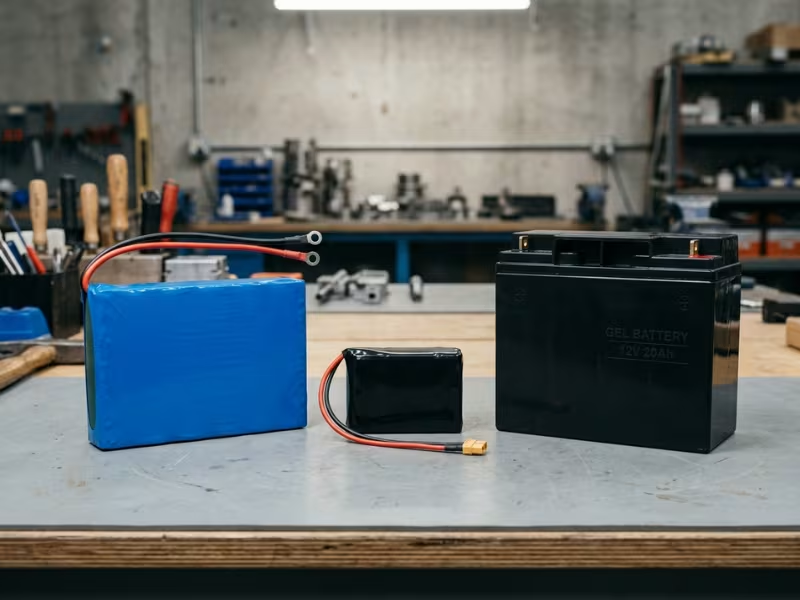
Open almost any solar street light quote, and you’ll find one of three batteries listed. Here’s what each one actually is.
LiFePO4 (lithium iron phosphate) uses iron phosphate as its cathode material. It belongs to the lithium family, but it’s a specific and very stable chemistry. Most integrated solar street lights now ship with it.
Lithium-ion in this market usually means NMC (nickel manganese cobalt) or a similar variant. The same chemistry powers many laptops and power tools. It packs a lot of energy into a small case.
Gel batteries are sealed lead-acid batteries. The electrolyte sits in a thick gel, so nothing spills and nobody needs to add water. Installers usually place them in a buried box or a pole-mounted cabinet.
Together, these three span the full range of project budgets, from the lowest upfront price to the longest service life.
Here’s where buyers get caught. Many quotes simply say “lithium battery.” That label tells you almost nothing. LiFePO4 and NMC behave very differently in heat, cold, and long-term cycling.
So ask for the exact chemistry in writing. If a supplier can’t or won’t name it, treat that as your first warning sign.
What Really Separates These Batteries in Real Projects
Spec sheets make these three batteries look closer than they really are. The differences show up later, on the pole, after a few hundred nights of real use. These are the four factors I check before I recommend any battery.
Usable Capacity Is Not the Same as Rated Capacity
This is where I see buyers get misled most often. The label tells you how much energy the battery holds. It doesn’t tell you how much you can safely use.
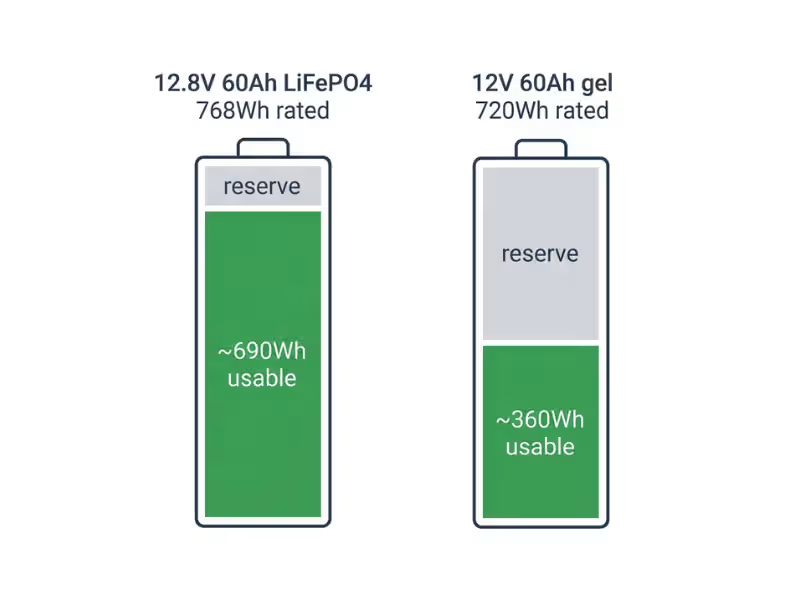
Gel batteries should only discharge to about 50% depth of discharge (DoD). Drain them deeper on a regular basis, and they age fast. LiFePO4 handles 80% to 90% DoD every night. NMC usually sits near 80%.
Here’s what that looks like with two batteries of similar size:
- 12.8V 60Ah LiFePO4: 768Wh rated, about 690Wh usable
- 12V 60Ah gel: 720Wh rated, about 360Wh usable
The labels look almost the same. The usable energy differs by nearly half.
Now apply that to a real design. Say your light uses 300Wh per night, and you want two backup nights. You need about 900Wh of usable energy. LiFePO4 gets there with roughly 80 to 90Ah. Gel needs about 150Ah.
So when two quotes list the same amp-hours, don’t assume they deliver the same runtime. Always ask for usable capacity at the supplier’s stated DoD.
Cycle Life Changes the Replacement Schedule More Than Buyers Expect
A solar street light cycles once every night. That’s about 365 cycles a year, with no days off.
Typical cycle ratings look like this:
- Gel: 500 to 1,200 cycles
- Lithium-ion (NMC): 1,000 to 2,000 cycles
- LiFePO4: 2,000 to 5,000+ cycles
Many nights only use part of the battery, so real life runs a bit longer than the raw math suggests. Even so, over a 10-year project, I usually plan for two or three gel replacements, one or two for NMC, and often none for quality LiFePO4.
That gap rewrites your whole plan:
- Labor visits: Each replacement round on a 200-light project means 200 lift-truck stops.
- Downtime risk: Batteries from the same batch age together. When one starts failing, dozens follow within months, and streets go dark in clusters.
- Procurement cost: You’ll buy again at future prices. The original model may be gone by then, which forces new brackets or controller settings.
A longer cycle life means fewer surprises, not just a longer warranty.
Climate Performance Matters More Than Brochure Claims
Most spec sheets test batteries at 25°C (77°F). Your pole rarely sits at 25°C.
Cold weather. All three types lose capacity in the cold. A gel battery at -20°C (-4°F) may deliver only about half its rated energy. Lithium chemistries hold up better, but they still lose output.
Low-temperature charging. This is the risk many buyers miss. LiFePO4 and NMC should not charge below about 0°C (32°F). If they do, lithium plating can damage the cells permanently. In cold regions, I require a BMS with a low-temperature charge cutoff, or a self-heating pack.
High heat. Heat quietly shortens battery life. For lead-acid batteries, every 10°C rise above 25°C can roughly halve service life. NMC also degrades faster in heat. LiFePO4 handles heat best, but it still ages faster above 45°C (113°F).
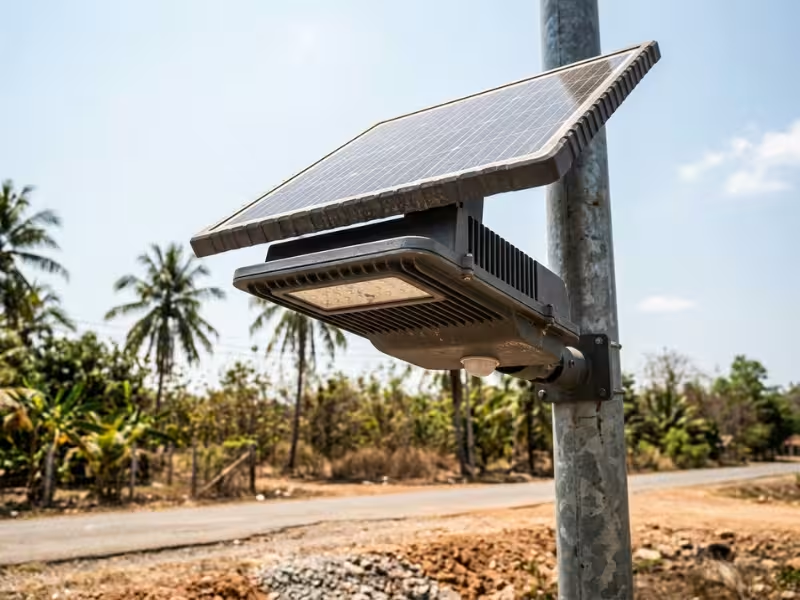
Housing and ventilation. In an integrated light, the battery often sits right under the panel. In tropical summers, that compartment can pass 60°C (140°F). Good designs shade the battery, leave an air gap, and use aluminum housings that shed heat.
Equatorial heat, coastal humidity, and long rainy seasons expose weak batteries much faster than lab tests suggest. Our solar street light project in Tanzania shows how a separate battery compartment, die-cast aluminum housing, and oversized LiFePO4 storage keep lights running through those conditions.
So don’t just ask what temperature range the battery tolerates. Ask what range it can charge in, and how the housing keeps it there.
Safety, Maintenance Burden, and Field Reliability
Public lights hang above sidewalks, schools, and parked cars. That changes how I rank safety.
LiFePO4 has the most stable chemistry of the three. Its cathode holds onto oxygen tightly, so thermal runaway starts at much higher temperatures than in NMC. A damaged or overcharged cell rarely turns into a fire.
NMC stores more energy in less space, but it depends heavily on the battery management system (BMS). Cell balancing, temperature sensors, and charge limits all have to work every night for years. When a cheap BMS fails, the risk rises quickly.
Gel won’t catch fire easily, but it brings a different burden. A 150Ah gel battery can weigh over 40 kg. Swapping it takes two people. Buried boxes collect water, and lead batteries attract thieves in many regions.
Compact energy matters in a phone. On a street light pole, predictable behavior matters more: no fire risk, no early failures, and no surprise replacement rounds.
LiFePO4 vs Lithium-Ion vs Gel: Which One Usually Wins, and Where
Specs only tell you so much. What matters is how each battery fits a real site, budget, and maintenance plan. Here’s how I match each chemistry to the projects where it earns its place.
LiFePO4: The Strongest Default for Long-Life Street Lighting
When a client tells me the lights must run for ten years with little attention, I start with LiFePO4. It suits municipal roads, main arterials, highway ramps, industrial perimeters, and remote sites where one crew visit can take a full day.
The reasons add up quickly:
- Cycle life: A quality pack often lasts the full 10-year project without a swap.
- Deep discharge: At 80% to 90% DoD, a smaller pack covers the same runtime.
- Thermal stability: It’s the safest lithium option above sidewalks and parked cars.
- Built-in BMS: A good one guards against overcharge, over-discharge, short circuits, and cell imbalance.
- High efficiency: At 95% to 98%, more of each day’s solar harvest reaches the LED.
It does have limits. A LiFePO4 pack often costs two to three times more than a gel battery with the same rated amp-hours.
Cold also hurts it. Below -20°C (-4°F), usable capacity drops sharply, and it can’t charge below freezing without help. For cold regions, I specify a low-temperature charge cutoff, a self-heating pack, or both.
Still, for any light meant to stay up for a decade, LiFePO4 is where I start.
Lithium-Ion: Workable, But Only When the Project Conditions Fit
NMC has a real role. It just needs the right conditions.
Its biggest strength is size. NMC packs more energy into a smaller, lighter case. That helps with slim integrated heads, decorative fixtures, and older poles that can’t carry much extra weight.
I consider NMC only when a project checks all four boxes:
- Compact design matters. The fixture has little room for the battery.
- The budget is moderate. The client can’t stretch to LiFePO4 but wants more than gel.
- The climate stays mild. Temperatures sit between 10°C and 35°C (50°F to 95°F) year-round.
- Crews can reach the lights. A failed light gets serviced within days, not months.
Miss one box, and I switch to LiFePO4.
NMC is not a general replacement for LiFePO4. Its cycle life means at least one replacement over 10 years. It runs into thermal runaway at lower temperatures. And its safety relies on a BMS working perfectly for years. Heat makes all three problems worse. If your site sees summer peaks above 40°C (104°F), NMC is the wrong choice.
Gel: Cheaper Upfront, But Rarely Cheaper Over the Full Project Life
I understand why gel still shows up in quotes. Many rural councils, NGOs, and developers work with fixed capital budgets. A lower price per pole can mean lighting 120 streets instead of 80. That pressure is real.
But the low sticker price hides a long-term cost trap:
- Low usable capacity. At 50% DoD, you need roughly double the rated capacity.
- Lower efficiency. Gel returns only 80% to 85% of the energy you put in, which often forces a bigger panel.
- Heavy weight. Swaps need two people, and boxes need more support.
- Frequent replacement. Three to five years of service means two or three replacement rounds per decade.
- Heat sensitivity. In hot climates, service life can drop by half.
Gel still makes sense in a few cases: tight capital with separately funded maintenance, cheap local labor with easy pole access, temporary lighting, or low-priority areas where a dark night causes no safety risk.
Outside those cases, gel rarely wins on total cost. It just moves the expense to later years.
A Simple Comparison Table Buyers Can Actually Use
Procurement teams and contractors rarely have time to read three spec sheets side by side. So I built the table I wish more suppliers would hand their clients.
Use it as a first filter. It helps you rule out the wrong chemistry in minutes. A few notes first:
- Cost ratings compare price per rated amp-hour. On a usable-energy basis, the gap between gel and LiFePO4 shrinks a lot.
- Cycle life and DoD ranges reflect quality products. Budget packs often fall below them.
- “Best fit” assumes a typical 10-year project.
|
Battery Type |
Upfront Cost |
Cycle Life |
Usable DoD |
Weight |
Cold Performance |
Heat Tolerance |
Safety |
Maintenance Burden |
Best Fit |
|---|---|---|---|---|---|---|---|---|---|
|
LiFePO4 |
High (about 2–3× gel per rated Ah) |
2,000–5,000+ |
80%–90% |
Light |
Fair. Needs charge cutoff or self-heating below 0°C (32°F) |
Best of the three. Ages faster above 45°C (113°F) |
Highest. Strong thermal runaway resistance |
Low. Often no swap in 10 years |
Municipal roads, highways, remote sites, permanent installs |
|
Lithium-Ion (NMC) |
Medium |
1,000–2,000 |
About 80% |
Lightest |
Fair. Same no-charge-below-freezing limit |
Weak. Avoid peaks above 40°C (104°F) |
Moderate. Relies on a quality BMS |
Medium. At least one swap in 10 years |
Compact fixtures, mild climates, easy crew access |
|
Gel |
Low |
500–1,200 |
About 50% |
Heavy (150Ah can top 40 kg) |
Poor. Can lose half its capacity at -20°C (-4°F) |
Poor. Life can halve in hot climates |
Good. Low fire risk, but lead disposal and theft |
High. Two to three swaps in 10 years |
Temporary lighting, tight capital, low-cost labor |
If one row clearly fits your site, you’ve likely found your answer. If two rows look close, let the 10-year cost decide.
Cost Over Time: Why the Cheapest Battery Often Loses
A battery quote shows you one price. Your project pays a different one over ten years. When clients bring me three quotes, I compare what each option costs by the time the project ends.
A 10-Year Cost Example for a 60W Solar Street Light
Here’s a setup I quote often. A 60W light runs about 10 hours a night on a dimming profile and averages roughly 300Wh. The client wants two backup nights, so the battery must deliver about 900Wh of usable energy.
Each chemistry needs a different pack to hit that target:
- Gel: 12V 150Ah, about $240
- NMC lithium-ion: about 1,150Wh, about $300
- LiFePO4: 12.8V 90Ah, about $400
I budget about $100 per pole for each replacement visit. That covers the lift truck, a two-person crew, and disposal.
|
Battery |
Upfront Cost |
Swaps in 10 Years |
Cost per Swap (Battery + Labor) |
10-Year Battery Cost |
|---|---|---|---|---|
|
Gel |
$240 |
2 |
$340 |
~$920 |
|
NMC Lithium-Ion |
$300 |
1 |
$400 |
~$700 |
|
LiFePO4 |
$400 |
0 |
— |
~$400 |
Gel wins on day one by $160. By year ten, it costs more than twice as much as LiFePO4.
Now scale it. On a 200-light project, gel adds up to about $184,000. LiFePO4 lands near $80,000. That’s a $104,000 gap from one line on the quote.
These numbers also leave out batch failures, rising battery prices, and discontinued models. So treat the purchase price as a down payment, not the real cost.
Why Gel Systems Often Need Larger Capacity on Paper
Many buyers see gel’s low price per amp-hour and stop there. That number misleads you, because gel needs far more amp-hours to do the same job.
Depth of discharge. You can safely use only about 50% of a gel battery. To deliver 900Wh, you need 1,800Wh rated. LiFePO4 needs about 1,000Wh rated, and a 90Ah pack adds healthy margin.
Round-trip efficiency. Gel returns 80% to 85% of the energy you charge into it. LiFePO4 returns 95% to 98%. For gel to deliver 300Wh each night, the panel must harvest about 365Wh. LiFePO4 needs only about 310Wh. After a cloudy stretch, gel also takes longer to refill.
That gap often pushes you from a 100W panel to a 120W panel, plus a heavier bracket and a larger battery box.
Compare price per usable watt-hour instead. On that basis, LiFePO4’s premium shrinks from nearly 3× to about 1.5×. Add the bigger panel gel requires, and “cheap per Ah” stops looking cheap.
How to Choose the Right Battery for Your Project
When a client asks me which battery to buy, I don’t answer right away. I ask four questions first. The answers usually point to one chemistry before anyone opens a price list.
Four Questions to Answer Before You Choose
- What temperatures will the battery face through the year?
Use record lows and summer highs, not averages. A battery under a panel in the tropics can run 20°C hotter than the air. If winters drop below 0°C (32°F), any lithium pack needs a charge cutoff or self-heating. If summers top 40°C (104°F), rule out NMC. - How many nights of autonomy does the project require?
Most roads need two to three backup nights. Safety-critical sites in rainy regions may need four or five. With gel, every extra night doubles in rated capacity. - How easy is maintenance access after installation?
Price out one real service visit. A pole beside a parking lot takes 20 minutes. A highway ramp may need lane closures, permits, and a night crew. The harder the access, the more each avoided swap is worth. - Is the real constraint upfront budget or total 5–10 year cost?
Ask who pays for replacements. If one owner funds purchase and upkeep, compare 10-year cost. If budgets are separate, a cheaper pack may fit the first one. Someone still pays later, so make that trade-off on purpose.
Best Battery Choice by Real Project Scenario
Here’s where those answers usually land on the sites I quote most often.
Cold-region municipal road: LiFePO4 with cold protection.
Specify a low-temperature charge cutoff, and choose a self-heating pack where winters stay below freezing for weeks. Size for the shortest winter days, and add one extra autonomy night. Skip gel here.
Hot-climate roadside project: LiFePO4 with smart placement.
Keep the pack shaded behind the panel, with an air gap and an aluminum housing. Avoid NMC entirely. Consider gel only if budget forces it, and only in a well-drained buried box.
Budget-limited rural installation: gel, with a replacement plan.
Gel works when labor costs little and crews live nearby. Set aside replacement funds from year one, and expect the first swap around year four. Before you sign, price a smaller LiFePO4 pack with a dimming profile. It often costs less over ten years.
Hard-to-access highway or industrial perimeter: LiFePO4, no exceptions.
Require a stated cycle life at 80% DoD or higher and a 10-year design life. One avoided lane closure usually covers the price premium. In dusty or remote areas, I also look at low-maintenance solar street light systems that keep panels clean on their own. A clean panel refills the battery fully each day, which protects it from chronic undercharging.
Property project with easy maintenance access: the most flexible case.
In mild climates, NMC suits compact decorative fixtures. Gel can work for short leases or temporary lighting. LiFePO4 still delivers the lowest long-term cost if the owner plans to keep the lights.
If your site matches two scenarios, follow the stricter one. The harsher condition decides how long the battery lasts.
Supplier Red Flags That Should Make Buyers Slow Down
A polished quote can hide a weak battery. When I review supplier offers, I focus less on price and more on what the spec sheet leaves out.
“Lithium battery” with no chemistry named. A vague label often means the supplier uses whatever cells cost least that month. Ask for the exact chemistry, cell brand, and cell model in writing.
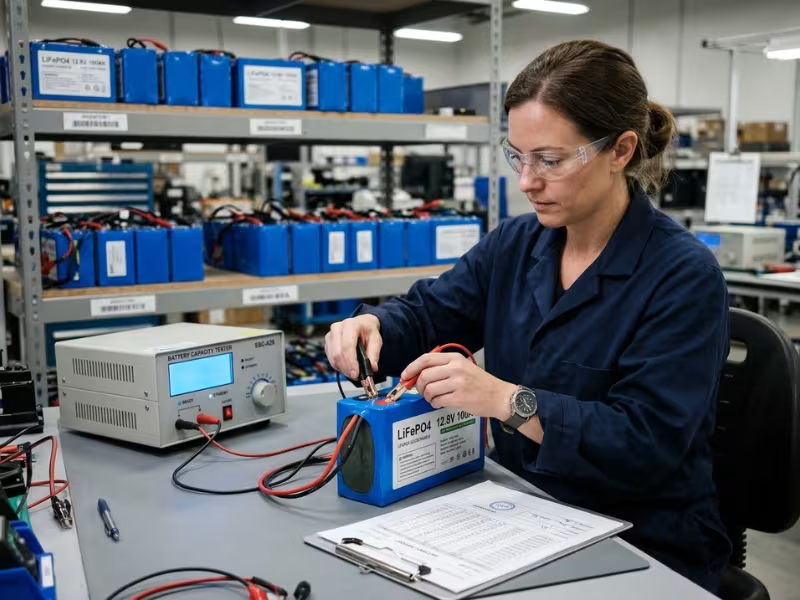
Cycle life with no depth of discharge. A pack might reach 3,000 cycles at 30% DoD but only 1,200 at 80%. Ask directly: “How many cycles at 80% DoD and 25°C before capacity falls to 80%?” A serious supplier answers with a test report.
Missing BMS and temperature data. Ask for overcharge, over-discharge, short-circuit, and cell-balancing specs. Then ask at what temperature charging stops. “It works in all weather” is not an answer. You want a number.
Vague warranty terms. Check four details:
- Full replacement or pro-rated?
- What capacity counts as failure, 60% or 70%?
- Who pays shipping and labor?
- How long will they stock the same model?
Capacity with no discharge conditions. Suppliers can inflate amp-hours by testing at a slow rate or a warm temperature. Ask for discharge rate (such as 0.2C), test temperature, and cutoff voltage. Confirm nominal voltage too, since 12V and 12.8V packs hold different energy.
Send every shortlisted supplier the same written checklist, then compare answers side by side. Ask for third-party reports, such as IEC 62619 for safety and UN38.3 for transport. Fast, specific answers usually point to a factory that knows its product. Vague replies often point to a trader reselling the cheapest pack available.
Installation and Setup Mistakes That Shorten Battery Life
Many dead batteries I pull off poles started out as good batteries. The chemistry fit the site, but the setup didn’t.
1. A panel that doesn’t match the battery. An undersized panel never fully refills the pack, so each night starts with less charge. Gel sulfates in this state, and lithium wears out faster. I size the panel to refill one full night’s use, plus margin, on the shortest winter day. Then I confirm the controller can handle the panel’s peak current.
2. Controller settings left on the wrong chemistry. Many controllers ship with lead-acid defaults. A 12.8V LiFePO4 pack wants roughly 14.2V to 14.6V and no float or equalization charge. A 15V equalization cycle can damage gel cells and trip a lithium BMS. Check every setting before lights leave the warehouse.
3. A battery cooking in its housing. Direct sun on a dark plastic box can push internal temperatures past 60°C (140°F). Shade the pack behind the panel, and use an aluminum housing with an air gap and vents.
4. No low-temperature charge cutoff. Charging lithium below 0°C (32°F) causes permanent damage you won’t see at first. Many cheap BMS boards skip the temperature sensor. Ask where it sits. It should touch the cells, not the circuit board.
5. Autonomy built on hope. Clients often want three rainy nights of backup but budget for one. Check local weather data for the longest cloudy stretches. Then add a dimming profile, such as full output until midnight and 50% after, to stretch your reserve.
When a light dies early, people often blame the chemistry and switch types. Then the new battery fails the same way. Check the panel, controller, housing, temperature protection, and autonomy first.
FAQ
Which battery lasts the longest in solar street lights?
LiFePO4. A quality pack often runs 8 to 10 years or more. Gel usually lasts 3 to 5 years, and NMC lands in between. Heat, deep drains, and wrong controller settings can cut any battery’s life in half.
Is LiFePO4 worth the higher upfront cost?
For most permanent projects, yes. It costs more on day one but less by year five, because you skip one or two replacement rounds. On temporary lighting that runs two or three years, a cheaper battery may win.
Can I replace a gel battery with a lithium battery in an existing solar street light?
Often you can, but check four things first:
- Controller: It must support a lithium charge profile with no equalization.
- Voltage: Use a 12.8V LiFePO4 pack for a 12V system.
- Capacity: A lithium pack about 60% the size of the gel battery often delivers the same runtime.
- Mounting: Secure the lighter pack properly and keep it shaded.
Do lithium batteries work in cold weather for solar lights?
Yes, with protection. They can discharge well below freezing but can’t charge safely below about 0°C (32°F). Ask for a low-temperature charge cutoff, and choose a self-heating pack where winters stay freezing for weeks.
What size battery do I need for a solar street light?
Use this formula:
Nightly energy × (1 + backup nights) ÷ usable DoD ÷ battery voltage = amp-hours
For 300Wh a night and two backup nights, LiFePO4 at 90% DoD on 12.8V needs about 78Ah. Round up to 80 or 90Ah. Gel needs about 150Ah for the same job.
Are gel batteries still a good choice for solar street lights?
In a narrow set of cases: temporary lighting, very tight capital, and sites with cheap labor and easy access. If you choose gel, budget replacement funds from year one, keep it cool, and set a 50% discharge limit.
Choose for the Next 10 Years, Not Just the First Quote
The best battery isn’t the newest one or the cheapest one. It’s the one that delivers the most usable energy, survives the most cycles, needs the fewest crew visits, and costs the least over ten years.
By that standard, LiFePO4 wins most permanent installations. NMC works when the climate stays mild and crews can reach the poles easily. Gel only makes sense when capital is tight, labor is cheap, or the lighting is temporary.
Before you sign any order, ask every supplier for cycle life at a stated DoD, full BMS specs, and the exact charge cutoff temperature. Then plug their numbers into a 10-year cost comparison.
The unit price shows what you pay today. The 10-year cost shows what your project really pays.