
Sigostreetlight

Leading Solar Street Light Manufacturer In China
en.png
Reply within 6 hours
whatsa.png
Quick Contact

LED Equivalent Charts: Replace Old Bulbs Without the Guesswork

September 16, 2026
LED bulb replacement guide

You grab a new bulb, check the box, and look for the wattage you’ve always used. But an LED equivalent chart tells a different story now. That old number no longer means what you think.

Here’s why: wattage measures power, not brightness. A 9W LED can outshine a 60W incandescent with ease.

An LED equivalent chart fixes the confusion. It translates old watts into the light output you actually want.

So let’s clear it up. You’ll learn how to read the chart, match your old bulb, and pick the right LED without the guesswork.

Why Watts Stopped Telling You How Bright a Bulb Is

For years, watts worked as a rough stand-in for brightness. That shortcut is gone now, and here’s why.

A watt measures power. It tells you how much electricity a bulb pulls from the socket, not how much light it throws into the room. Those are two different things.

The old incandescent bulb blurred that line. It burned most of its watts as heat. Only a small slice turned into visible light. So a high wattage really did mean a hot, bright bulb.

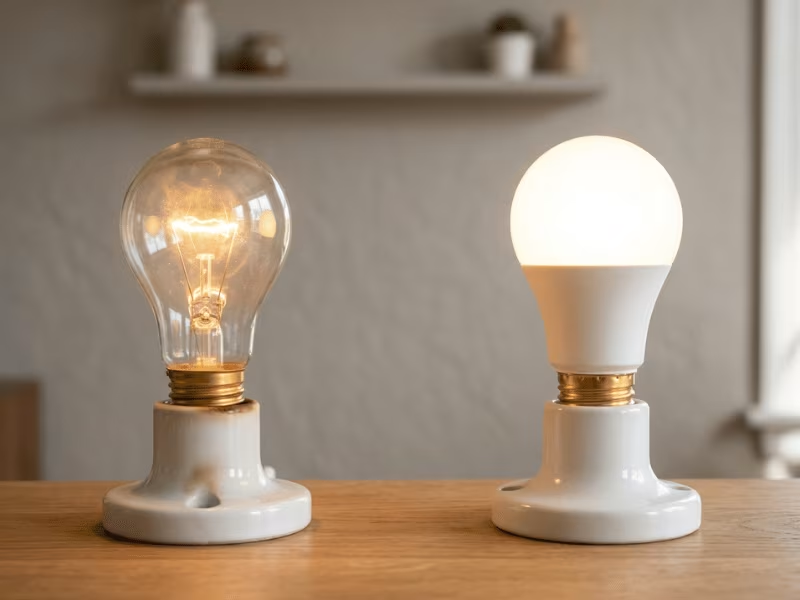
LEDs flipped the math. They waste very little as heat and send far more of each watt out as light. That gap is the whole story. A 9W LED matches the brightness of a 60W incandescent, and it barely warms up doing it.

This is where the box gets tricky. Makers print “60W equivalent” to bridge the old world and the new one. But that number is loose. Brands round it their own way. One “60W replacement” might give you 750 lumens. Another might reach 900. Same label, noticeably different light.

So stop shopping by watts. Shop by lumens, the true measure of brightness. An LED equivalent chart hands you that number fast.
watts vs lumens bulbs

What an LED Equivalent Chart Actually Shows

Think of the chart as a translator. It maps a traditional bulb’s wattage to the LED wattage that gives you similar light. So “60W equivalent” points you toward a roughly 9W LED.

But treat it as a shortcut, not a hard rule. The real measurement sitting underneath is lumens. That’s what your eyes actually read as brightness.

Here’s the catch I want you to remember. Charts differ by brand and by bulb shape. Two bulbs both labeled “60W replacement” won’t always throw the same light.

So use the chart to get close, then check the lumen number on the box to be sure. That’s exactly how you should read the tables coming up.

The LED Equivalent Chart by Bulb Type

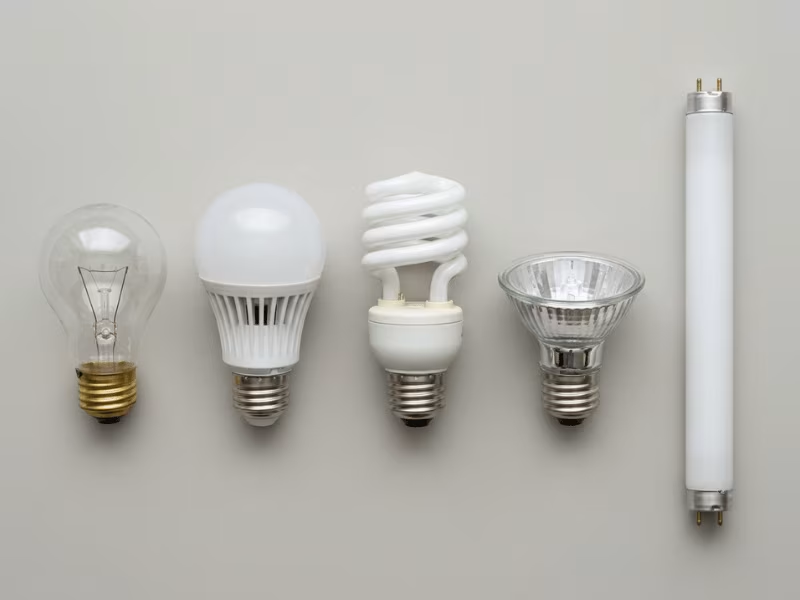
Here’s the part you came for. Find your old bulb below, read across, and shop by the lumen number. I’ve grouped the charts by the bulb you’re replacing, since each type converts a little differently.
LED equivalent chart bulbs

Incandescent to LED

This is the most common swap, and the numbers are the easiest to trust.

Old Incandescent

Lumens

LED Wattage

40W

~450 lm

4–6W

60W

~800 lm

7–10W

75W

~1,100 lm

10–13W

100W

~1,600 lm

14–18W

The LED wattage lands in a range because efficiency varies by brand. A well-made 9W LED can hit the same 800 lumens a cheaper 10W struggles to reach.

Halogen and CFL to LED

These two sit close to incandescent, but each needs a small adjustment before you shop.

Old Bulb

Compared to Incandescent

What to Do

Halogen

Runs 10–15% brighter per watt

Trim your lumen target by 10–15%

CFL

Sits between incandescent and LED

Match lumens directly, then upgrade

One more reason to replace CFLs early: they contain mercury. A broken one means careful cleanup, so I tell clients to swap them before they fail.

Linear Fluorescent (T8 / T12) to LED

Tubes take a different route than screw-in bulbs. You have two paths.

Ballast-compatible (plug-and-play)
Drops straight into an existing T8 fixture. Fast install, but it still relies on the old ballast.
Ballast-bypass (direct wire)
Costs more upfront and needs rewiring, but it removes the ballast from your failure list entirely. Fewer parts, fewer service calls.

One caution: T12 fixtures usually can’t take a ballast-compatible LED tube. Older magnetic ballasts often won’t drive them. For most T12 setups, go the bypass route.

Read the LED wattage column as a range, not a promise.

How to Read the Chart in Four Steps

The chart gives you the number. These four steps make sure that number turns into a bulb that fits, lights up, and looks right in the room. Skip one, and you may end up back at the store.

Step 1 — Start with the bulb you’re replacing

Before you shop, get the details off the old bulb.

Write down four things:

  • Wattage — the number printed near the base
  • Base type — how it screws or pins into the socket
  • Shape code — the letter-number label like A19 or BR30
  • Color — warm, soft white, or daylight

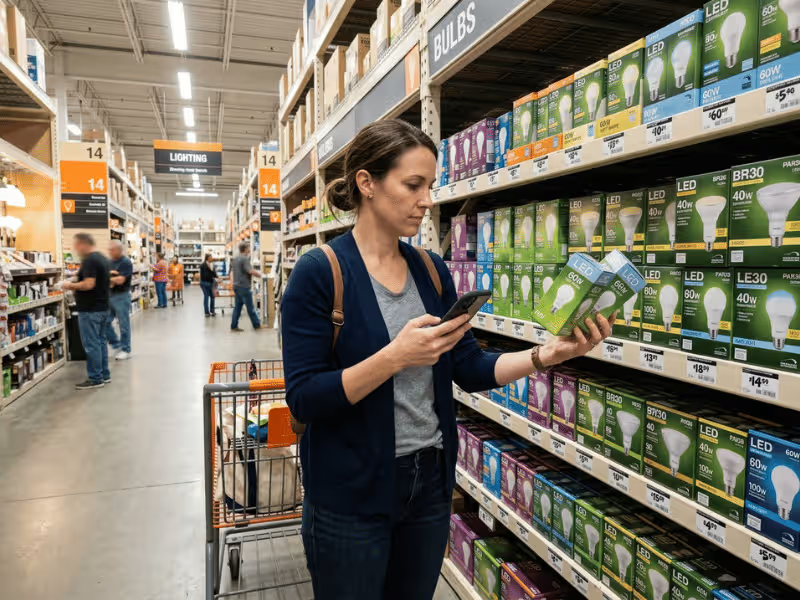
Then pull out your phone. Snap a clear photo of the base and any markings.

I tell every client to do this. The store lighting is bright, the aisle is crowded, and it’s easy to grab the wrong size from memory. A photo settles every guess on the spot.

Step 2 — Convert old watts to a lumen target

Now turn that old wattage into a lumen goal. Lumens are what you actually shop by.

Start with the incandescent baseline:

Old Watts

Lumen Target

40W

~450 lm

60W

~800 lm

75W

~1,100 lm

100W

~1,600 lm

Two quick adjustments:

    • Halogen runs a bit brighter per watt. Trim your lumen target by 10–15%.
    • CFL sits between incandescent and LED. Match the lumens directly, then upgrade.
      • CFL sits between incandescent and LED. Match the lumens directly, then upgrade.

Once you have the number, ignore the “equivalent” wattage on the box. Look for the lumen figure and match it to your target.

Step 3 — Match the base, shape, and size

A bulb can hit your lumen target and still refuse to fit. So check the physical details next.

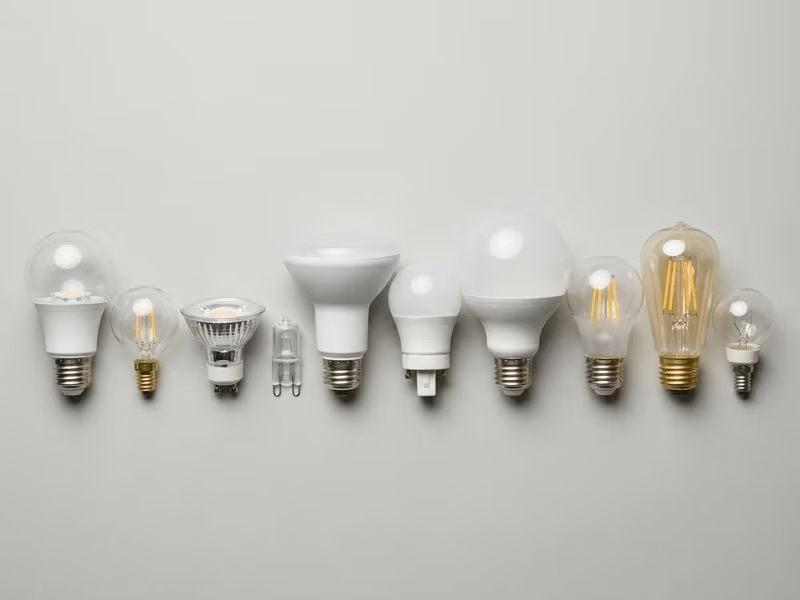
Common bases:

      • E26 — standard medium screw
      • E12 — smaller candelabra screw
      • GU10 — twist-lock pins
      • G9 — thin double-pin
      • GU24 — twist-lock, two prongs

Common shapes:

      • A19 / A21 — the classic rounded household bulb
      • BR30 — wide flood for recessed cans
      • PAR — tighter spot or flood
      • MR16 — small reflector, often low-voltage
      • Globe — round vanity bulb
      • T8 — linear tube

Here’s the trap. Your new LED might match on lumens, base, and shape, yet still sit too tall or too wide for a shade, sconce, or recessed can. LED bulbs sometimes run a touch longer than the incandescent they replace.

If the fixture is tight, check the bulb’s length and diameter against the space before you buy.
LED bulb base types
LED bulb base types

Step 4 — Confirm it works in the fixture

The last step catches the problems that show up after you flip the switch.
Enclosed fixtures
A closed globe or lantern traps heat. That heat shortens LED life fast. Look for a bulb marked “enclosed rated” for any fixture that seals the bulb inside.
Damp and wet ratings
Bathrooms, covered porches, and outdoor spots need the right rating. A damp rating handles moisture in the air. A wet rating handles direct water. Match it to the location.
Dimmers
A dimmable LED still needs a dimmer built for LEDs. Pair it with an old incandescent dimmer, and you’ll often see flicker or hear a buzz. Check the LED’s compatibility list against your switch.
Voltage
Most bulbs run on standard line voltage. But MR16 and similar low-voltage types run on 12V through a transformer. Confirm the voltage before you swap, or the new bulb won’t light at all.
LED fixture compatibility

Run through these four steps and the chart does its real job. You walk out with a bulb that fits the socket, suits the space, and gives you the exact brightness you set out to buy.

The Specs the Chart Leaves Out

The chart nails brightness. But four things it never lists can still make or break the swap. Here’s what I check before every purchase.

Color temperature (Kelvin)
Kelvin sets the mood of the light. Warm 2700K glows soft and yellow, like the old incandescent. Daylight 5000K reads crisp and blue-white.
Pick one and stick with it. Mixing temperatures in a single room looks worse than any wattage mismatch. One warm lamp beside a daylight one just looks broken.
Color rendering (CRI)
CRI tells you how true colors look under the bulb. Aim for CRI above 90. At that level, skin tones, food, and fabric stay close to natural.
Drop below it and the room turns flat. Low-CRI light drains color and leaves everything looking slightly gray. You feel it most in kitchens and bathrooms.
Beam angle
Two bulbs can share the same wattage and lumens yet do very different jobs. The beam angle is why.
A 40° spot throws a tight pool of light. It suits accent work and art. A 120° flood spreads wide for general room lighting. Match the angle to the task, not just the lumens. The same rule scales up outdoors, where a flood LED needs the right spread to cover a driveway or yard evenly.
Dimming and flicker
Not every dimmable LED dims the same way. Some fade smoothly down to 5%. Others cut out entirely below 20%, leaving you with no low glow at all.
Flicker hides too. Your eye may miss it, but a phone camera won’t. Point your phone at the bulb before you commit. If the screen shows bands or pulsing, that flicker will wear on you over time.

Check these four, and you avoid the surprises the chart can’t warn you about.

The Mistakes That Send People Back to the Store

I’ve seen the same six slip-ups trip up buyers again and again. Run through this before you check out.

Buying on equivalent wattage
Ignore the “60W” claim. Match the lumen number instead.
Trusting any dimmer
A dimmable LED still needs an LED-rated dimmer. The old one often brings flicker or buzz.
Skipping the enclosed rating
A standard LED in a sealed fixture cooks itself. Look for “enclosed rated.”
Mixing color temperatures
One warm bulb next to a daylight one looks broken. Keep the room consistent.
Forgetting the base check
Right lumens, wrong base, no fit. Confirm E26, E12, GU10, whatever yours is.
Swapping only some bulbs
New beside old gives you patchy, uneven light. Change them all together.

What You Actually Save (Cost and Payback)

The savings show up in two places: your power bill and your ladder time.

Start with lifespan. An incandescent burns out around 1,000 hours. A good LED runs 15,000 to 50,000 hours. So you replace one LED where you’d have swapped dozens of old bulbs.

Now the energy math. Here’s the formula I use:

(watts saved ÷ 1,000) × hours per day × 365 = kWh saved per year

Let’s work a real example. Swap a 60W incandescent for a 9W LED, running 3 hours a day.

      • Watts saved: 60 − 9 = 51W
      • (51 ÷ 1,000) × 3 × 365 = about 56 kWh saved per year

At 15 cents per kWh, that’s roughly $8.40 saved each year from one bulb.

An LED that costs about $3 pays for itself in under five months. Everything after that is money back in your pocket.

Multiply that across every bulb in the house, and the numbers add up fast. The same efficiency logic drives large outdoor upgrades too, where switching to LED street lights cuts both power draw and maintenance visits across dozens of poles.

Your Pre-Purchase Checklist

Take this list to the store. It catches every problem before you pay.

Old bulb logged. Wattage, base, shape, and color written down.
Fixture checked. Max wattage confirmed, plus an enclosed rating if the bulb sits sealed inside.
Lumen target set. Pull the number straight from the chart.
Dimmer verified. On a dimmer switch? Make sure the LED matches it.
Color temperature matched. Same Kelvin as the rest of the room.
Quantity counted. Add one spare for the drawer.

Run this once, and the swap works the first time.

FAQs

What LED wattage replaces a 60W incandescent bulb?
A: A 7–10W LED does the job. Aim for around 800 lumens, and check the box for that number rather than the “60W equivalent” claim.
How many lumens do I need to replace a 100W bulb?
A: Look for about 1,600 lumens. Most LEDs hit that with 14–18W of power, so you get the same brightness for a fraction of the draw.
Can I put an LED in a fixture rated for a lower wattage?
A: Usually yes. The fixture’s wattage limit protects against heat, and LEDs run far cooler while pulling fewer watts. Just confirm the actual LED wattage sits under the fixture’s rating.
Why does my LED flicker when I dim it?
A: Your dimmer is likely built for old incandescent bulbs. Pair the LED with an LED-rated dimmer, and check the bulb’s compatibility list before you buy.
Do LED bulbs work in enclosed fixtures?
A: Only if the bulb says “enclosed rated.” A sealed fixture traps heat, and that heat shortens the life of any LED not built for it.
Is an LED equivalent chart the same for every brand?
A: No. Brands round their “equivalent” numbers differently, so two “60W replacements” can vary by 150 lumens. Use the chart to get close, then confirm the actual lumen figure on the box.

The Bottom Line

Match lumens, not watts.
The old wattage number stopped telling you brightness long ago. So run the pre-purchase checklist before you buy. It catches every problem in one pass.
And remember what really decides the swap. Base type, fixture rating, and color temperature make or break it. The wattage printed on your old bulb doesn’t. Get those three right, and the new light works the first time.
In this article

Related Products

Related Cases

Off Grid Solar Storage Diesel Integrated Power Supply System
Solar Bus Shelter Lighting Solution for Smart City & Municipal Projects
Malaysia Solar Billboard Power System Case for 220V LED Modules
Solar Street Light Project in Tanzania Engineering Configuration for East African Climate
Off grid Solar Power System Case – Madagascar (2024)
Case Study 8.5-Meter Pole Solar LED Streetlight Retrofit Project in Punjab Province, Pakistan
Project Case Kenya Billboard Retrofit – From Grid to Off Grid Solar Power System
1761897590155

Author Bio for Nicole Sun

Nicole Sun is the Manager at SIGOLED Light & Solar Energy, a leading manufacturer of solar street lights, garden lights, and solar systems since 2009. With over 16 years of experience in the solar and LED lighting industry, Nicole combines professionalism and sincerity to deliver innovative and cost-effective solutions. Her expertise spans supply chain management, project sourcing, and international business, ensuring high-quality products and reliable partnerships. Under her leadership, SIGOLED has grown into a trusted global brand, offering cutting-edge solar lighting systems for diverse applications. Connect with Nicole to explore sustainable lighting solutions tailored to your needs.

Get in touch with us!

Contact Form Demo

Get in touch with Us !

Contact Form Demo