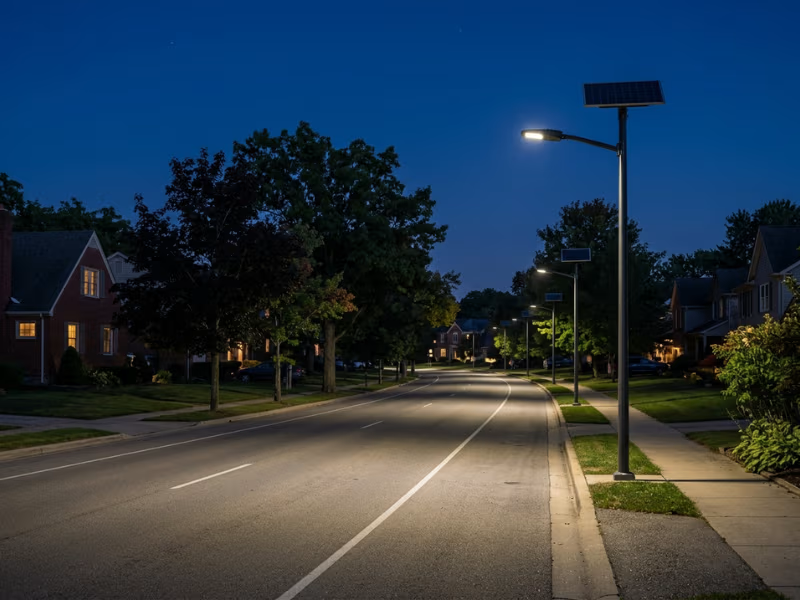
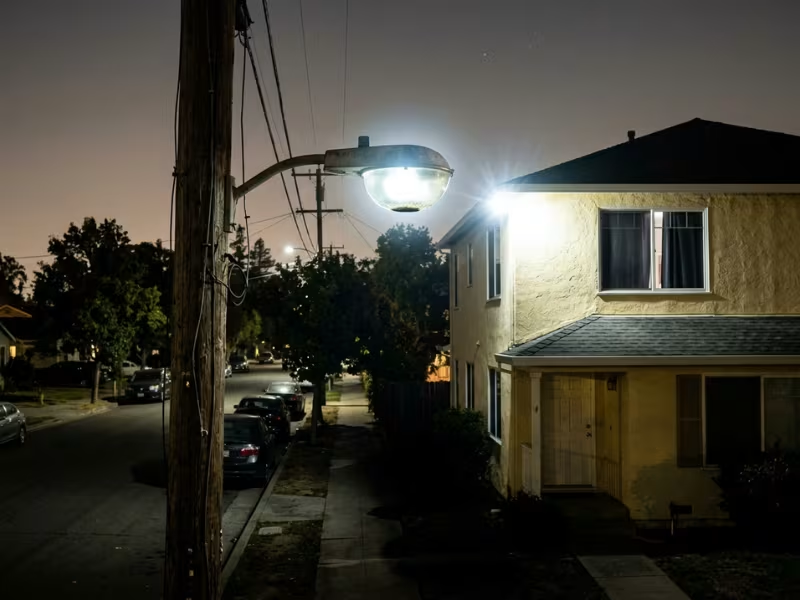
Cities need light at night. Drivers need to see the road, and people want to feel safe on the walk home. Yet many streets now glow brighter in all the wrong ways.
I have worked on outdoor solar lighting projects for years. On site visits, I keep seeing the same problems: glare in drivers’ eyes, light spilling into bedrooms, and a sky that never gets dark. Most of these problems don’t come from the light itself. They come from poor design choices.
Solar street lights can help fix that. But they only work when you pair them with warm color temperatures, proper shielding, and smart dimming controls.
I wrote this guide for city planners, campus managers, park teams, and developers. It covers where solar helps, where it falls short, and how to plan a project that lights the path without lighting the sky.
Why More Cities Now Treat Light Pollution as a Real Problem
A few years ago, most lighting complaints I heard were about dark streets. Now I hear the opposite almost as often. Residents call about a new fixture shining into their bedroom. Council members ask why a quiet road looks like a stadium.
Light pollution usually shows up in three forms:
- Skyglow: The orange or gray haze over a town at night. Light escapes upward, bounces off dust and moisture, and the stars fade.
- Glare: Harsh, direct light that hits your eyes. It makes drivers squint and can hide a pedestrian just past the pole.
- Light trespass: Light that lands where nobody wants it, such as a bedroom window or a backyard.
People feel these problems before they can name them. Bright light through a window disrupts sleep. Glare makes evening walks uncomfortable. On new projects, I’ve watched one upset resident delay a pole layout for months.
Wildlife pays a price too. Migrating birds lose their way around brightly lit areas. Insects circle fixtures until they die, which hurts the bats and birds that feed on them.
Then there’s the money. Every lumen that goes into the sky still draws power. On solar projects, wasted light means bigger panels and batteries than the site needs. That’s why light pollution has moved from an environmental talking point to a line item in project reviews.
Light Pollution Is Usually a Design Problem
Many people assume light pollution means a town has too many lights. In my site reviews, that’s rarely the real issue. Most problem streets have enough light. They just send it to the wrong place, in the wrong color, at the wrong time.
Too much light is not the same as good light. A road lit far above its target can feel less safe than one lit correctly, because harsh glare deepens the shadows past each pole.
When I trace a complaint back to its source, I usually find one of five causes:
- Overlighting. Someone picks a 150W fixture “to be safe” where a 60W fixture would meet the target.
- Upward spill. Tilted heads, globe lamps, and decorative fixtures send light straight into the sky.
- Poor shielding. Unshielded or semi-cutoff fixtures throw light sideways into windows and drivers’ eyes.
- Cool, blue-rich LEDs. Many low-cost fixtures run at 5000K to 6500K. Blue light scatters more in the air, so it adds skyglow and harsher glare.
- All-night full output. A quiet lane gets the same light at 3 a.m. as at 7 p.m., even when nobody walks there.
None of these causes needs more darkness to fix. Each one needs a better choice about direction, color, or timing. That’s the shift I ask every client to make: dark-sky lighting is about control, not darkness.
What Dark-Sky Street Lighting Actually Requires
When a client asks me to make a project “dark-sky friendly,” I don’t start with a product catalog. I start with four checks. Every fixture I approve must pass all of them, whether it runs on solar or grid power.
Shield the Light and Point It Down
A full-cutoff fixture sends no light above the horizontal line. On a spec sheet, look for a BUG rating of U0, which means zero uplight. I also check how crews mount it. A shielded fixture tilted upward to “reach farther” stops working as a shielded fixture.
Choose a Warm Color Temperature
I use 3000K for most residential streets, campuses, and parking areas. Near parks, wildlife corridors, coastal habitat, or observatories, I drop to 2700K or lower. Skip 5000K fixtures, even when they cost less.
Right-Size the Output
A quiet residential street often needs only about 5–10 lux on average. If a 40W fixture meets that target, a 90W fixture just adds spill and complaints. Ask for a photometric layout before you approve any wattage.
Dim When the Street Goes Quiet
Traffic drops sharply after midnight on most local roads. A solid schedule runs at 100% until about 11 p.m., then 30–50% until dawn, with motion sensors raising output when someone passes.
DarkSky International’s Fixture Seal of Approval offers a quick way to screen products, and cities such as Flagstaff, Arizona, set clear local rules on shielding and color. I treat these as a starting point. Always check your own city’s ordinance before you order.
How Solar Street Lights Help Reduce Light Pollution
Solar street lights don’t cut light pollution because the sun powers them. They help because their design makes control easier. Each light runs as its own small system, with its own controller, battery, and schedule.
That independence gives you three real advantages. It also hides one trap that catches many buyers.
Smarter Output Control Built Into Every Pole
Most grid street lights share a circuit and a simple photocell. They burn at full power from dusk to dawn. Adding dimming usually means extra control nodes, software, and budget.
A solar light ships with its controller inside. On most residential projects, I set it to 100% for the first four hours, then 30% until dawn. A motion sensor lifts output to full when a car or walker passes, then drops it again after about 30 seconds. On a quiet lane, that schedule can cut emitted light by more than half.
Warm LEDs and Tighter Optics
Battery limits push solar designers to waste nothing. Every lumen that leaks upward drains energy the light needs later, so good optics pay off directly.
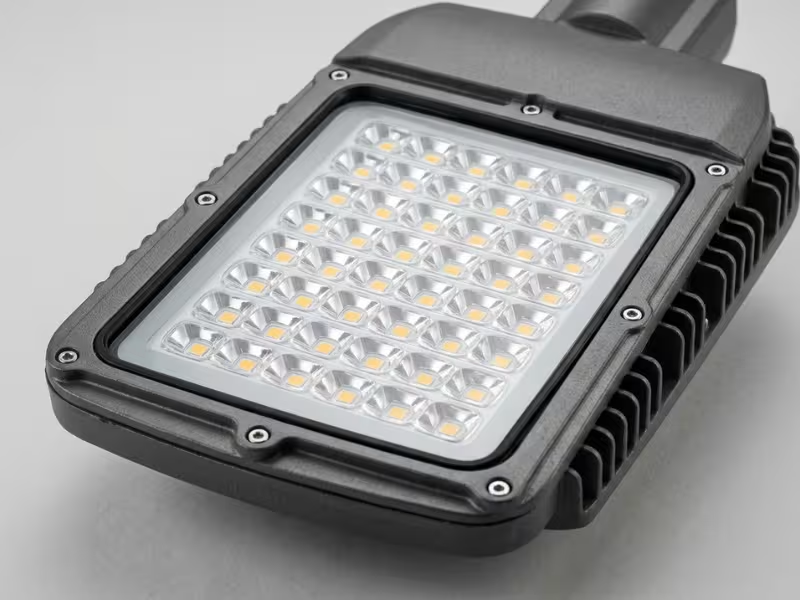
Warm LEDs lose about 5–10% efficacy compared with 5000K chips. I size the panel slightly larger rather than accept cold light. Then I pair the warm module with a flat-glass, full-cutoff head and a Type II or Type III roadway optic. That setup keeps light on the path and removes the glowing lens drivers see from far away.
A Better Fit for Parks, Trails, and Sensitive Edges
Grid power shapes layouts in ways people rarely notice. Trenching costs a lot per meter, so designers often stretch spacing and mount taller, brighter fixtures. That overbuilds the light right where nature is most sensitive.
Solar removes that pressure. You can place a low 4–5 m pole exactly where a trail bends, and skip the stretch beside a wetland. On park paths, I often use lower output at closer spacing, so the light stays near the ground and out of the trees.
Why Solar Isn’t Automatically Dark-Sky Friendly
I’ve removed plenty of solar lights that made pollution worse. Cheap all-in-one units often run at 6500K, use domed lenses that scatter light sideways, and claim lumen numbers they can’t sustain.
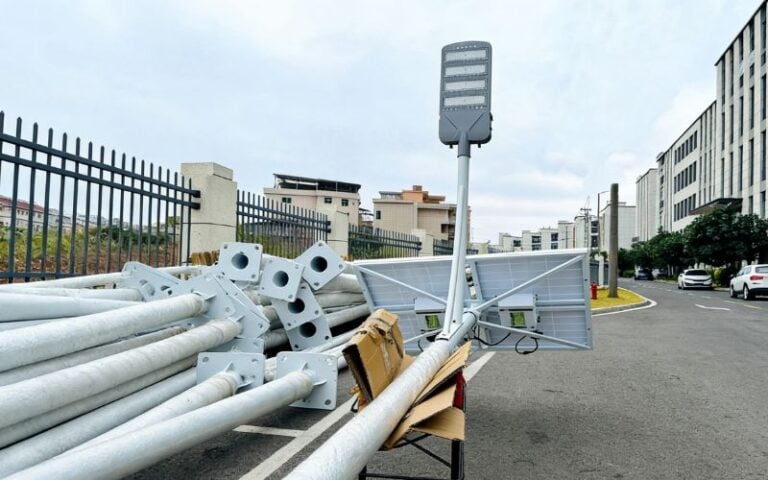
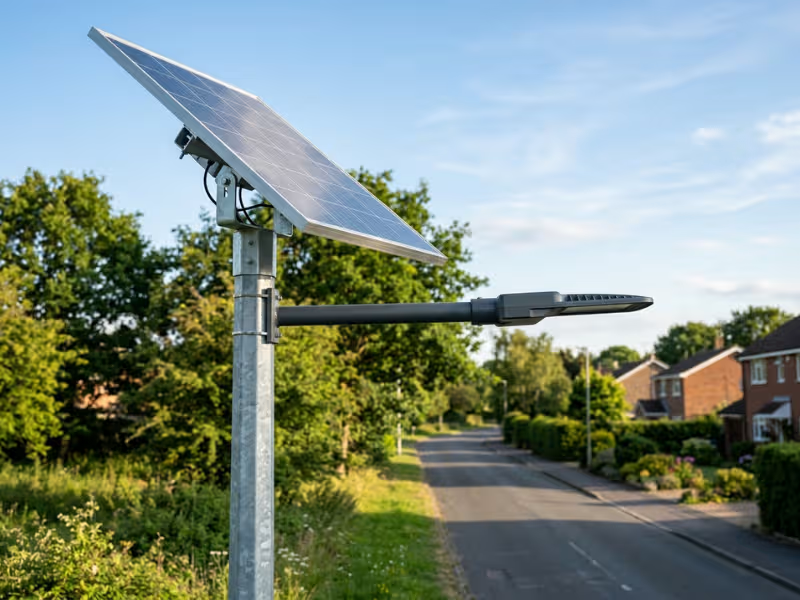
The worst mistake starts with the panel. On integrated units, crews tilt the whole head toward the sun for better charging. That tilt aims the LED at windows and the sky. If your site needs a steep panel angle, choose a split design with a separate panel bracket.
Solar gives you the tools. Your fixture choice and installation decide whether you use them well.
Where Solar Street Lights Fit Best, and Where They Don’t
I turn down some solar projects, and clients find that surprising. But a solar light that fails in its second winter hurts a dark-sky program more than a well-designed grid light. Solar works best where control matters more than raw output.
Strong Fit: Modest Light, Sensitive Surroundings
These sites usually need about 5–20 lux, low poles, and little light after midnight:
- Trails and park paths: Low 3–5 m poles at 2700K keep light out of tree canopies.
- Parking perimeters: Edge lights often sit far from feeder cables, and traffic drops after closing.
- Campuses: Motion boosting suits scattered late-night foot traffic.
- Residential and rural roads: Two-lane streets rarely need more than a 40–60W fixture.
- Wildlife-sensitive zones: Wetland edges and green corridors get dimmed light without trenching.
Climate and grid access shape the design as much as site type. Our Solar Street Light Project in Tanzania shows how local conditions drive system sizing on a real installation.
Use Caution: High Output or Weak Sun
Some sites push solar past what it does well. I don’t rule them out, but I run the numbers twice:
- High-output arterials: Roads needing 150W or more at 10–12 m all night require large panels, batteries, and heavier poles.
- Very wide roads: Covering 20 m or more usually means poles on both sides, doubling the systems to maintain.
- Cloudy climates with strict output rules: A week of overcast forces you to oversize everything.
- Poor solar access: Tall buildings or dense tree cover can cut daily charging in half.
Solar or Grid-Tied LED: Which Fits a Dark-Sky Project Better?
Both systems can use the same warm LEDs and full-cutoff optics. The real difference comes down to how much control you get and how much infrastructure each site demands.
Where Solar Gives You Tighter Control
Each solar light runs its own dimming profile. I can set a trail pole to 30% after 10 p.m. and let a parking entrance brighten only on motion, with no central control system. Many older grid circuits still switch a whole street as one block. Solar also skips trenching, which matters on park edges where digging disturbs habitat.
Where Grid-Tied Still Makes More Sense
Grid-tied LED still wins on high-output arterials and roads wider than about 15 m. Long cloudy seasons also favor the grid. A solar light low on charge must dim hard, while a grid light holds its target.
Hybrid Paths for Phased Upgrades
Most cities don’t have to pick a side. I often suggest this sequence:
- Start with solar in parks, trails, and side streets.
- Retrofit arterials with warm, full-cutoff grid LEDs and dimming nodes.
- Use solar-grid hybrid poles where outages or gray months cause concern.
Choose by site, not by technology. Then test every option with one question: does it put light only where people need it, and only when they need it?
Common Objections to Solar Street Lights, and What Actually Matters
The same three doubts come up in almost every meeting. Each has some truth behind it.
“Solar Lights Are Too Dim”
This was fair ten years ago, when fixtures ran at 80–100 lm/W on small lead-acid batteries. Today’s LEDs often reach 160–180 lm/W, and LiFePO4 batteries let you use far more stored energy. A well-sized 40W solar fixture can hold 5–10 lux on a residential street. The objection still holds on wide arterials, where I recommend grid-tied LED.
“Batteries Fail”
Old lead-acid packs often lasted two or three years. LiFePO4 handles roughly 2,000–4,000 cycles, or about 5–8 years in the field. I ask clients to budget one battery swap per pole over a 15-year life. Choose fixtures that let you replace the battery without changing the whole head.
“The Upfront Cost Is Too High”
Per pole, solar usually costs more. But that comparison leaves out trenching, cabling, transformers, and years of power bills. On a trail 300 m from the nearest supply, trenching alone can cost more than the lights. Solar loses when you oversize it, so match autonomy to your local weather instead of buying the biggest pack.
How to Plan a Dark-Sky Solar Lighting Project
Most projects I review go wrong before anyone installs a pole. The team picks a fixture first and asks questions later. I reverse that order: site first, problem second, product last.
- Audit the problem area at night. Record each fixture’s height, wattage, color temperature, and tilt. Take photos from a resident’s window and a driver’s seat.
- Map glare, trespass, and complaints. Pin each complaint to a location on a site plan. Problems usually cluster around a handful of poles.
- Define the visibility need. A park trail may need 3–5 lux until 10 p.m. A campus crosswalk needs strong vertical light so drivers can see faces. Write the target lux and active hours down.
- Set CCT, shielding, and controls. Specify zero uplight and a stepped schedule, such as 100% at dusk, 50% after 10 p.m., and 30% after midnight with motion boost.
- Request real data. Ask for the IES file, BUG rating, battery capacity in Wh, and autonomy based on your dimming profile.
- Pilot before rollout. Install five to ten poles on your worst complaint block. Run them through at least one full season, including your darkest month.
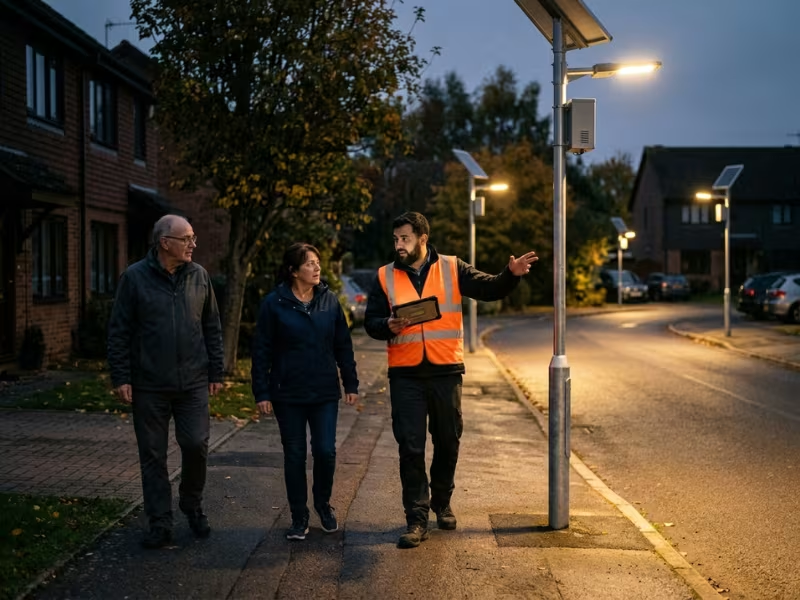
- Review with residents and crews. Walk the pilot site with the people who complained. Then ask maintenance crews about battery access and controller settings.
Keep every finding on one shared sheet. A well-run pilot wins over skeptics far better than any brochure.
Questions to Ask Before You Buy
A glossy brochure can make any fixture look dark-sky friendly. So I send vendors eight questions instead:
- What is the CCT? Look for 3000K or warmer.
- Is it full cutoff, or just “shielded”? Ask for U0 in the BUG data.
- What dimming schedules are available? You want several steps, not just on and off.
- Can you enable motion boosting? Confirm the sensor range and hold time.
- How many autonomy days? Ask which dimming mode that number assumes.
- What happens in long cloudy periods? The light should step down in stages, not shut off.
- Is there a photometric file? Without an IES or LDT file, you can’t check the layout.
- Has this fixture worked on dark-sky sites? Ask for a project name and a contact.
A vendor who answers all eight with clear data usually delivers a light that stays where you aim it.
Dark-Sky Solar vs. Conventional Overlighting
The power source rarely makes the difference. Design choices do. Hold each bid against the right-hand column. If it lands in the left column on two or more rows, send it back before you compare prices.
|
Design Factor |
Poor Lighting Approach |
Better Dark-Sky Solar Approach |
|---|---|---|
|
Fixture shielding |
Open or partly shielded heads that leak light upward |
Full-cutoff housing with a U0 BUG rating |
|
Color temperature |
5000K–6500K cool white |
3000K or warmer, 2700K near wildlife |
|
Beam direction |
Round flood beams or upward-tilted heads |
Flat-mounted roadway optics aimed at the path |
|
Output schedule |
100% from dusk to dawn |
Stepped dimming through the night |
|
Motion control |
None |
Sensor boosts output only when people approach |
|
Installation footprint |
Trenching that pushes teams toward fewer, brighter poles |
No trenching, poles placed where needed |
|
Light trespass risk |
High, with glare in windows and habitat edges |
Low, with light kept inside the target area |
Your Dark-Sky Solar Project Checklist
I run every plan through these ten checks before approval. Bring this table to your next vendor meeting.
|
Item |
What to Confirm |
|---|---|
|
Site type |
Trail, park, campus, road, or parking perimeter, with width and nighttime use |
|
Target lighting need |
Written lux target and active hours |
|
Complaint zones |
Glare and trespass points mapped to specific poles |
|
CCT |
3000K or warmer, lower near sensitive habitat |
|
Shielding |
Full-cutoff optics with U0 rating |
|
Dimming controls |
Stepped schedule plus motion boost |
|
Autonomy |
Calculated on your dimming profile, not full output |
|
Cloudy-weather performance |
Staged step-down and full recharge in 2–3 sunny days |
|
Maintenance plan |
One battery swap budgeted per pole |
|
Pilot review plan |
5–10 poles, one season, lux readings, resident walk-through |
If any row stays blank, fill it in before you order a single pole.
FAQs
What color temperature is best for dark-sky street lighting?
For most streets and paths, I specify 3000K or warmer. Near coastlines, wildlife corridors, or observatories, go to 2700K or even 2200K amber. Always confirm the CCT for the exact model, not just the product family.
Are solar street lights bright enough for public safety?
Yes, for most low- and medium-traffic sites. A well-sized 30–40W solar fixture can hold 5–10 lux on residential streets, park paths, and parking perimeters. Ask the supplier to prove it holds your target through the night on your dimming schedule.
Do solar street lights reduce glare?
They can, but optics and installation cut glare, not the power source. A flat-mounted full-cutoff head sends light onto the pavement instead of into drivers’ eyes. Pick a fixture with an adjustable panel so the light head can stay level.
Do solar street lights work in cloudy climates?
Yes, with careful sizing. Plan for your darkest month and look for 3–5 nights of autonomy on your dimming profile. Dust also cuts charging, so a self-cleaning solar street light helps keep output steady on dry, dusty sites.
What is the difference between full cutoff and semi-cutoff fixtures?
A full-cutoff fixture emits zero light above the horizontal plane. A semi-cutoff fixture lets a small share escape upward, and that leak adds up across hundreds of poles. For dark-sky work, ask for an uplight rating of U0.
Are solar street lights cheaper than traditional street lights over time?
Often, yes, but it depends on the site. Solar removes trenching, cabling, and power bills, though it costs more per pole. Compare total cost over 10–15 years. Solar usually wins on remote sites, while grid-tied wins where power lines already run along the road.
Conclusion
Light pollution rarely comes from having too many lights. It comes from lights that point the wrong way, glow too blue, and run at full power on empty streets. That makes it a design and control problem.
Solar street lights give you strong tools for that job when you pair them with warm LEDs, full-cutoff shielding, and dimming that follows real nighttime use. Without those three, a solar light is just another bright pole.
So skip the citywide rollout for now. Pick the one block or trail that draws the most complaints. Install five to ten properly specified poles, run them for a full season, and walk the site with residents. Let those results shape the next phase.