Many buyers share the same worry. A solar light looks great in sunny weather, but what happens when the sky stays gray for days? They want a clear answer before they spend money or approve a project.
The short answer is yes. Solar street lights still charge on cloudy days. They just charge much more slowly.
That answer covers only part of the problem. A light does not stay reliable just because the panel collects some power in weak daylight. The battery reserve, the panel size, and the load setting decide whether the light keeps working through bad weather or fades early.
Yes, They Charge on Cloudy Days, Just Much More Slowly
A solar panel doesn’t need a clear blue sky. Clouds scatter sunlight, but they don’t block all of it. That scattered glow, called diffuse light, still reaches the panel and still produces power.
The real issue is how much power. On a typical overcast day, I expect a panel to deliver about 10–30% of its rated peak. A 100W panel might give you only 10 to 30 watts at midday.
Gray weather also comes in different forms. Here is how I rank the common conditions on site:
- Light haze: Output often stays at 50–80% of peak. Most systems charge close to normal.
- Thin, broken clouds: Output swings as clouds pass. Bright gaps push power back near full.
- Fog: Morning fog cuts early charging hard. If it clears by late morning, the day can still recover.
- Heavy overcast or steady rain: This is the worst case. Output often falls to 10–20%, and sometimes lower under dark storm clouds.
Rain itself does little harm. It even washes dust off the panel. The thick cloud layer that comes with the rain causes the drop.
So when a seller says a light “charges on cloudy days,” the claim holds up. But a trickle of charge does not equal a full refill.
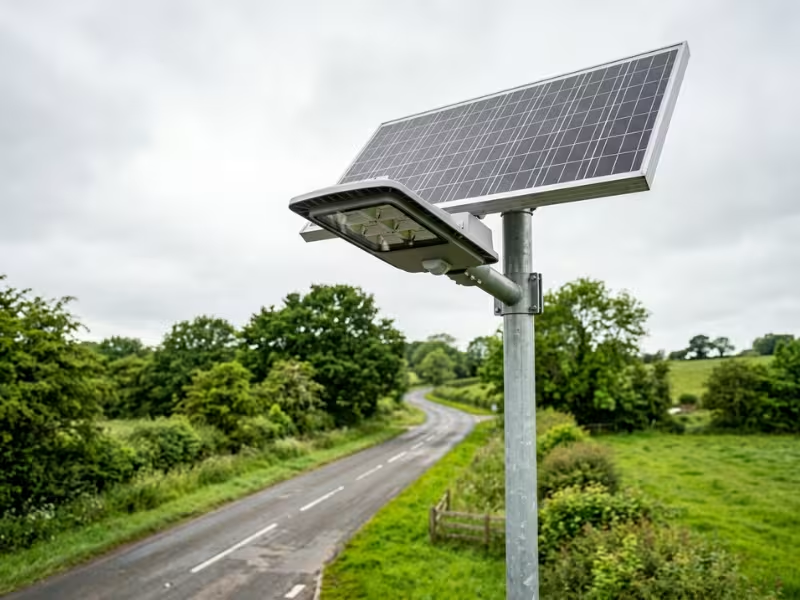
The Better Question: Will It Last Through a Gray Week?
When a buyer asks me, “Will it charge on a cloudy day?” I hear a deeper worry. They really want to know whether the light will still work on Thursday after five gray days in a row.
One cloudy day rarely causes trouble. A well-built light treats it like a small dip in income. It draws a little from savings and moves on.
Trouble starts when gray days stack up. Each night, the light spends more energy than the panel earned that day. The reserve shrinks a little more every evening.
So I ask clients to judge a system on two other points:
Stored reserve. How many nights can the battery run the light in your chosen mode with almost no help from the sun? This number decides whether the street stays lit on day four.
Recovery speed. When the sun returns, how fast can the panel refill the battery? A system that needs a week to recover will start the next storm half empty.
Cloudy-day charging still matters, but it plays a supporting role. The battery carries the light through bad weather. The panel decides how quickly the system gets ready for the next round.
The Three Parts That Decide Cloudy-Day Performance
A solar street light has plenty of small parts. When the sky turns gray, three of them matter most. The panel collects, the controller captures, and the battery protects.
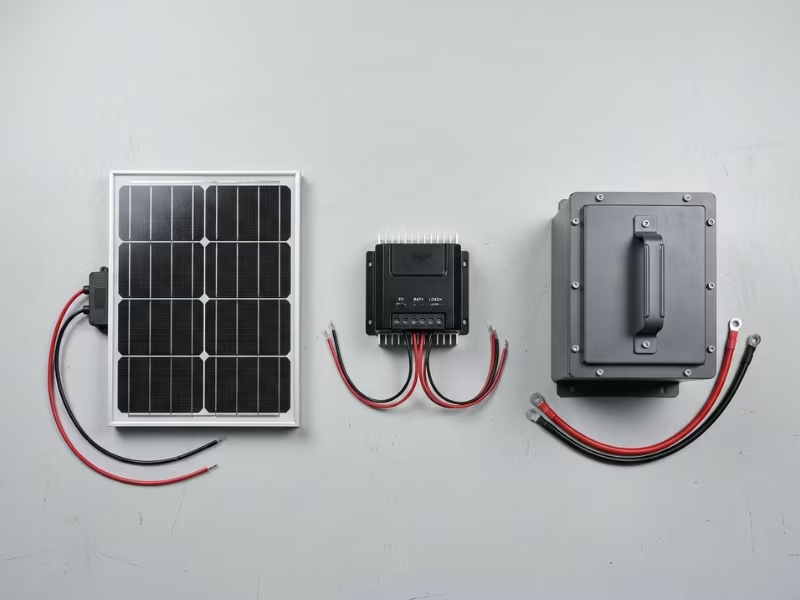
Solar Panel: How Much Light It Can Catch
Panel type makes a real difference in weak light. Monocrystalline panels convert about 20–23% of sunlight into electricity, while polycrystalline panels usually reach 15–18%. Mono cells also keep producing usable voltage at lower light levels. For cloudy regions, I treat mono as the baseline.
One point confuses many buyers. Panel wattage tells you how much energy the light can harvest each day. It does not tell you how bright the lamp shines at night. A bigger panel gives you faster refills, not more lumens.
Charge Controller: Catching the Weak Light
On a bright day, a cheap controller does a passable job. On a gray day, it wastes energy you can’t afford to lose.
A PWM controller drags the panel’s voltage down to battery level, so the panel rarely works at its best point. An MPPT controller keeps tracking that best point as the light changes. It usually harvests 10–30% more energy, and the gain often grows in cold weather or dim morning light.
That gain matters most under heavy cloud. Say a 100W panel delivers only 15 watts, and a basic controller wastes a quarter of it. The battery loses charge it badly needs. Over a gray week, those small losses can cost whole nights of light.
Battery: Your Buffer Against Bad Weather
If the panel is your income, the battery is your savings account. It keeps the light on when the sun stops paying.
Lithium iron phosphate (LiFePO4) lets you safely use about 80–90% of its rated capacity. It handles roughly 2,000–4,000 cycles, which often means 5–8 years in the field.
Lead-acid and gel batteries should only discharge to about 50%. At the same voltage, a 100Ah lead-acid battery gives you roughly the same usable energy as a 60Ah LiFePO4 pack. Lead-acid also lasts only about 300–800 cycles, and deep drains during gray spells wear it out faster.
Battery Autonomy: The Real Reason Some Lights Survive Bad Weather
Autonomy answers one simple question. How many nights can a fully charged battery run the light with no help from the sun? A light with four nights of autonomy stays lit through four dark days and still switches on at dusk.
I trust this number more than any cloudy-day charging claim. One gray afternoon might add 10–20% to the battery. That helps, but a week of storms decides the outcome.
What “3 rainy days” really means. Many spec sheets list “3–5 rainy days” near the bottom. The seller claims the battery stores enough usable energy for three to five nights with almost no solar input. It does not promise full brightness all that time. It also says nothing about how fast the battery refills afterward.
Here is a simple example. Say a lamp draws 40W. At full power for 12 hours, it uses 480Wh a night, so three nights need 1,440Wh of usable energy.
Now switch to motion mode, with the light idling at 30% most of the night. Nightly use may drop to about 180Wh. The same battery could now last seven or eight nights.
That is why I never accept an autonomy figure on its own. A rating only means something when you know the load behind it. Ask the seller two things: Which mode does the rating use? How many hours per night does it assume?
How much autonomy you need. In sunny regions with short, rare gray spells, two to three nights usually works. For monsoon zones, coastal fog belts, or northern sites, I plan for three to five. Sites that must never go dark, such as emergency gates, need five or more.
What Happens in Real Weather: Four Common Scenarios
Spec sheets describe perfect test days, and your site won’t give you many of those. Here is what I see on real projects when the weather turns.
Light Cloud and Haze: Business as Usual
A hazy summer sky looks dull, but the panel barely notices. Output often stays at 50–80% of peak. Any decent system still refills most or all of its battery by late afternoon and runs its normal schedule that night.
If a light struggles on hazy days, don’t blame the weather. Look for an undersized panel, shade, or a dirty surface.
Full Overcast or Steady Rain: The Battery Takes Over
Picture a low, gray sky from morning to dusk. The panel delivers only about 10–20% of its rating. If the lamp needs 300Wh, a gray day may return only 60 to 100Wh. The battery covers the gap.
One day like this causes no visible change. The light switches on at dusk and runs as usual. But the battery starts tomorrow with less in the tank, and that hidden drop matters.
Several Gray Days in a Row: The Reserve Runs Down
This scenario exposes weak systems. On a light with three nights of autonomy, the battery may sit near 30% by the third evening.
A good controller reacts before the battery runs empty. It lowers brightness, shortens the full-power window, or holds the light at its dim motion level for longer. People notice softer light, but the street stays lit.
If voltage keeps falling, the low-voltage cutoff turns the LED off to protect the cells. After one decent sunny day, the light usually returns.
If your site sees four or five gray days in a row every season, plan for that stretch, not an average week. Our Solar Street Light Project in Tanzania shows how we sized panels and batteries around East Africa’s long rainy seasons.
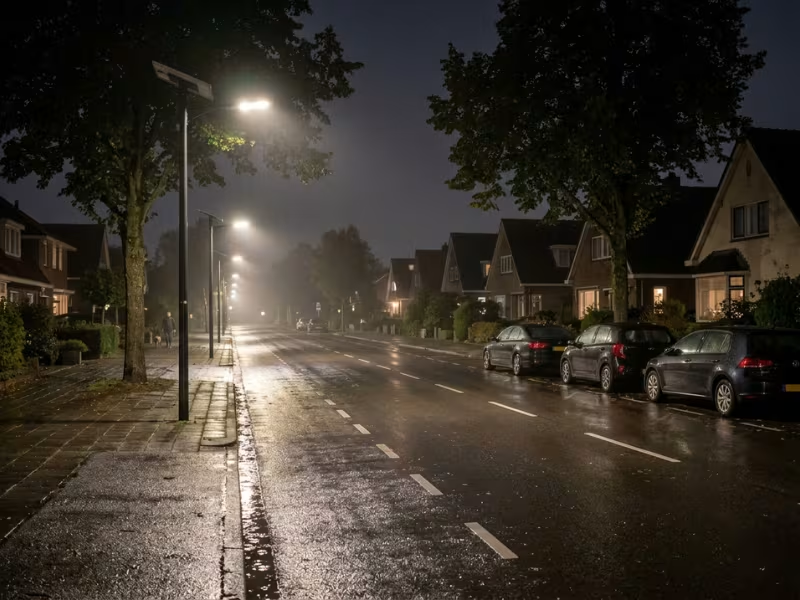
Winter’s Short Days: The Hardest Test
Winter attacks from three directions at once. The sun sits lower in the sky. Daylight shrinks to eight hours or less at higher latitudes. And longer nights force the lamp to use more energy just when the panel earns less.
Snow makes it worse. Even a thin layer can stop charging completely. On snowy sites, I tilt panels at latitude plus 10–15 degrees so snow slides off faster. Clean off autumn dust and leaves before winter arrives.
That’s why I size every system for its worst month. A light that looks oversized in June may barely keep up in December.
Recovery After Bad Weather: The Part Buyers Often Ignore
Most buyers ask how long a light can survive without sun. Few ask how long it takes to bounce back. That second number tells you more about a system’s real health.
A large battery can keep the light alive through five gray days. But only the panel can refill it. If the panel barely covers one night’s use, it has almost nothing left over for recovery.
Take a lamp that uses 300Wh a night. Its panel harvests 400Wh on a clear day, which leaves just 100Wh of surplus. If a storm drained 900Wh from the battery, the system needs nine sunny days to recover. Few climates offer nine clear days in a row.
Now double the panel. The surplus jumps to 500Wh, and recovery takes under two days.
A slow system develops chronic undercharging. It never reaches full charge between storms, so each gray spell starts with a half-empty battery. Batteries that sit at low charge for weeks also age faster. In winter, some systems slip into a deficit cycle from November to February. They run dim every night and never catch up.
So ask the seller one direct question: How many sunny days does this light need to recover from empty? I look for two to three at most.
Why Some Solar Street Lights Fail in Cloudy Climates
When a solar light fails in a cloudy region, people blame the weather. I rarely do. On most failed sites, I find the same few mistakes, and someone could have caught each one before ordering.
- A panel sized for someone else’s sun. The seller designs for 5 peak sun hours. The buyer installs it where the worst month brings 1.5. No battery can cover that gap for long.
- A battery with no real reserve. If the light needs 13 hours on a winter night and the battery holds enough for 9, the first gray afternoon pushes it toward cutoff.
- An unrealistic schedule. Full brightness from dusk to dawn on a quiet lane can triple nightly energy use compared with motion mode.
- Missed shade. Someone picks a pole spot at noon in summer. By winter, the low sun drops behind a building or tree line.
- A cheap controller. PWM wastes a large share of the weak trickle a panel produces under heavy cloud.
- Vague spec sheets. “Supports 3–5 rainy days” means little without the mode, brightness, and run hours. If the seller can’t name the load profile, assume the most generous one.
None of these failures comes from solar itself. Each one comes from a sizing or setup choice.
How to Choose a Solar Street Light for Cloudy Weather
Most buyers start with a catalog. On cloudy sites, I ask them to start with a weather map. Work through these four steps in order, because each one sets the targets for the next.
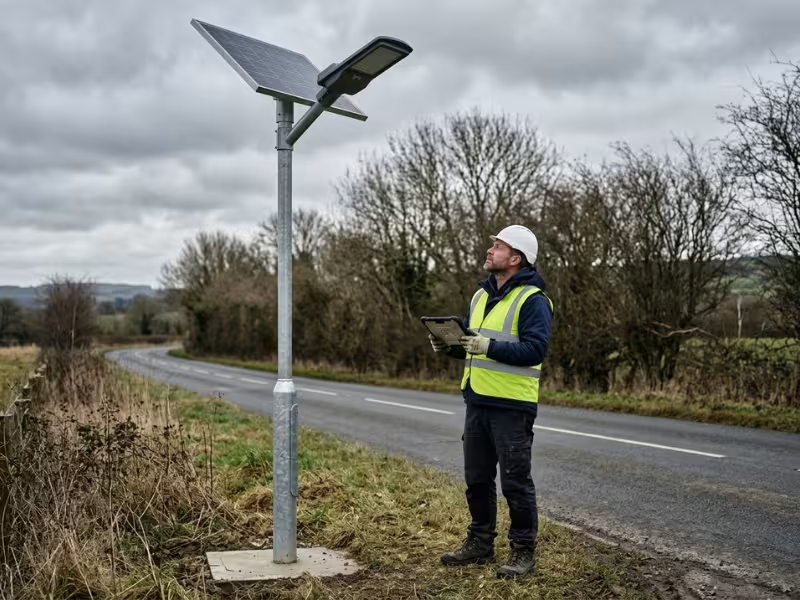
Step 1: Read Your Local Weather First
Look up peak sun hours for your worst month, not the yearly average. A site that averages 4.5 hours may drop to 1.5 in December. Free tools such as PVWatts, or your national weather service, show monthly figures.
Then count how many overcast days usually come in a row. That number sets your autonomy target. Also note snow, frost, and how early the sun drops behind nearby buildings or trees.
Step 2: Decide What the Light Must Do at Night
Write down the runtime for your longest night. At higher latitudes, it can reach 14 hours. Then choose a mode:
- Motion mode: Suits most quiet streets, parks, and compounds.
- Timed dimming: Fits roads with evening traffic that fades after midnight.
- Constant full power: Use it only for gates or junctions with steady all-night traffic.
Keep brightness realistic. A residential street needs about 5–10 lux on the ground. Every extra lumen you ask for raises the panel and battery size you need.
Step 3: Match the Spec Sheet to Your Targets
Now open the catalog. Look for a monocrystalline panel sized for your worst month, a LiFePO4 battery with capacity listed in Wh, autonomy tied to a specific mode, an MPPT controller, and an adjustable panel bracket.
Then run a quick check. Multiply nightly energy use by your autonomy days, and divide by 0.8. A 180Wh nightly load with four backup nights needs about 900Wh of rated capacity. If the battery falls short, so does the autonomy claim.
Step 4: Walk Away From These Red Flags
I pass on any listing that shows:
- “Supports 5 rainy days” with no mode, brightness, or run hours
- A battery described only as “lithium” or “high capacity”
- No controller type
- A “300W” claim next to a panel smaller than a doormat
Ask the seller to fill each gap in writing. Good suppliers answer quickly with real numbers. If the answers stay vague, the light will likely let you down in its first gray week.
When Solar Street Lights Are a Poor Fit
I design solar lighting projects, and I still tell some clients no. Pushing solar onto the wrong site leads to dark streets and frustrated property managers.
Deep, permanent shade. If buildings or a dense canopy block the panel most of the day, a bigger battery won’t help. A battery stores energy. It cannot create it.
Extreme latitudes. Near the Arctic Circle, winter brings little usable sun while nights stretch past 18 hours. The panel-to-load math simply doesn’t work.
Very high output, all night. A wide arterial road may need 20,000 lumens or more at full power every night. Solar can deliver it, but the panel and battery grow so large that cost and wind load become hard to justify.
In these cases, I often suggest a hybrid solar-grid light. It runs on solar most of the year and draws grid power only during long gray spells. You still cut energy bills, and you avoid dark nights in the worst weeks.
Cloudy-Site Spec Checklist: Nine Lines to Check First
Gray climates expose weak specs fast. Before I approve any light for a cloudy site, I check these nine lines.
|
Spec |
Why It Matters in Cloudy Weather |
What to Look For |
|---|---|---|
|
Panel wattage |
Sets how fast the battery refills after a storm |
Sized for worst-month sun hours, with clear surplus beyond one night’s use |
|
Panel type |
Decides output in weak, diffuse light |
Monocrystalline, about 20% efficiency or higher |
|
Controller |
Captures the thin trickle under heavy cloud |
MPPT, not PWM |
|
Battery chemistry |
Shapes usable energy and cycle life |
LiFePO4 |
|
Usable capacity |
Shows the real reserve, not just the label |
Capacity in Wh; about 80% usable for LiFePO4 |
|
Autonomy days |
Keeps the light on through gray spells |
3–5 nights, tied to a stated mode and runtime |
|
Runtime mode |
Controls how fast the reserve drains |
Adjustable motion or timed dimming |
|
Mounting flexibility |
Lets you aim the panel and shed snow |
Tiltable bracket, latitude to latitude +15° |
|
Low-temperature protection |
Stops battery damage from charging in freezing weather |
Charge cutoff or built-in heater below 0°C (32°F) |
If a listing skips more than two of these, ask for the numbers in writing. Missing data usually hides a weak point.
FAQs
Do solar street lights charge on cloudy days?
Yes, but slowly. Under heavy overcast, a panel often delivers only 10–20% of its rated output. That trickle helps, but it rarely refills a battery in one day. When you compare products, ask suppliers for low-light output data, not just peak figures.
How many days can a solar street light run without sun?
Most quality lights run two to five nights on stored energy alone. The real figure depends on battery size and operating mode. The same light might last three nights at full power or seven in motion mode. For critical sites, request a written runtime table for each mode.
Do solar street lights need direct sunlight?
No, but direct sun does most of the work. Plan for at least 4–6 hours of unshaded sun around midday.
Dust, pollen, and bird droppings can cut output noticeably, so clean panels at least twice a year. On dusty or hard-to-reach sites, a self-cleaning solar street light saves you repeated maintenance trips. If your best pole spot sits in shade, a split system lets you mount the panel somewhere brighter.
Do solar street lights work in winter?
Yes, if you size them for winter. Base the panel on your darkest month’s sun hours, and use a steeper tilt on snowy sites. Also confirm low-temperature charge protection, because LiFePO4 should not charge below 0°C (32°F).
How long does it take to recharge after cloudy weather?
A well-sized system recovers in one to three sunny days. A small panel may take a week or more. Recovery depends on surplus, meaning the energy the panel earns beyond one night’s use. On new installs, let the battery charge fully for a day or two before you judge the light.
Are lithium batteries better than lead-acid for cloudy climates?
For most sites, yes. LiFePO4 offers far more usable capacity and cycle life. Lead-acid also suffers from sulfation when it sits partly charged through long gray spells, which steadily cuts its capacity. In very cold regions, choose LiFePO4 with low-temperature protection rather than switching chemistry.
Conclusion
Solar street lights do charge on cloudy days. They just charge much more slowly, often at a fraction of their sunny-day output.
But one gray afternoon rarely decides whether a street stays lit. Three things do: battery autonomy that carries the light through a dark week, correct sizing that keeps nightly use within what the panel can earn, and fast recovery that refills the battery before the next storm.
So start with your weather data, not a catalog. Find your worst-month sun hours and count your typical run of gray days. Then check each light’s panel size, battery reserve, and operating mode against those numbers. If a product can’t match your site on paper, it won’t match it in December.