

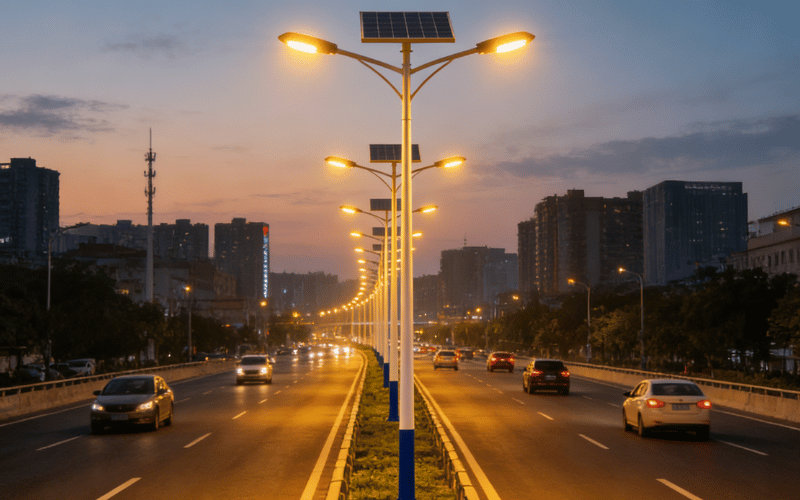
I often meet city planners who point to dark spots between street lights and wonder if they’ve spaced them too far apart or too close together. They worry about safety, wasted money, and public complaints.
Most solar street lights are spaced according to a simple rule: three to four times the pole height. A 6-meter pole means lights are 18-24 meters apart. Matching the distance to the pole height keeps light even and keeps costs down.
Many owners stop reading after this simple formula. Yet spacing also shapes uniformity, visual comfort, and long-term performance. The details below show how I determined the final distance and why a one-meter error can compromise an entire project.
What Is the Standard Distance for Solar Lights on Rural Roads?
Quiet country lanes feel safe until a sudden bend hides a parked vehicle. Proper spacing fixes that risk without breaking the bank.
On quiet rural and community roads, a spacing of 18–22 m for 6 m poles with 30-50W LED heads gives enough light for walkers and cyclists while staying cheap to install.
Why closer spacing wins on low-traffic lanes
My first big rural project was a series of access roads in a provincial park. Pedestrian traffic was low but consistent. Spacing the lights too far apart would have created dangerous dark zones. We set the distance at 20 m. The client saved on the number of high-wattage fixtures, and visitors stopped complaining about uneven light.
Solar is ideal here. The lights are needed for shorter periods, and a motion-sensing mode can conserve power. A 40W head, a 20Ah LiFePO₄ battery, and a 60W panel can easily last five rainy nights without grid backup. The full system costs less than trenching for grid power.
|
Spacing |
Pole Height |
LED Rating (W) |
Light Uniformity |
|---|---|---|---|
|
18 m |
6 m |
30W |
High |
|
20 m |
6 m |
40W |
Good |
|
22 m |
6 m |
50W |
Average |
The table shows why a middle-ground option is often best. A 20 m spacing with a 40W LED provides good uniformity without the higher cost of more poles or more powerful fixtures. Over a one-kilometer road, this balance provides consistent, safe lighting efficiently.
When clients worry about creating light pollution, I recommend fixtures with cutoff optics. These direct light downwards, minimizing skyglow while keeping the path well-lit. The cost difference is minimal, but the environmental benefit is significant.
What Is the Typical Distance for Solar Lights on Main Roads?
Busy town roads breathe stress. Buses, e-bikes, and delivery vans cut across lanes all night.
On primary streets, a spacing of 26–30 m for 8-10 m poles balances broad light coverage, low glare, and installation costs.
Balancing brightness, reach, and cost.
I learned this range after a project in a major city where the client initially demanded maximum spacing to save money. We proposed a slightly tighter 28 m distance instead. The improved uniformity eliminated dark spots, reducing accident risks and ultimately saving more in liability than the initial extra cost.
At Sigolight, I pair this spacing with Type II or Type III optics. Light reaches the curb uniformly without creating harsh shadows. For a solar application, this setup requires a powerful panel and battery to run all night. You can see my full checklist in my guide on what to consider when buying an LED street light.
|
Spacing |
Pole Height |
Optimal LED Range (W) |
Uniformity |
|---|---|---|---|
|
26 m |
8 m |
100-120W |
High |
|
28 m |
9 m |
120-160W |
Excellent |
|
30 m |
10 m |
160-200W |
Good |
A two-meter change in spacing may seem small until you see its effect on nighttime visibility. Wider spacing often requires much higher wattage to achieve the same minimum light level between poles, increasing energy and fixture costs.
In my proposals, I often show a DIALux simulation comparing different spacing options. When managers see the difference in uniformity between 28 m and 32 m, they understand the safety value. They can then justify the budget for proper spacing and ensure the road is safe for everyone.
How Far Apart Should Solar Lights Be on Highways?
Highways never sleep. Trucks roar at 100 km/h in rain and fog. A dark patch kills.
High-speed roads rely on spacing of 30–38 m with powerful 200–300W LED engines, plus at least a five-year full warranty.
When safety drives the budget
In 2023, I helped plan a 25 km highway expansion. We chose a 36 m spacing with 250W asymmetric LEDs. The client first questioned the need for such powerful fixtures. I countered with crash data: a single fatal night accident costs more than the entire lighting project. They approved the specification.
Wider spacing reduces the number of poles and foundations, yet each installation must survive high winds and extreme weather. This requires robust engineering from the base up.
Solar is challenging on highways due to the large panels required and the potential for inconsistent output during storms. If sustainability rules demand solar, hybrid systems that can switch to the grid on low-charge nights are a reliable compromise.
|
Spacing |
Pole Height |
LED Power (W) |
Pole Count per km |
|---|---|---|---|
|
30 m |
10 m |
200-240W |
33 |
|
36 m |
11 m |
240-280W |
28 |
|
38 m |
12 m |
260-300W |
26 |
The table proves why a 36 m spacing often wins. It significantly reduces the pole count per kilometer compared to a 30 m setup, dramatically cutting installation and material costs. Over 100 km, that can mean hundreds fewer poles, foundations, and fixtures, all while meeting strict highway luminance standards.
Every project’s success lands on my desk. I sleep better when I specify components that exceed minimum requirements, like IP67-rated drivers and dual-layer powder coating. The extra cost per pole is minimal. The peace of mind is priceless.
Factors That Influence the Ideal Distance Between Solar Street Lights
I learned the importance of balancing factors after a client insisted on maximum spacing for a city project. The result was uneven light and dark patches between poles, forcing a costly redesign.
At Sigolight, I now use a multi-factor approach. Spacing depends on pole height, LED power, optics, and road type. You must get the balance right. You can find my complete checklist in my guide on things to consider when buying an LED street light.
|
Factor |
Influence on Spacing |
Consideration |
|---|---|---|
|
Pole Height |
Taller poles allow wider spacing |
Higher cost, more wind load |
|
LED Power & Optics |
Powerful LEDs with good optics increase reach |
Higher energy use, potential for glare |
|
Road Type |
Highways allow wider spacing than local roads |
Must meet specific safety standards |
|
Local Conditions |
Trees or buildings can block light |
Requires site-specific adjustments |
A two-meter mistake sounds small until you see the final result. Poor spacing leads to safety hazards or wasted money.
In my proposals, I always include a lighting simulation. When project managers see how these factors interact to affect light uniformity, they understand the value of a balanced design. It’s not just about putting lights on a road; it’s about creating a safe, efficient, and cost-effective lighting system.
Practical Tips for Determining Solar Light Spacing
My first solar job was on a winding country road where the client wanted to save money by stretching the distance between lights. The result was a ‘zebra stripe’ pattern of bright spots and dark patches. We had to add more lights later, costing them more than if they had planned it correctly from the start.
Solar lighting is about balance. You have to match spacing to pole height and LED wattage. A lighting simulation can confirm your design, but a real-world test is the final check to ensure safety.
Why getting the spacing right matters
I always run a DIALux simulation before finalizing a layout. It shows precisely how the light will spread and helps avoid costly mistakes. This isn’t just about numbers; it’s about ensuring pedestrians feel safe and drivers can see clearly. You can’t guess this part.
For solar, this is even more critical. Each light is a self-contained power plant. Optimizing spacing means you get the most out of every watt without draining the battery too fast. For more on this, I often point clients to my article on the pros and cons of solar lighting.
|
Tip |
Action |
Benefit |
|---|---|---|
|
Simulate |
Use software like DIALux to model light coverage |
Prevents dark spots and ensures uniformity |
|
Match |
Align spacing with pole height and LED wattage |
Optimizes performance and efficiency |
|
Avoid Over-spacing |
Stick to a 3:1 or 4:1 height-to-spacing ratio |
Enhances safety and visibility |
|
Test |
Install a few lights first to verify performance |
Confirms the design works in reality |
The table shows why a systematic approach works. A simulation identifies the ideal balance before you spend a dollar on hardware. Proper matching ensures the system is efficient, and a real-world test validates your calculations.
When clients push for wider spacing to cut costs, I show them the simulation results. Seeing the potential dark zones on a screen makes the safety risks clear. A small investment in proper planning prevents much higher costs and liabilities down the road.
Conclusion
Choose 18–22 m for quiet lanes, 26–30 m for city arteries, and 30–38 m for highways. The proper spacing saves money, improves efficiency, and keeps every journey safe.