

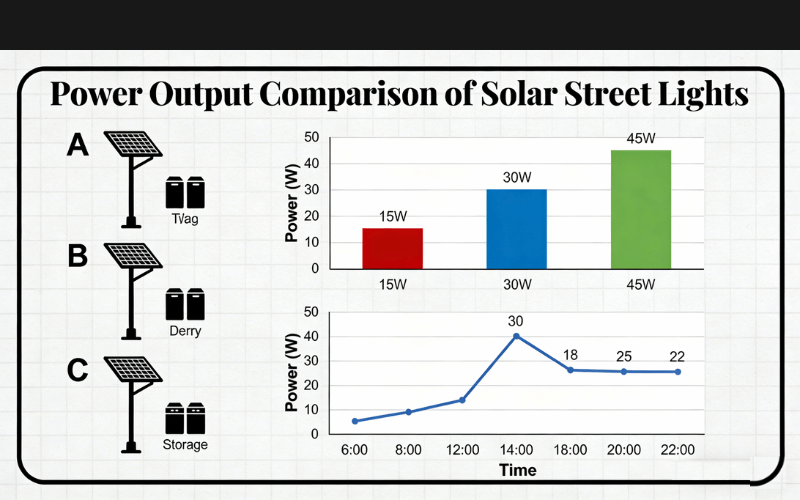
All solar street lights are not created equal. Knowing how much electricity your lighting system requires to run efficiently throughout the night is essential when planning your next outdoor project. Whether you are lighting a residential driveway or a public roadway, understanding the actual power output ensures you get the brightness and reliability you expect.
Also, before investing in new solar lighting, you’ll need to know how much power it actually generates to calculate your potential savings in the same way homeowners base their appliance purchases on energy ratings. Misunderstanding these figures can lead to lights dimming too early or failing during cloudy spells. It’s not just about the wattage listed on the box; it’s about the real-world performance that keeps your environment safe and illuminated. Let’s dive into the specifics of power output to help you make a more intelligent, more sustainable choice.
How Much Power Do Solar Street Lights Generate?
According to industry standards, watts (W) and watt-hours (Wh) are the primary units for measuring solar lighting performance, representing instantaneous power usage (W) and energy capacity over time (Wh). A typical solar street light might range from 20W to 100W in LED power, but the solar panel generating that power operates differently.
The average efficiency of solar street light panels is often rated in peak watts. For example, a system with a 60W LED fixture might be paired with a 100W solar panel. This works out to generating roughly 400Wh to 500Wh of energy on a standard sunny day, assuming 4-5 peak sun hours. In other words, on average, solar street lights need to generate significantly more power than the light fixture consumes per hour to account for battery charging inefficiencies and energy storage for days without sunlight.
Several factors determine the actual output range of a solar light. These include the capacity of the lithium-ion battery, shading from trees or buildings, panel orientation, temperature, and the efficiency of the charge controller. Just like electric vehicles, the “mileage” or duration of light you get depends heavily on these variable conditions.
Daily and Monthly Power Output of Solar Street Lights
Assuming a standard commercial solar street light consumes about 400Wh per night to operate a 40W LED at full brightness for 10 hours, and using the figures for average solar insolation in the US, we can calculate the operational requirements.
- Electricity usage per year: A single solar street light typically generates and consumes around 146,000 Wh (146 kWh) annually.
- Electricity usage per month: This comes to approximately 12,166 Wh (12.1 kWh).
- Electricity usage per day: The system uses about 400 Wh (0.4 kWh) per day.
However, generation fluctuates. In the summer months, a 100W panel might generate 600Wh daily, creating a surplus that can be stored in the battery. In winter, that same panel might only generate 250Wh. Smart controllers handle this deficit by dimming the light to 30% or 50% brightness to conserve energy. This intelligent management ensures that the daily and monthly power output remains balanced against the available stored energy, preventing the system from going completely dark during periods of low production.
Factors Affecting the Power Output of Solar Street Lights
Several variables influence how effectively a solar street light converts sunlight into usable electricity. Understanding these can help you troubleshoot performance issues or select the correct installation location.
Solar Panel Efficiency
The efficiency of the photovoltaic cells is paramount. Monocrystalline panels generally offer higher efficiency (around 20-22%) than polycrystalline panels. This means they can generate more power in a smaller surface area. The quality of the panel directly determines the lithium-ion battery’s capacity to reach a full charge. Dust, bird droppings, or snow accumulation on the panel surface can significantly block sunlight, reducing the actual power output by up to 50% if not cleaned regularly.
Weather and Climate Conditions
Environmental factors play a massive role. Wind, temperature, and topography all impact performance. Interestingly, solar panels operate less efficiently in extreme heat; they perform best in cooler conditions with bright sunlight. Cloudy or rainy days obviously reduce the incoming solar radiation, dropping energy production. Geographic location is also critical—a light installed in Arizona will naturally have a higher, consistent power output than one installed in Seattle due to the sheer difference in annual peak sun hours.
Battery Capacity and Storage
The battery is the system’s fuel tank. The capacity of a lithium-ion battery (usually measured in Amp-hours or Watt-hours) determines how long the light can run. If the battery is old or degraded, it cannot store the full power the panel generates, effectively limiting the system’s output. A healthy battery ensures that the power generated during the day is actually available for output at night. Without sufficient storage capacity, high daytime generation is wasted.
How to Measure the Power Output of Solar Street Lights
If you suspect your lights aren’t performing to spec, you can measure the actual output. This requires some basic tools and safety precautions, but it provides a clear picture of system health.
- Check the Solar Panel Voltage (Voc): Using a multimeter, measure the voltage of the solar panel wires when disconnected from the controller in bright sunlight. This Open Circuit Voltage should match the specs on the back of the panel.
- Measure Charging Current (Isc): With the multimeter set to the amp range, measure the short-circuit current. Multiply the volts by the amps (Volts x Amps = Watts) to get a rough estimate of the instantaneous power coming from the panel.
- Monitor Battery Voltage: Measure the battery voltage at different times of the day. A healthy 12V system should read around 13-14V when charging and settle at around 12.6V when fully charged.
- Check Load Consumption: Connect the multimeter in series with the LED light to measure the current being drawn. If a 40W light is only drawing 10W, the controller may be in a dimming mode, or the driver could be faulty.
- Review Controller Logs: Many modern MPPT controllers have Bluetooth or screens that display daily yield in kWh. This is the most accurate method to track historical power output without manual testing.
Costs of Power Generation for Solar Street Lights
The financial appeal of solar street lighting lies in its operational independence. Unlike traditional grid-tied lights, the cost of “fuel” (sunlight) is zero, but the initial equipment represents the bulk of the expense.
The cost of generating power via solar street lights is essentially the amortized cost of the hardware over its lifespan. A high-quality solar street light might cost $500 to $1,000 upfront. If it lasts 10 years and generates 1,460 kWh in that time, the effective cost is roughly $0.34 to $0.68 per kWh. While this seems high compared to grid rates, it excludes the massive savings on trenching, cabling, and transformers required for grid lights, which can run into thousands of dollars per pole.
For a homeowner, the calculation is more straightforward. Installing a wired garden light might cost $200 plus an electrician’s fee and ongoing monthly bills. A self-contained solar light costs $150 with zero ongoing bills. Over five years, the grid light continues to cost money, while the solar light has paid for itself. The “cost” of solar generation is a pre-payment on energy that stabilizes your budget against rising utility rates.
Public Solar Street Lights – Power Output and Costs
Public infrastructure requires reliability on a larger scale. Available commercial solar street lights for public use often feature robust systems with inputs from 100W to 300W panels and large battery banks to ensure autonomy for 3-5 days.
Public charging and lighting projects often face scrutiny regarding costs. According to municipal data, a traditional grid-tied street light costs between $100 and $200 per year just for electricity. In contrast, a public solar street light has an electricity cost of $0. However, maintenance costs must be considered. Batteries typically need replacement every 5-7 years, costing $200-$400 per unit. Even factoring this in, the 10-year total cost of ownership for solar is often 20-40% lower than grid lights in new developments where infrastructure doesn’t exist.
Different public lighting needs dictate different power outputs. A pedestrian crossing requires intense, high-lumen output (80W+) for safety, while a park pathway might only need 20W for ambiance. Municipalities are increasingly adopting “smart” solar lights that network together, enabling remote monitoring of power output and proactive maintenance, further reducing the operational costs associated with public lighting.
Future Innovations in Solar Street Light Power Output
The future of solar street lighting is bright, driven by rapid technological advancements that promise even higher power outputs and greater efficiency. We are moving beyond simple panels and batteries into integrated, innovative energy systems.
One central area of innovation is bifacial solar panels, which can capture sunlight from both the front and back sides (via reflection), potentially increasing power output by up to 25%. Additionally, improvements in solid-state battery technology promise to double energy density while eliminating the safety risks of liquid electrolytes. This means lights can run brighter for longer, even in smaller form factors.
Hydrogen fuel cells, as used by innovators like Gencell Energy in other sectors, are also being explored for large-scale outdoor lighting solutions. These could act as long-term seasonal storage, ensuring that even during a week of snowstorms, critical highway lighting remains operational. When combined with AI-driven adaptive lighting that adjusts brightness based on real-time traffic and weather data, the next generation of solar street lights will achieve a level of efficiency and reliability that rivals, and perhaps exceeds, the traditional grid.
Conclusion
Understanding the actual power output of solar street lights helps you look past the marketing hype and focus on performance. By knowing how much energy your system generates and consumes, you can ensure your property remains lit safely without unexpected blackouts. It allows you to size your system correctly for your specific climate and usage needs.
Remember that while the initial investment might be higher, the long-term savings and environmental benefits are substantial. Whether you are a homeowner looking for a driveway light or a city planner designing a new park, focusing on power output metrics—watt-hours, panel efficiency, and battery capacity—is key to a successful project. As technology evolves, these systems will only become more powerful and cost-effective, solidifying solar as the standard for outdoor illumination.