

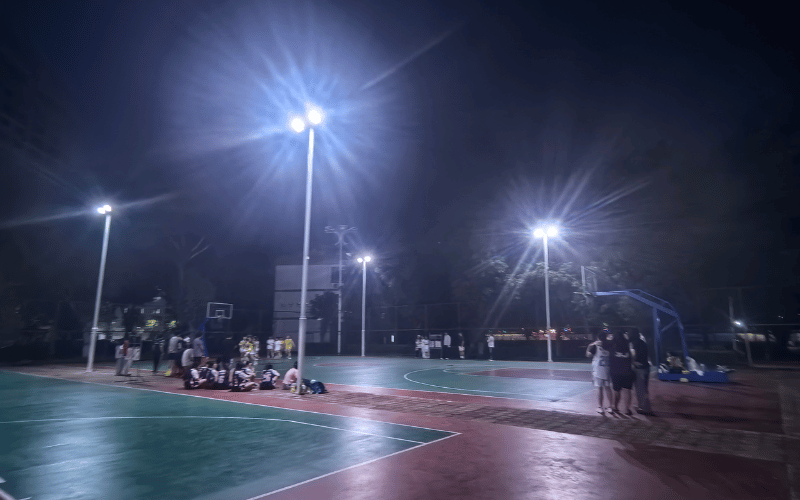
Picking the wrong lighting system for a basketball court is an expensive mistake — and a surprisingly common one. Some facilities install solar lights expecting competition-level brightness, only to come up short. Others run electrical conduit to remote park courts when a solar setup would have cost half as much and taken a fraction of the time.
The choice between solar basketball court lights and AC-powered outdoor sports lighting isn’t complicated once you know what each system actually delivers. This guide breaks it down clearly: what each option does well, where it falls short, and how to match the right system to your specific court, budget, and usage pattern.
Quick Answer
Solar basketball court lighting is generally the better choice for parks, schools, rural courts, and community projects where grid connection is expensive, difficult, or unavailable. It installs faster, costs less to run, and works well for recreational play.
AC basketball court lighting is the better choice when the court hosts organized night games, must meet formal lux standards, or requires full-brightness performance across all seasons and weather conditions.
In short:
- Choose solar if installation flexibility and lower operating costs matter most.
- Choose AC if maximum brightness and guaranteed all-night performance are non-negotiable.
Solar vs. AC Basketball Court Lighting at a Glance
| Factor | Solar Basketball Court Lighting | AC Basketball Court Lighting |
|---|---|---|
| Power Source | Solar panel + battery | Utility grid |
| Installation | Easier, no trenching or wiring | Requires trenching, wiring, conduit, and electrical work |
| Electricity Cost | Nearly zero | Monthly electricity cost |
| Brightness | Suitable for recreational play | Suitable for high-lux sports lighting |
| Weather Dependency | Depends on sunlight and battery capacity | Not affected by weather |
| Best For | Parks, schools, rural courts, community courts | Competitive courts, leagues, professional facilities |
| Maintenance | Battery and solar panel checks | Electrical system and fixture maintenance |
| Project Timeline | Usually faster | Usually longer |
| Long-Term Cost | Lower operating cost | Higher energy cost, but stronger performance |
Solar Basketball Court Lights: What They Are and How They Work
Solar basketball court lights generate power from sunlight captured during the day and stored in onboard batteries. When darkness falls, the stored energy powers LED fixtures mounted on the court poles. Most modern systems combine the solar panel, LED light, lithium battery, and charge controller into a single all-in-one unit — no separate electrical cabinet, no trenching, no utility connection required.
A standard solar court lighting setup includes:
- Solar panel
- LED flood light (typically with a wide beam angle for court coverage)
- Lithium battery
- Smart charge controller
- Pole or mounting bracket
- Optional timer or motion sensor
The practical result is that each light operates independently. If you’re building a court in a park with no nearby power infrastructure, solar removes the biggest obstacle — you don’t have to pay for a grid connection at all.
Key Advantages of Solar Court Lighting
- Lower installation cost. Without trenching, conduit runs, electrical panels, or utility hookups, solar installations are typically completed in one to two days. A comparable AC project can take several weeks once permits, electrical work, and utility inspections are factored in.
- No electricity bills. Once installed, the operating cost is essentially zero. For schools, municipalities, and community organizations running courts several nights per week, that adds up meaningfully over five to ten years.
- Ideal for remote and off-grid sites. Rural courts, island communities, park locations far from the nearest electrical panel — solar handles all of these without the cost penalty that grid extension would create.
- Low maintenance footprint. Modern battery management systems automatically protect battery health. Most solar court lighting requires nothing more than a seasonal inspection to keep running reliably.
Where Solar Lighting Has Limits
Performance depends on sunlight. After consecutive overcast days, battery reserves run low, which can reduce runtime or dim the output. In regions with short winter days, heavy shading, or frequent cloud cover, a well-sized solar system may not deliver consistent performance through the full night.
Brightness is the other constraint. Current solar sports lights work well for recreational and casual play, but they generally can’t sustain the lux levels required for competitive-standard basketball courts. If your facility needs to meet lighting standards set by an athletic association or governing body, solar alone usually won’t get you there.
AC Basketball Court Lighting: What It Is and When It Wins
AC-powered basketball court lighting draws directly from the utility grid through a standard wired installation. These systems use high-output LED floodlights that deliver consistent, full-brightness illumination regardless of battery charge, time of year, or how many hours the lights have already been running.
AC sports lighting is the standard at:
- School athletic programs
- Community recreation centers and sports complexes
- Facilities hosting regular evening leagues
- Semi-professional and professional venues
- Courts with mandatory lux compliance requirements
Key Advantages of AC Court Lighting
- Higher, consistent brightness. Grid-connected LED flood lights can achieve the illumination levels required for organized play — standards set by bodies like FIBA and NCAA that solar systems are not typically rated to meet. Full brightness from the moment the lights switch on, sustained across a six-hour tournament night.
- No weather dependency. AC systems perform identically in summer and winter, in overcast conditions and full sun. There’s no battery to deplete and no solar input to rely on.
- Better integration with facility systems. AC lighting connects easily to timers, smart control panels, and centralized facility management systems — useful for larger venues with multiple zones and scheduled programming.
- Infrastructure that ages well. As the electrical grid shifts toward cleaner energy sources, every connected court benefits from that transition without any hardware upgrade. The lighting itself gets cleaner over time.
Where AC Lighting Requires More Investment
Installation cost is the primary trade-off. Trenching, conduit, wiring, circuit breakers, and utility coordination all add cost and extend the project timeline. For courts located far from existing electrical infrastructure, those costs can be substantial.
There’s also an ongoing electricity bill. Modest with modern LED technology, but real — and it accumulates over the years.


Cost and Brightness: A Practical Comparison
In terms of cost, solar lighting tends to reduce infrastructure costs because it eliminates grid connection work. The fixtures themselves often cost more (each unit includes a panel, battery, controller, and LED lamp), but for remote sites, the total project cost is often lower than that of an AC installation.
AC lighting may offer a lower per-fixture cost, but total project cost rises quickly when trenching, conduit, and electrical labor are included. For courts where grid power already exists nearby, AC becomes more cost-competitive.
On brightness, the gap is real but context-dependent:
- Recreational court: Solar is typically sufficient. Casual evening play doesn’t require competition-grade lux.
- School training or practice court: Solar or AC, depending on the brightness and runtime requirement.
- League or competition court: AC is recommended. Consistent high-lux output matters here.
- Professional sports venue: AC is the appropriate choice, with fixtures specified to meet the relevant standards.
Choosing the Right System for Your Specific Court
There’s no universal answer here. The right choice depends on how the court is used, where it’s located, and what performance it needs to deliver.
Choose solar basketball court lights if:
- The court is in a park, school yard, rural community, or any location where grid connection is expensive or unavailable
- The primary use is recreational or casual evening play
- Fast installation is a priority
- Ongoing electricity costs need to be eliminated
- The project location gets reliable daily sun exposure
Choose AC basketball court lighting if:
- The court hosts regular organized night games, leagues, or competitions
- Lighting must meet a specific lux standard required by an institution or athletic body
- Grid power is already accessible near the installation site
- All-night, all-season performance is non-negotiable
- The facility runs year-round in a climate with limited winter sun
Consider a hybrid approach if the court serves mixed purposes. Solar fixtures cover the perimeter and ambient lighting. AC LED floodlights handle the primary playing surface. This balances installation flexibility with the sustained brightness that competitive play demands — and it’s a practical middle ground for facilities that need to serve both casual and organized use.
Frequently Asked Questions
Are solar basketball court lights bright enough for real play?
For recreational and casual play, yes. Modern solar sports lights deliver useful illumination for community courts and school playgrounds. For organized competition or courts that must meet formal lighting requirements, AC lighting is the more reliable option.
Which is cheaper — solar or AC basketball court lighting?
It depends on the site. Solar significantly reduces infrastructure costs in remote locations. If electrical infrastructure already exists near the court, AC may be more cost-competitive on the total project. Solar eliminates ongoing electricity costs; AC carries a monthly utility bill.
Can solar court lights handle cloudy or rainy weather?
Yes, within limits. A well-designed solar lighting system includes enough battery capacity to handle a few overcast days. Extended periods of poor weather or locations with consistently limited sunlight can noticeably reduce run time.
What lux level does a basketball court need?
Recreational courts generally require around 200–300 lux. Competitive courts used for organized league or school athletics often need 500 lux or more, with requirements varying by governing body and level of play.
Is solar lighting a good choice for school basketball courts?
Often yes — for general student use and casual evening activity. If the school runs formal night games or competitive programs with specific lighting standards, AC lighting is the safer choice for those sessions.
What’s the best lighting option for rural or off-grid courts?
Solar is typically the strongest option. It avoids the high cost of extending grid power to a remote site and installs faster with less infrastructure complexity.
Is a hybrid solar-and-AC system worth considering?
For multi-purpose courts, yes. Solar handles ambient and perimeter lighting efficiently; AC floodlights deliver the high brightness needed on the main playing surface. It’s a practical solution when energy savings and competition-level performance both matter.
The Bottom Line
Solar basketball court lights and AC outdoor sports lighting each solve a real problem — just for different courts and different priorities.
If your court is a community park, school playground, or rural facility used primarily for recreational play, solar lighting delivers reliable performance with a simpler install and no ongoing electricity cost. If your court needs to support organized night games, meet formal lighting standards, or perform consistently through long winter evenings, AC LED floodlights are the right investment.
Before committing to either system, answer four questions: How often does the court run at night? What lux level does it need to meet? Is grid power already accessible nearby? And is the project optimizing for upfront simplicity or long-term performance?
Those answers will point you to the right system — and help you avoid an expensive correction later.
Need help choosing the right basketball court lighting for your specific project? Our team works with schools, parks departments, contractors, and sports facility developers to recommend the right solar or AC lighting solution based on court size, location, usage schedule, and project budget. Reach out for a tailored recommendation.