
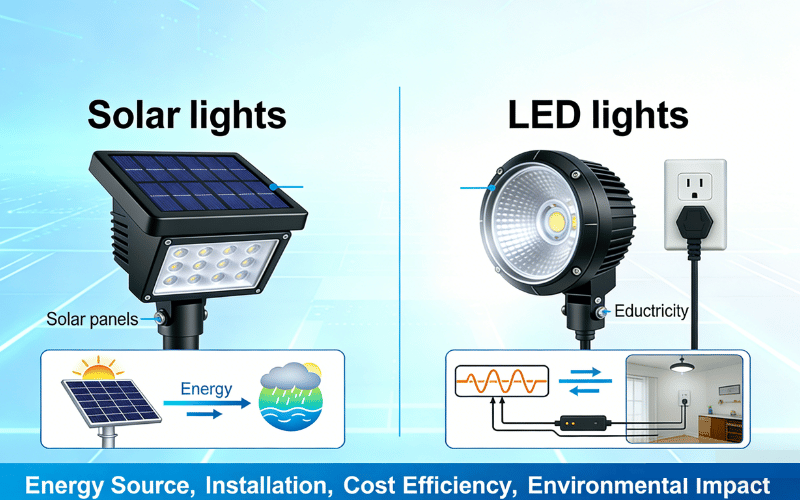
Learn more about the differences between these two types of lights.
There’s no denying that both solar lights and LED lights are beneficial technologies and are very popular among customers for a wide range of applications. Still, they’re so similar that it can be hard to know the difference so that you can choose between them. They’re both energy-efficient, long-lasting, and eco-friendly, and can be designed for various levels of brightness and durability. They’re both common choices for residential, commercial, and industrial lighting. As if that’s not confusing enough, they can both be found in many different styles, each with its own set of unique benefits.
With all these similarities, you could be inclined to believe that these terms are interchangeable, but you’d have to think again. Some crucial differences make them more or less suitable for specific applications. We explain more about each of these lights further down and have even prepared a table that pits solar lights and LED lights against each other to see how they fare.
What Are Solar Lights?
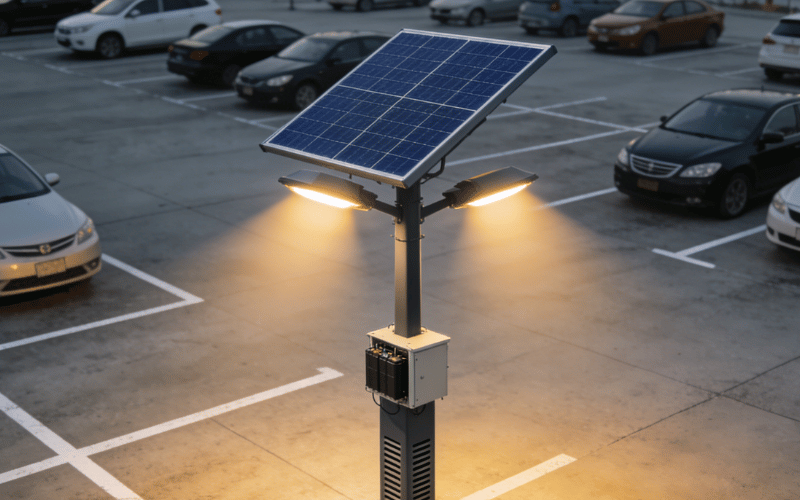
A solar light is a self-contained lighting system that uses photovoltaic (PV) panels to convert sunlight into electricity, stores it in a battery, and powers an LED lamp at night. These components work together to provide off-grid illumination, making them eco-friendly and cost-effective. They are suitable for various outdoor applications and are a common choice for street lighting, garden accents, security, and pathway illumination. Just a few of the parts they include are a solar panel, a rechargeable battery, a controller, and an LED fixture.
Although there are many types of solar lights, they generally fall into two categories: integrated and split-type. Integrated models, in which all components are housed in a single unit, are the most common and popular for residential use, such as garden and pathway lights. These systems are simple to install and are often more compact. They are efficient for smaller applications but can be less potent than other types.
Split-type solar lights have separate components, with the solar panel detached from the light fixture. This allows for optimal placement of the panel to maximize sunlight exposure, making them extra robust and reliable. They’re used for professional applications such as streetlights and parking lot lighting, and in sectors such as public infrastructure and commercial properties.
There’s also another one worth mentioning—hybrid solar lights. Used in areas with unreliable sunlight, these systems can connect to the grid as a backup power source, ensuring consistent illumination. This combines the benefits of solar with the reliability of conventional power.
What Are LED Lights?
LEDs are lighting devices that use a semiconductor known as a light-emitting diode to produce light. They are already highly efficient and durable, but can be designed to offer even greater longevity through advanced heat management. They are used to make various fixtures and their components, bulbs, strips, automotive lights, and industrial displays. One of the great things about them is that they can be powered by various sources, including many modern systems such as solar panels, low-voltage drivers, battery packs, and grid power. LED light types fall into four different categories depending on the design and application of the diode:
- Bulbs (aka “retrofit lamps”): standard replacements for incandescent lights.
- Strips: flexible circuit boards with surface-mounted LEDs.
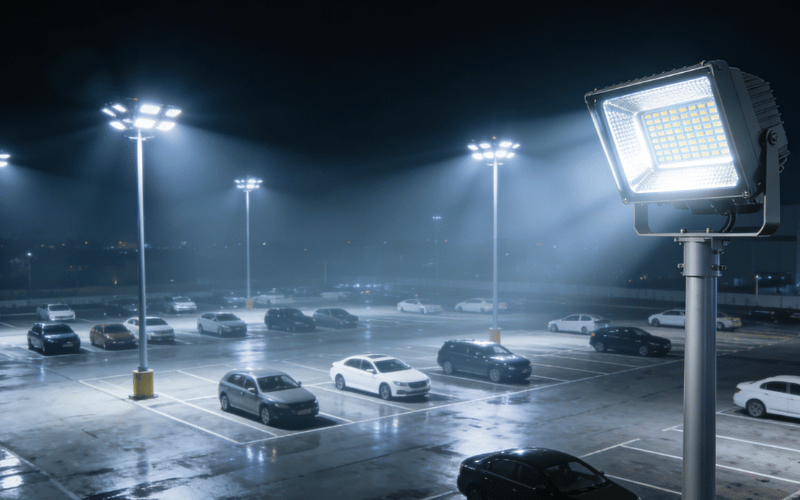
- Fixtures: integrated units like streetlights and floodlights.
- Specialty: focused designs for horticulture, medical, or display use.
Solar Lights vs. LED Lights: A Comparison
This is the fun part where we get to put these two lights side by side, compare their properties, and find the winner.
|
Property ↓ |
Solar Lights |
LED Lights |
Winner |
|---|---|---|---|
|
Power Source |
Solar energy (renewable) |
Grid electricity (variable) |
Solar Lights |
|
Installation |
Simple, no wiring |
Complex, requires an electrician |
Solar Lights |
|
Maintenance |
Low (panel cleaning, battery change) |
Very low (bulb replacement) |
LED Lights |
|
Upfront Cost |
High |
Low |
LED Lights |
|
Operating Cost |
None |
Low |
Solar Lights |
|
Reliability |
Weather-dependent |
High |
LED Lights |
|
Applications |
Outdoor, remote areas |
Indoor & outdoor |
LED Lights |
|
Lifespan |
Moderate (battery-dependent) |
High |
LED Lights |
|
Environmental Impact |
Very Low |
Low |
Solar Lights |
Types of Solar Lights
There are many different types of solar lights, each with unique properties and applications. Several broad categories are listed below:
- Garden Solar Lights: These lights are the most common for residential use and include path lights, spotlights, and accent lights. Garden lights are typically smaller and less potent than other types. They are widely used for decorative purposes and basic navigation in yards and along walkways.
- Solar Streetlights: High-power solar lights contain larger solar panels and batteries to deliver bright, consistent illumination for public spaces. These lights are robust and reliable, making them ideal for use on roads, in parking lots, and for commercial properties.
- Solar Security Lights: A type of solar light well-suited for deterring intruders. It contains a high-power LED and often includes a motion sensor to trigger bright light when movement is detected. These lights are incredibly effective and easy to install, making them ideal for protecting homes and businesses.
Types of LED Lights
LED lights are classified by design and intended use. Below are the categories of LED lights:
- LED Bulbs: (also known as retrofit lamps) Designed to replace traditional incandescent or fluorescent bulbs in existing fixtures.
- LED Strips: Flexible, adhesive-backed ribbons containing multiple LEDs, used for accent and decorative lighting.
- LED Floodlights: High-intensity lights designed to illuminate large outdoor areas like parking lots or building facades.
- Bright LED Lights: Wi-Fi or Bluetooth-enabled lights that can be controlled remotely via a smart device for color, brightness, and scheduling.
Advantages of Solar Lights Compared to LED Lights
Listed below are the advantages of solar lights compared to standard grid-powered LED lights:
- Solar lights are fully independent and do not rely on the electrical grid.
- Solar lights have zero operational costs since they run on free energy from the sun.
- Solar lights can be easily installed in remote or off-grid locations without trenching or wiring.
- Solar lights are generally more environmentally friendly, as they reduce the carbon footprint.
Disadvantages of Solar Lights Compared to LED Lights
Listed below are the disadvantages of solar lights compared to standard LED lights:
- Solar lights have a higher initial cost to purchase and install than grid-powered LED lights.
- Solar lights depend on sunlight and may fail to operate reliably during extended periods of rain or cloud cover.
- Solar lights perform poorly in shaded areas where trees or buildings block direct sunlight.
- Solar lights rely on batteries that have a shorter lifespan compared to the LED fixtures themselves.
- Standard LED lights provide consistent brightness levels without the risk of power depletion during long winter nights.
Similarities Between Solar Lights and LED Lights
Solar and LED lights are both based primarily on solid-state lighting technology. They also utilize similar components, such as durable housings, advanced optics, wiring, and drivers or controllers. Both types can also be produced in a wide variety of styles, each with its own unique set of properties and characteristics. Both solar lights and standard LED lights are energy-efficient, long-lasting, and eco-friendly. They can be designed for various levels of brightness and durability.
Alternatives to Solar Lights and LED Lights
Below are some mutual alternatives to both solar and LED lights:
- CFL (Compact Fluorescent Lights): Like both solar and LED lights, CFLs are designed to be more energy-efficient than traditional bulbs. CFLs use a gas-discharge method involving argon and mercury vapor to produce visible light.
- Incandescent Lights: Incandescent lights contain a wire filament that is heated to high temperatures, causing it to glow. They are less efficient but offer excellent color rendering, making them ideal for aesthetic and dimmable applications.
Conclusion
We hope this article helped explain the differences between solar lights and LED lights, and that you’ve managed to decide which one is best for your specific needs. If neither sounds appealing, fret not! Energy-efficient lighting solutions remain essential for promoting sustainability. The market offers many different products using these technologies, including garden lights, street lamps, security floodlights, and much more! You can easily find your ideal match here, or for more information on any of these solutions or their benefits, please consult an expert.