

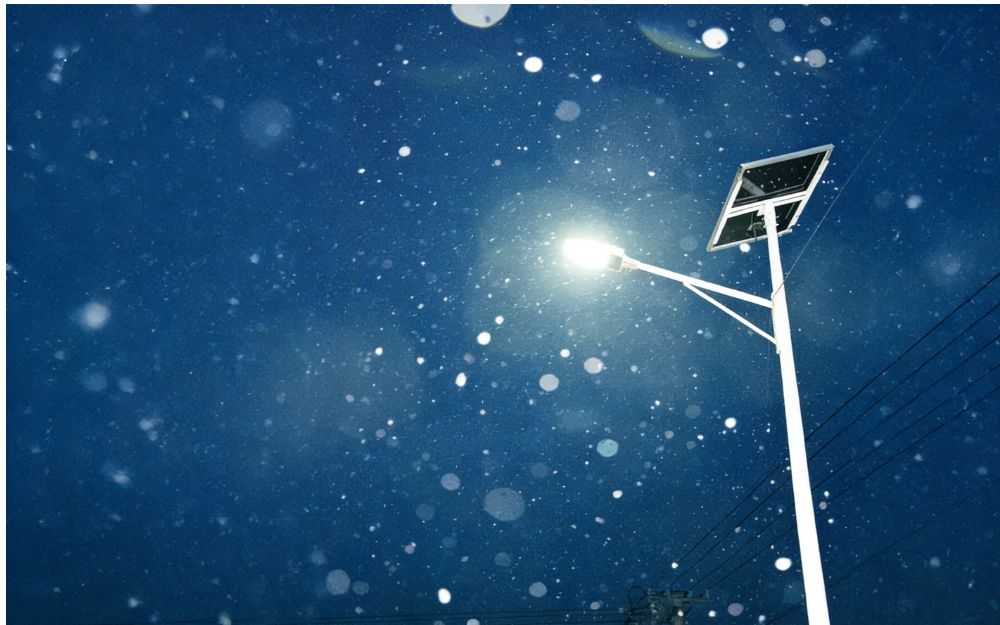
Operating solar lights in a cold climate poses additional challenges not present in warmer locations. These can include snow accumulation on solar panels, which reduces power generation; passive battery failure due to low temperatures (to prevent further damage, the battery management system adjusts charging and discharging parameters); and reduced effectiveness due to fewer daylight hours. Based on actual weather patterns, reduced sunlight can occur for a significant portion of the time between November and April. Solar lights must therefore be able to sustain at least limited charging without incurring damage that would prevent normal operation.
Solar light manufacturers are increasingly recognizing the impacts of cold climate operation and are building lights better equipped to handle winter conditions. Equipped with “cold weather packages” that provide insulation or gentle heating for battery components, some lights can operate in temperatures as low as -20 °C. Various types of panel designs and coatings, such as hydrophobic and angled surfaces, are currently being employed to limit snow accumulation.
However, it isn’t clear which cold-climate solutions deliver the highest performance while remaining cost-effective, making this an active area of research. The frequency and severity of snowfall vary significantly by region, meaning that snow mitigation and cold-adaptation methods need to be tailored to local conditions. Improving the accuracy of battery management systems represents another avenue for minimizing cold climate losses.
Challenges Solar Lights Face in Winter
Atmospheric conditions are a major concern for solar lights operating in cold climates, affecting installation, operation, and maintenance, and negatively influencing power production and reliability. Accurately accounting for the type, intensity, and duration of winter weather can help property owners and municipalities optimize their lighting strategy, anticipate performance issues, and invest in appropriate solar lighting technology. To this end, many manufacturers have developed models to forecast performance across various climates. These models are the result of pairing weather forecasting data with models designed to predict battery performance and light output. A summary of this data often helps customers choose the right product.
The objective of this analysis is to assess a solar light’s capacity to withstand winter conditions and the associated performance losses. Meteorological data, coupled with in-situ observations and performance prediction models, form the basis for comparison in this study. Data collected in past winters can be used to identify and characterize winter events, thereby evaluating the performance losses sustained by the solar lights included in the study. The events are modeled, and the performance losses associated with the conditions are calculated. The performance of a high-quality solar light model is compared with that of a standard, lower-quality model commonly found on the market. Although a basic solar light may function, its performance is often significantly lower than that of a well-engineered model. Consequently, it’s recommended that professional-grade models be further developed for operational use.
Manufacturers are also developing better energy-loss forecasts as part of a broader research project on advanced solar plant management. This work involves developing transfer functions that relate snow accumulation on a solar panel to the resulting production losses under distinct weather conditions. Understanding these relationships is key to designing more resilient and efficient products for year-round use in snowy regions.
Performance of Solar Lights in Winter Conditions
While severe snow events at particular locations can create headlines, one aspect that is not readily apparent is the overall impact of cold climate on energy generation from average solar light. There is a need to gain a better appreciation of the scale of the problem so that research and development efforts can be strategically directed towards mitigating such losses. This is the basis for assessing the impact of cold climates on solar light performance. For one study, an analysis of solar light power generation data from numerous solar installations across multiple provinces was conducted to quantify the extent to which cold-climate operation affects solar energy production.
Over a multi-year study period, for the specific type of solar lights included in the study (equipped with basic cold-resistant configurations and operating in temperate cold regions), the average loss factor for the summer period from May to October was estimated at 5%, compared to 25% for the winter period from November to April. The average cold-climate loss factor of 20% was calculated as the weighted average of the winter and summer loss factors, based on the actual operating hours of solar lights in each season. For individual solar lights, the average cold climate loss factor can range from 5% in milder climates to over 50% in regions with heavy snowfall and persistent cloud cover. Cold climate losses can be estimated to total millions of kilowatt-hours across the country each year, representing significant lost energy potential. The granularity (detail level) of most consumer data prevents identifying losses related to non-meteorological sources, such as improper installation or lack of maintenance. Further research will help to accurately classify and quantify losses directly attributable to winter weather conditions and improve product design accordingly.