

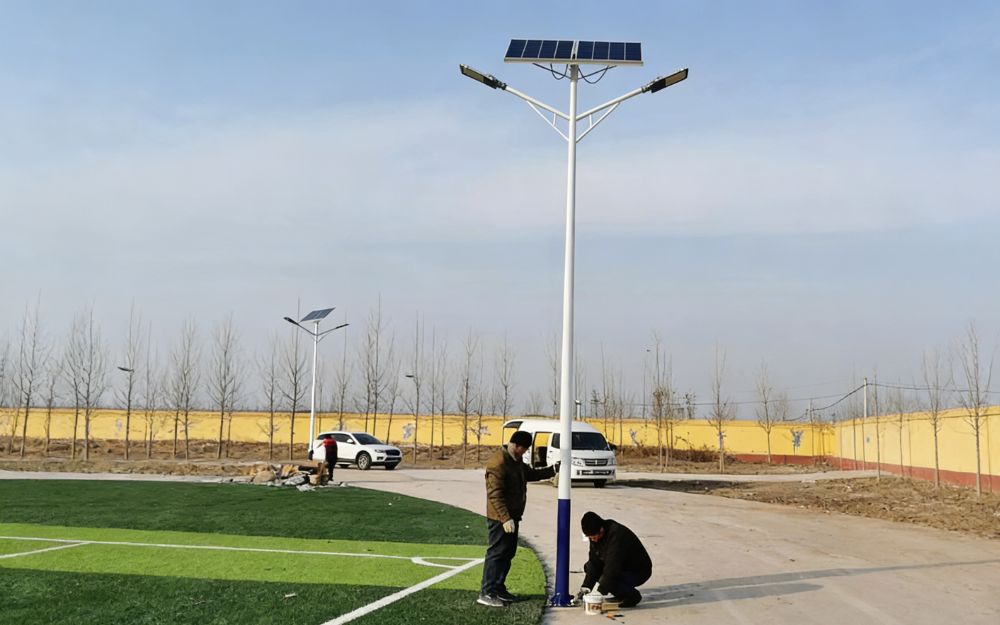
This guide provides an overview of the different business models available for commercial solar street lighting and the associated costs to be aware of. As businesses and municipalities increasingly adopt sustainable technologies, understanding how to implement and finance off-grid lighting solutions is crucial. Solar street lights offer significant benefits, from energy savings to enhanced safety and environmental responsibility. Choosing the right business model depends on your organization’s goals, whether that’s enhancing public spaces, recovering operational costs, or even generating a new revenue stream. This article will break down the primary models, their financial implications, and the key costs involved in bringing a commercial solar street lighting project to life, helping you make an informed decision for your property or community.
Business Models for Solar Street Lighting
There is a range of business models that can be applied to solar street lighting projects, each suited to a different business objective. They include:
- Loss Leader Model: Offer free public lighting to enhance safety, attract customers, and build community goodwill.
- Cost Recovery Model: Implement a system in which associated fees or savings cover operational and installation costs over time.
- Profit-Making Model: Structure the project to generate profit, often by integrating advertising or other paid services.
- Fully Funded Model: Partner with a third-party provider that funds, installs, and maintains the lighting infrastructure, often in exchange for a long-term service agreement or revenue share.
When considering a solar street lighting business model, it’s important to understand which models will be most effective for the type of location and the organization’s primary goals. For example, a retail center might prioritize attracting evening shoppers, while a municipality might focus on long-term cost savings.
Whatever approach you take, flexibility and scalability are absolutely critical. The technology is constantly improving, and your needs may change over time. It’s key to work with a lighting provider who will take the time to understand your location and make a tailored recommendation on what lighting systems and business models will be most effective for your specific circumstances.
What business/monetization models are available for commercial solar street lighting?
Loss Leader Model
With this model, solar street lighting is provided to the public at no cost to improve a location’s appeal, enhance safety, and build brand or community loyalty. The costs are offset by the increased revenue or public benefit gained through these improvements. A well-lit, safe environment can be the deciding factor for a customer choosing where to shop in the evening or a resident feeling secure in their neighborhood. The costs of offering standard solar lighting to attract people can be relatively modest compared to the potential gains. As such, your first consideration as a business or municipality should be whether you can offer lighting for free to maximize foot traffic, grow brand loyalty, and encourage on-site spending or community engagement.
| Pros | Cons | Typically suited to |
|---|---|---|
| Attract and retain more visitors and customers than unlit areas. | Liability for the upfront costs of the hardware and installation. | Businesses are aiming to increase customer attendance and on-site spending after dark. |
| Enhances brand image and public perception of safety. | Less suitable for projects that require direct ROI. | Municipalities and community organizations focused on public safety and quality of life. |
Analysis: For many businesses that rely on customer foot traffic, like shopping centers or entertainment venues, the revenue earned from attracting more visitors far outweighs the cost of the lighting infrastructure. It can, therefore, be sensible to absorb these costs rather than attempting to monetize the lights directly, which could create a negative public perception. To make the most of your lighting provision, it is recommended to ensure the installation is reliable (numerous lights, clear illumination), smart (scalable and future-proofed), and aesthetically pleasing.
Cost Recovery Model
With this model, a system is put in place to ensure the project pays for itself over time. This is not typically done by levying a direct fee on users, as with EV charging, but through other means. This can include securing government grants, integrating the project into a Special Improvement District (SID) where property owners contribute, or calculating the long-term energy savings against the initial capital cost. For many municipalities, the elimination of electricity bills and reduced maintenance costs for solar lights allows the initial investment to be recouped over the system’s lifespan.
| Pros | Cons | Typically suited to |
|---|---|---|
| Enables the project to pay for its own operational and/or capital costs over time. | Requires more complex financial planning and potentially navigating grant applications. | Municipalities and large property owners (e.g., HOAs) with long-term budget planning. |
| More financially sustainable than a pure loss-leader approach. | Payback period can be long, requiring patience and a stable financial footing. | Projects where eliminating ongoing electricity costs is a primary financial goal. |
Analysis: The core idea is to balance the upfront investment with long-term financial benefits. The most direct method is calculating the total cost of ownership (TCO) compared to traditional grid-tied lighting. The savings on electricity, trenching, and maintenance can be substantial. If a tariff or fee structure is part of the plan (e.g., within a commercial district), it’s imperative that the value proposition is clear to those contributing.
Profit-Making Model
With this model, a higher-level strategy is employed to turn the solar street lighting infrastructure into a profitable revenue stream. This goes beyond simple cost recovery. A common method is to integrate advertising into the light poles, turning them into digital or static billboards. Another approach is to include value-added services, such as public Wi-Fi hotspots, environmental sensors, or even small-cell 5G antennas, and lease this functionality to third parties. This model transforms a cost center into a profit center.
| Pros | Cons | Typically suited to |
|---|---|---|
| Enables the lighting infrastructure to pay for itself and generate ongoing profit. | Requires significant upfront investment in more advanced “smart pole” technology. | High-traffic urban areas where advertising space or connectivity services are in high demand. |
| Creates a new, sustainable revenue stream for the owner. | Can be complex to manage, involving contracts with advertisers or telecom companies. | Businesses or cities looking to innovate and monetize public infrastructure assets. |
Analysis: Profit-making models have broadly the same constraints as cost recovery models, but with the potential for much greater financial upside. However, the initial investment is also much higher. There can also be concerns about aesthetic impact or “visual clutter” if advertising is not implemented tastefully, potentially damaging the area’s perception. Success depends on securing high-value tenants for the advertising or tech services.
Fully Funded Model
In some circumstances, third-party infrastructure providers will offer to provide and install solar street lights free of charge to a business or municipality. This is often called a “Lighting as a Service” (LaaS) model. This can work very effectively, but it is important to take a long-term view to ensure that what is offered is mutually beneficial. The provider typically makes their money through a long-term service contract, by selling advertising on the poles, or through a combination of both.
| Pros | Cons | Typically suited to |
|---|---|---|
| No capital or operational cost to your business/organization. | Potential loss of control over the system’s design and features. | Organizations with limited capital budgets that still require a lighting upgrade. |
| Attracts and retains visitors with improved lighting at no upfront expense. | The provider’s pricing or advertising may negatively affect customer perception. | Businesses are less concerned about brand experience or the ability to control revenue from their assets. |
Analysis: Whilst the benefits of a fully funded model are clear, it is important to understand the constraints. Avoiding short-term capital expenditure may incur longer-term risks. A third party may set high advertising rates or use intrusive ads that negatively affect customers’ perception of your business. The proposed lighting solution may also be inappropriate for your site; for example, a provider might install a lower-quality light to save costs, which may not meet your illumination or reliability standards. Relinquishing control over the look, feel, and functionality of this infrastructure incurs a cost for a business.
What are the costs associated with commercial solar street lighting?
When planning the installation of solar lighting infrastructure, it is first important to understand the likely costs. These are split between:
Hardware Costs
Hardware costs vary depending on the power that the lights deliver, the features they offer (e.g., smart controls, motion sensors), and their build quality. Key components include the solar panel, battery, LED fixture, controller, and pole. High-quality, durable components will have a higher upfront cost but offer better performance and a longer lifespan, reducing long-term maintenance expenses.
Installation Costs
Installation costs vary depending on:
- The number of lights being installed.
- How the poles are to be installed (e.g., concrete foundations are standard).
- The site’s accessibility and the need for any special equipment.
- Labor rates in the specific region.
Unlike traditional lighting, solar lights do not require trenching for electrical wires or connection to the grid, which can represent a massive cost saving, often making the total installed cost of solar cheaper than a grid-tied equivalent.
Ongoing Costs
It will always be less expensive to operate solar lighting than traditional lighting because there are no electricity bills. However, there are ongoing costs to consider.
- Maintenance: This includes periodic cleaning of solar panels to ensure optimal performance and inspection of components. Well-designed systems require minimal maintenance.
- Battery Replacement: The battery is the primary component with a finite lifespan. Depending on the type and quality, a solar light battery will need to be replaced every 5-10 years. The cost of a replacement battery is a key factor in the long-term TCO.
- Standby Draw: Solar street lights have a minimal standby power draw to operate their controllers and sensors. This draw is covered by the solar panel and battery system, but it is worth ensuring the standby draw is sensibly low to maximize the energy available for illumination. A high-quality controller will have a very low standby draw.