

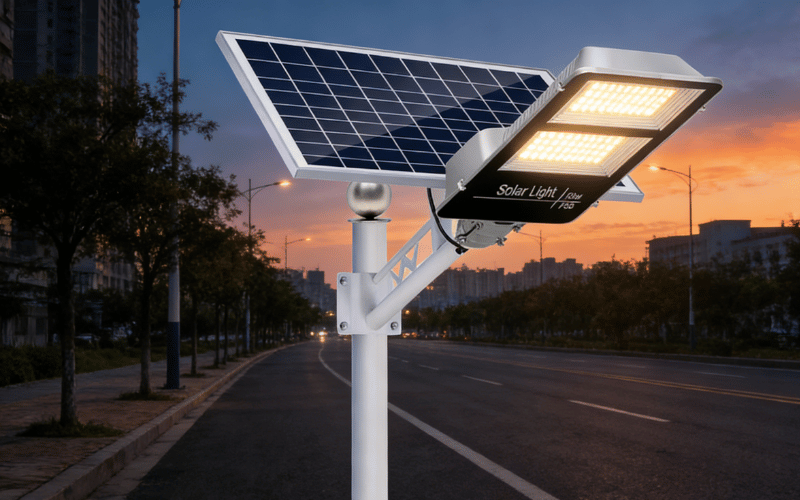
When it comes to solar street light maintenance and system protection, facility managers and homeowners often ask common questions, such as: How do we keep solar panels clean to maximize efficiency? How do we protect the battery from extreme temperatures? Or, how do users protect valuable solar street lights from theft or vandalism? Today, we share some easy fixes for common issues and great tips to protect your commercial solar street lights or residential solar parking lot lights.
To protect solar street lights, here is what you need to know:
- How to Protect: 8 specific solutions
- Protect From: Vandalism/dirt/weather, etc.
- Light Types: Commercial/residential solar lights
- Key Components: Panels, batteries, controllers
Question 1: How to Prevent Solar Street Lights from Vandalism or Theft
Public solar street lights or remote pathway lights are vulnerable to vandalism and theft because thieves or vandals may attempt to dismantle the unit to steal the batteries and solar panels, or simply damage the fixture for “fun.”
Solutions:
To prevent a solar street light from being stolen or vandalized, place the critical components out of arm’s reach. Mounting the battery box and controller high up on the pole, rather than at the base, makes it significantly harder for unauthorized personnel to access them. For integrated all-in-one solar lights, install them at a sufficient height (usually above 3-4 meters) to discourage casual tampering.
You may also use anti-theft screws and specialized fasteners when mounting the solar panels and light fixtures. These require unique tools to remove, adding an extra layer of security against theft.
Or use protective metal cages or wire guards around the light fixture, especially in high-risk areas like parks or alleyways. This helps protect the lens and LED modules from being broken by rocks or debris.
To make the solar street light pole tamper-proof, consider installing anti-climb spikes or collars on the pole to prevent individuals from scaling it to reach the equipment. Some municipalities also use graffiti-resistant paint on the poles to maintain a clean appearance.
Another way to protect solar lights is to use hidden or buried battery boxes. By burying the battery underground in a specialized waterproof box, you make it virtually impossible for thieves to locate and steal the system’s most expensive component.
Question 2: How to Keep Solar Panels Clean and Free from Debris
Outdoor solar lights rely entirely on sunlight to function. However, solar panels located near trees, construction sites, or in dusty environments will eventually accumulate a layer of dust, bird droppings, or fallen leaves.
Soon, your solar street light’s panel will be covered by grime or debris.
And this obnoxious layer of dirt will start to get annoying because it not only blocks sunlight from reaching the photovoltaic cells but also drastically reduces charging efficiency, leading to dimmer lights or shorter runtimes at night.
Solutions:
To keep debris away from your solar panels, the first step is to trim overhanging tree branches. This prevents leaves from falling directly onto the panel and also stops bird droppings from accumulating. Alternatively, installing bird spikes on the top edge of the panel frame can discourage birds from perching and fouling the surface.
To prevent dirt from accumulating on the solar street light panel, establish a regular cleaning schedule. For most environments, cleaning the panels twice a year with a soft brush and water is sufficient. In dustier areas, quarterly cleaning might be necessary.
Meanwhile, applying a self-cleaning coating or a hydrophobic solution to the solar panel’s glass surface can help. These coatings help rain wash away dust more effectively, keeping the panel cleaner for longer periods.
Another way to keep panels clean is to invest in smart solar street lights equipped with auto-cleaning systems. These advanced units feature a built-in wiper mechanism that automatically brushes the panel surface daily, ensuring maximum efficiency without manual labor.
Regularly wiping the panel surface with a non-abrasive sponge or cloth will protect your solar investment and help ensure it operates at peak performance.
Question 3: How to Protect Solar Street Lights from Extreme Weather Conditions
When you are in areas with very cold winters that drop below freezing or hot summers that reach 105°F, your solar lighting system may suffer if the components are not designed to operate in sub-zero temperatures or scorching heat.
Besides, there are all sorts of weather conditions & elements that you need to protect your outdoor lights from, including heavy rain, snow loads, and high winds.
Solutions:
First, check the solar light fixture’s IP (Ingress Protection) rating, which indicates its ability to withstand the elements.
For example, a solar street light with an IP rating of 65 or 66 can withstand impacts from solid matter such as dust and powerful water jets, such as heavy rain, making it effectively weatherproof for most outdoor applications.
And check the operating temperature range of the battery system, typically Lithium-ion or LiFePO4.
Many high-quality solar street lights typically operate in temperatures ranging from -4°F to 140°F (-20 °C to +60 °C). If you live in an area with extreme cold, ensure the battery management system (BMS) has a heating function or temperature protection to prevent damage during charging.
In addition, you should ensure the wind load rating of the pole and bracket matches your local climate. Strong winds can tear panels off if the mounting brackets are flimsy. Use reinforced brackets and ensure the foundation is deep enough to support the pole during storms.
In addition to fixture protection, when the solar street light is installed in the open, cables and connectors should be waterproofed with UV-resistant conduit or high-quality insulation tape. Exposure to UV rays can make standard cable insulation brittle and prone to cracking over time.
Another feasible way to protect the system from snow accumulation is to adjust the tilt angle of the solar panel. A steeper angle allows snow to slide off more easily, preventing heavy loads from damaging the bracket and ensuring the panel isn’t blocked from the sun.
Besides, in extremely humid or coastal environments, it’s important to choose marine-grade aluminum or galvanized steel for the housing and pole to prevent saltwater corrosion and rust.
Question 4: How to Avoid Glare and Light Reflection Issues
When a powerful solar street light is positioned incorrectly near residential windows or reflective surfaces such as glass buildings or water features, it can cause light pollution, intrusive glare, and obstruct visibility for drivers.
Sometimes, the wrong distribution pattern could be the culprit of light trespassing into homes or blinding pedestrians.
Solutions:
To avoid the snag, carefully plan the placement and orientation of your solar street lights. Ensure the light head is angled specifically toward the target area (the road or path) rather than spraying light horizontally.
To prevent light reflections and intrusive glare, it’s advisable to use fixtures with appropriate optical lenses (such as Type II or Type III distribution) that direct light downward and outward in a controlled manner.
Here are more great tips for controlling light spill: for example, install backlight shields or visors on the fixture to block light going in unwanted directions, or choose “full cutoff” fixtures that emit no light upward, preserving the dark sky.
Question 5: How to Prevent Fogging or Condensation in Solar Light Fixtures
Solar light fixtures are typically sealed and airtight during assembly, which reduces the risk of moisture seeping into the LED module or controller housing.
However, some users find that their solar street lights sometimes fog up inside the lens cover or that moisture condenses inside the battery compartment.
One user said the light cover starts to fog up and obscure brightness in the early morning or after heavy rain.
Solutions:
A fogging problem that occurs in the early morning sometimes goes away on its own as the sun’s heat and the LED’s evaporate the moisture, so there is no need to panic immediately.
Sometimes, the issue stays for a long time. The solution to internal condensation would be checking if the fixture has a “breather valve” or vent. These allow air pressure to equalize and moisture to escape without letting water in.
Sometimes condensation happens because the solar light seals are compromised. Try inspecting the rubber gaskets around the lens and housing. If they are dried out or cracked, replace them and ensure the screws are tightened evenly to create a proper seal.
Placing a packet of silica gel inside the controller box or battery housing (if accessible) can also help absorb excess moisture and protect sensitive electronics from corrosion.
Question 6: How to Protect Solar Street Lights from Lightning and Power Surges
Think ahead to prevent a lightning strike from ruining your valuable infrastructure.
Since solar street lights are often installed on tall metal poles in open areas, they act as lightning rods during storms. A strike can cause massive voltage spikes, leading to fried controllers, exploded batteries, or complete system failure.
Solutions:
Avoid mounting the solar panel at the very highest point without protection if you are in a high-lightning area. Instead, install a lightning rod or air terminal at the very top of the pole that extends above the solar panel to capture the strike.
Make sure your solar street light pole is grounded properly. A dedicated grounding wire connecting the pole and the metal components to a grounding rod driven deep into the earth can minimize damage by redirecting immense lightning current into the ground rather than discharging it through your electronics.
Surge protection devices (SPDs) are essential. Installing a DC surge protector between the solar panel and the controller, and between the controller and the LED, will stop voltage spikes and surges by blocking voltage levels exceeding specific thresholds.
Using high-quality, insulated wiring inside the pole can also prevent internal arcing during a power surge event.
If living in areas where thunderstorms are a common occurrence, you should consult with a professional electrician to ensure your grounding resistance meets local safety standards.
Question 7: How to Secure Solar Street Lights from Hacking or Tampering
One vulnerability of modern “smart” solar street lights is the risk of being hacked, either by jamming remote-control signals or by accessing the IoT network to disrupt lighting schedules.
Solutions:
The solution to the problem is to secure your lighting network. If your solar lights use a wireless management system (such as Zigbee or LoRaWAN), ensure the network uses strong encryption (e.g., AES-128) to prevent unauthorized access.
Changing your default passwords for the management software immediately upon installation is vital. Many systems come with generic admin logins that are easy to guess.
Updating your solar street light controller firmware frequently helps address loopholes and security vulnerabilities. Manufacturers often release patches to fix bugs or strengthen security against tampering.
Question 8: How to Troubleshoot Common Solar Street Light Issues
If your solar street lights experience performance issues—such as lights not turning on, dim output, flickering, shorter run times, or blackouts at night —occasionally or constantly.
Solutions:
Check the solar street light cables to ensure they are in good condition and not damaged by rodents or weather. Loose connections between the panel and the controller are a common cause of charging failure. Here are some common tips for troubleshooting solar lights: check the battery voltage with a multimeter, ensure the solar panel voltage is normal, and reboot the system by disconnecting and reconnecting the battery.
Don’t install your solar street lights in shaded areas or under tall buildings that block the sun for most of the day. This will prevent the battery from reaching full charge, leading to premature failure or dim light.
Inspect the “eye” or photocell sensor. If it is covered by dirt or tape, the light may not know when to turn on or off. Cleaning the sensor usually resolves this simple issue.
Conclusion
From preventing theft and vandalism to handling extreme weather and technical troubleshooting, protecting your solar street lights requires a proactive approach. These durable systems are designed to last for years, but a little care goes a long way in maximizing their lifespan and ROI.
By following these 8 tips, you can ensure your solar lighting infrastructure remains efficient, secure, and reliable. Whether you are managing a municipal street lighting project or lighting up a private driveway, taking these protective measures will help you avoid costly repairs and keep the lights on when you need them most.