How much wattage do you actually need? And what exactly is an MPPT controller? We decipher the technical jargon and explain exactly what you need to look for to help you choose the right solar street light for your property.
Everyone wants reliable and bright outdoor lighting, and a good solar street light can help, but how do you actually choose one? The trick is to work out how the complicated mess of battery standards, confusing technical acronyms, and specialized features translates to better illumination in your driveway, street, or parking lot. Join us as we tear back the curtain to reveal the pertinent facts about solar panels, battery capacities, mounting requirements, and other industry jargon. Hopefully, you will feel much better equipped to buy a solar street light.
Who Is Your Solar Street Light Provider?
Solar street light providers supply the essential hardware to keep your outdoor spaces illuminated safely. They design and manufacture the core components: the solar panel, the light fixture, the battery, and the pole mounts. Many commercial providers sell massive, industrial-scale units to city planners, but countless brands now sell direct-to-consumer models for private use. You often find a wide spectrum of companies, ranging from unknown overseas manufacturers flooding online marketplaces to established local brands that offer extensive warranties. Choosing an unverified provider might seem like a great way to save money upfront, but these budget options often offer poor battery life, dim screens, and no customer support.
We strongly recommend researching your provider carefully before making a purchase. By choosing a reputable brand, you can save significant money in the long term and avoid the cost of replacing dead batteries or broken solar panels after just one winter. You can also enjoy brighter illumination, improved weather resistance, easier installation, and extra features such as motion sensing and smart app controls. Check for recognized safety certifications and solid warranties before you add anything to your cart. You can also search online forums to find posts where real users discuss their long-term experiences with specific brands. A little research before you shop can save you a big headache down the line.
What Kind of Solar Street Light Do You Need?
There are various ways to effectively light up your outdoor spaces, and buying a brand-new solar street light is one of the most obvious solutions. To help you decide on the specific type of light to choose, calculate the approximate square footage of the area you need to illuminate before you begin shopping.
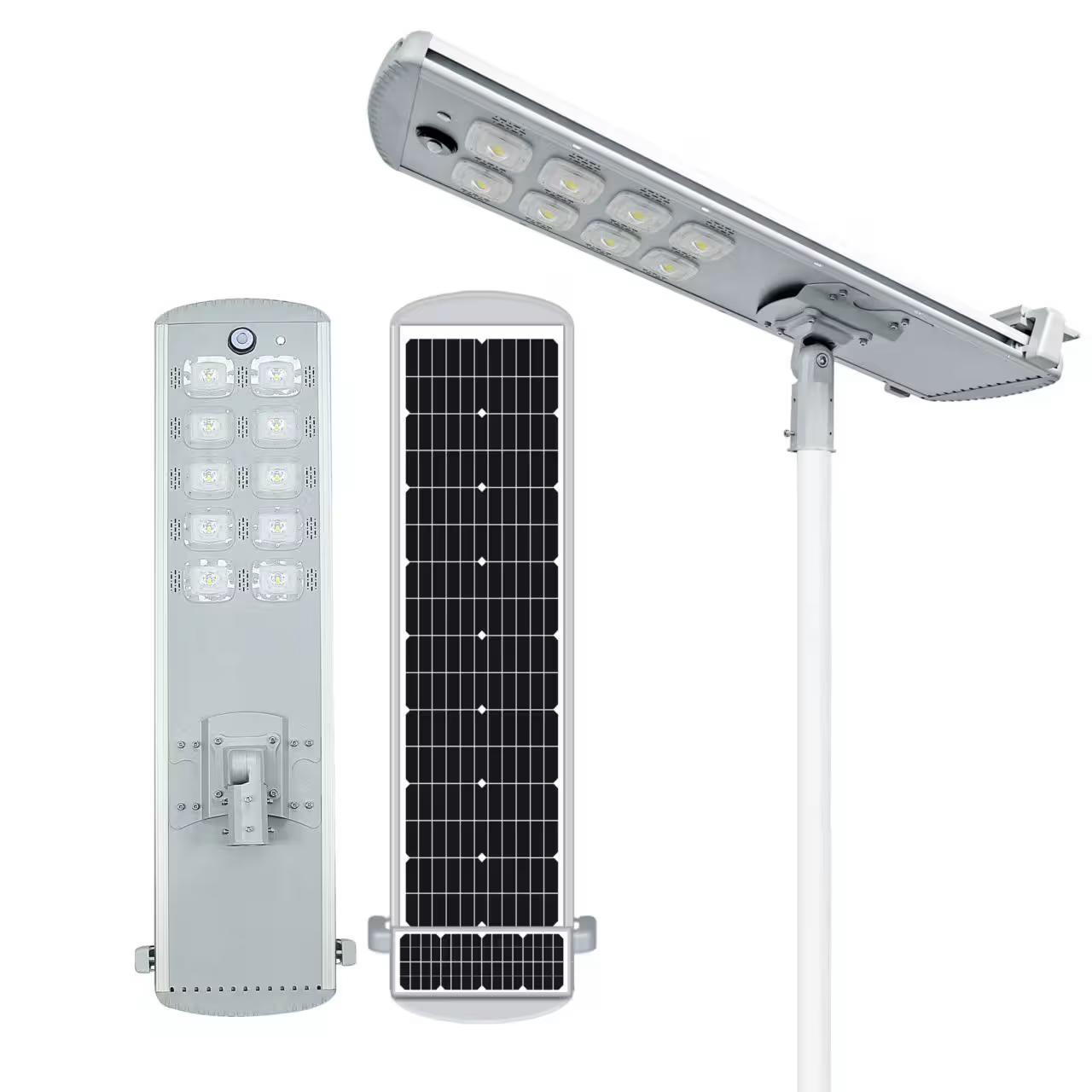
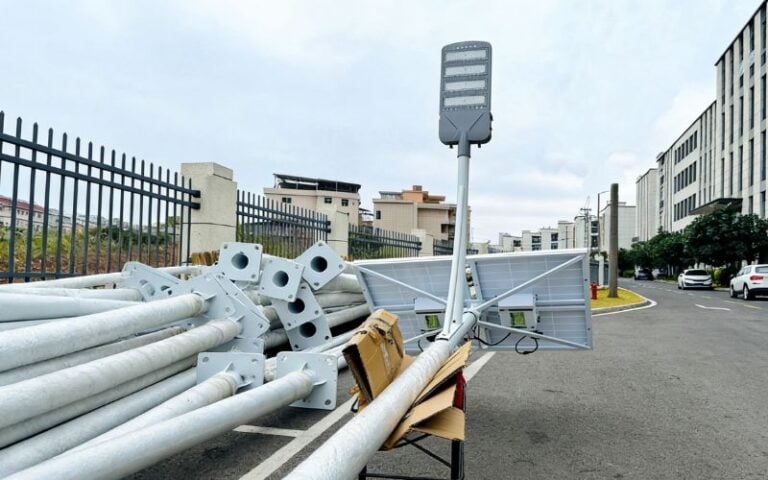
The simplest solution for most people is to choose a standard single-unit solar street light, often called an all-in-one system. Bear in mind that this device integrates the solar panel, battery, and LED light into a single compact fixture, which limits where you can position the panel relative to the sun. The light will obviously be strongest directly underneath the fixture and will gradually drop off the further away you get. Place your streetlight in a completely unshaded area, if possible, ensuring the top-mounted solar panel receives maximum direct sunlight.
Manufacturers should always state the expected coverage area for their lights, but certain environmental factors—like tall trees, adjacent buildings, and winter weather—can interfere with charging, so do not expect full-brightness lighting if you install it in a shadowy spot. Powerful street lights with massive coverage areas are often large, heavy devices with separate external solar panels, but they can be very expensive.
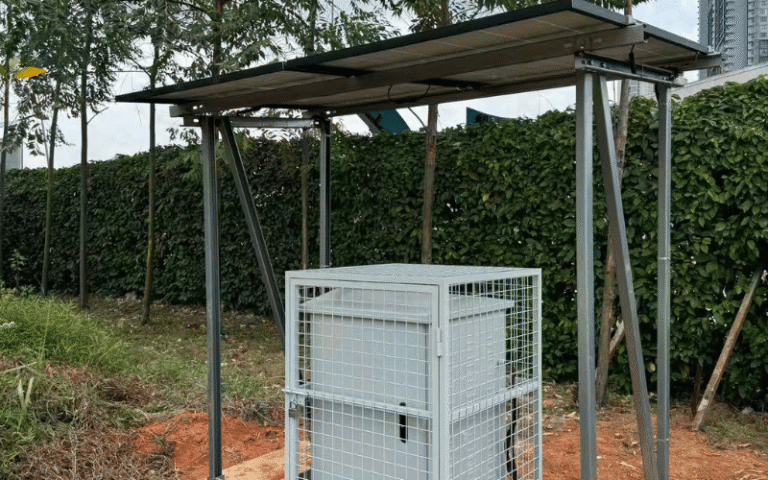
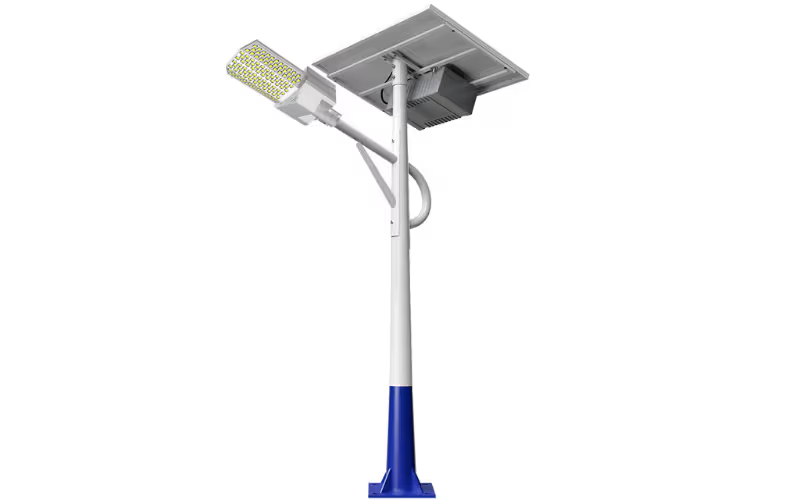
If you have a large commercial property and want solid coverage across a sprawling parking lot, or you have specific high-security zones with your current setup, then modular solar lighting systems could be the answer. Modular systems consist of separate solar panels, high-capacity external battery boxes, and distinct LED light heads that you mount individually.
Because you mount the solar panel separately from the light fixture, you can position the panel for optimal sun exposure while directing the light exactly where you need it. Just bear in mind that modular setups require a more complex installation process. Modular systems are typically more expensive than all-in-one setups, but they enhance lighting coverage and reliability, and they often boast much larger battery capacities to survive consecutive cloudy days. They also tend to be larger and heavier, requiring sturdy poles or reinforced walls for mounting.
If you cannot dig trenches for standard grid-tied lighting, you might also consider heavy-duty commercial solar street lights designed for major roadways. These lights typically require professional installation and massive 12-meter poles, just like city infrastructure. It is worth noting that these commercial units operate at massive lumen outputs and are complete overkill for a standard residential driveway. A few specialized providers offer these industrial-grade systems, complete with advanced remote monitoring software.
Alternatives to a New Solar Street Light
If your issue is more about localized visibility and you have a single dark corner where you want to improve safety, or a particular pathway that needs a bit of illumination, you might not need to buy a massive new street light. Try one of these alternatives. Each has its own technical challenges and potential issues. Even when successfully deployed, they will not come close to matching the raw power of a dedicated solar street light, but they are all much cheaper.
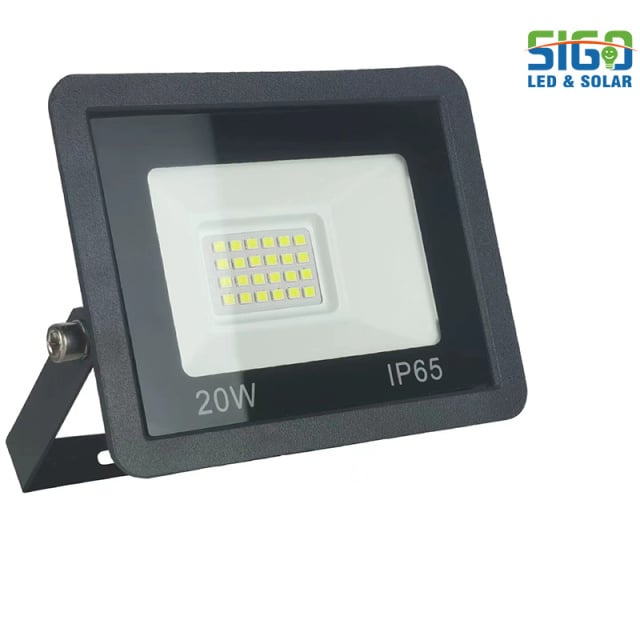
Before solar technology became affordable, we relied entirely on hardwired floodlights to illuminate our properties. Hardwired connections offer incredibly consistent performance, regardless of how many cloudy days you experience. The drawback is that you must hire an electrician to run dangerous high-voltage wires from your home’s electrical panel to the fixture. If you need to run wiring to multiple spots, trenching alone can run into the thousands of dollars.
For quick security fixes, battery-powered motion lights offer a decent stopgap. You mount these small units to a fence or wall, and they rely entirely on standard disposable or manually rechargeable batteries. They can be a good solution if you just want to see the keyhole on your shed door at the back of the house. Unfortunately, their effectiveness depends heavily on you remembering to climb a ladder and change the batteries every few months.
If your home already has low-voltage landscape lighting installed, you can easily expand it to create a reliable network of path lights. You can safely buy transformers and wire extensions for low-voltage systems without an electrician. Much like basic hardwired lights, this can be a great way to illuminate a garden path or a small patio that does not get enough sunlight for solar units.
You can also use small solar retrofits to upgrade existing non-functioning gas lamps or old electrical posts. These devices are a good solution for some people, preserving a property’s historic look while adding modern solar efficiency. Nowadays, replacing the whole fixture is often cheaper and easier, but retrofit kits can save the day if you have a beautiful antique post you want to keep.
If you do not mind a bit of manual labor, you can look into portable solar work lights. This can be particularly effective if you only need bright light occasionally, like when working on a car in the driveway, though moving them around daily can prove annoying.
What Wattage Do You Need?
There is plenty to consider when deciding how powerful your solar street light should be. The maximum brightness of your light is heavily influenced by the LED fixture’s wattage and the solar panel’s output. Wattage simply measures energy consumption and generation. The median basic solar street light has a stated power of around 100W to 300W. Most manufacturers will prominently display a high wattage number on the box—like 500W or 1000W—but what you actually get in terms of brightness is often lower than the marketing suggests, as those numbers sometimes represent theoretical maximums rather than sustained output.
You can check what brightness you actually need by evaluating your specific use case. To get a rough idea of how wattage translates into practical use, we suggest looking at installation height: a 3- to 5-meter pole usually requires a 50W to 100W true-power light, a 6- to 8-meter pole needs around 100W to 200W, and anything over 10 meters demands 300W or more. Generally speaking, if you are lighting a large commercial parking lot, you will want at least 400W true power per pole. If you only have a small residential driveway and mostly just want to deter trespassers, you will be fine with a high-quality 50W to 100W unit.
If your light’s battery maxes out its storage capacity quickly, the high wattage of your solar panel becomes useless because there’s nowhere to send the extra energy. It is also important to note that many budget manufacturers print wildly exaggerated wattage numbers on the box. The stated wattage on cheap brands often reflects the equivalent of an old incandescent bulb rather than the actual LED draw. You will always get a better understanding of brightness by looking at the lumen count instead.
Solar Panel and Battery Standards Explained
The components inside your solar street light determine how well it performs year-round. There is a short list of solar panel types and battery chemistries that offer varying lifespans and efficiencies. You will typically see panels categorized as either monocrystalline or polycrystalline.
Since solar technology varies widely, monocrystalline panels are the gold standard. They are made from a single, pure silicon crystal structure, making them highly efficient at converting sunlight into electricity, even on overcast days. The alternative, polycrystalline, is cheaper to produce but noticeably less efficient. If you live in an area with long, dark winters, a monocrystalline panel is absolutely vital for keeping your lights on.
We recommend lithium iron phosphate (LiFePO4) batteries as a minimum standard for your street light. Lead-acid batteries are outdated, heavy, and degrade rapidly when completely drained. LiFePO4 batteries are not just about longer lifespan; they also offer greater safety, improved temperature tolerance, and much faster charging times. That improved efficiency translates to a lifespan of up to ten years before the battery needs replacing.
You should know that if you get a high-end solar panel, your internal battery needs to have enough capacity to truly reap the benefits. A massive panel paired with a tiny battery will stop charging by noon, wasting hours of potential sunlight. But the benefits of a balanced system are pretty clear: it provides reliable dusk-to-dawn lighting without sudden shut-offs at 2 AM.
Light Output and Color Temperature
Different lighting applications require different types of illumination. You will mostly see solar street lights that produce either warm white, neutral white, or cool white light. When a manufacturer lists color temperature, it is measured in Kelvin (K). The lower the number, the warmer and more yellow the light; the higher the number, the cooler and more blue the light.
Each of these color temperatures serves a specific purpose. A 3000K light produces a warm, yellowish glow ideal for cozy residential gardens. The 4000K range offers a neutral, clear white perfect for standard pathways. The 6000K range provides a harsh, bright daylight-blue tint designed for maximum visibility on roadways.
The main difference is that lower Kelvin ratings feel more pleasant and less disruptive to local wildlife, whereas higher Kelvin ratings offer faster detail recognition and greater perceived brightness. It is like jumping from a gentle living room lamp (3000K) to a standard office light (4000K) to a high-intensity warehouse floodlight (6000K).
While the 6000K cool white promises maximum visibility for security purposes, we have tested several high-intensity systems and found that the glare can be overwhelming. If you are directly under the light, you can see perfectly, but the harsh blue light can blind drivers or annoy your neighbors.
Any street light you choose nowadays is likely to have a fixed color temperature, but you may want to check how the lumen output is handled. Lumens measure the actual brightness of the light, completely independent of the color. Many of the latest premium solar lights will produce over 10,000 lumens.
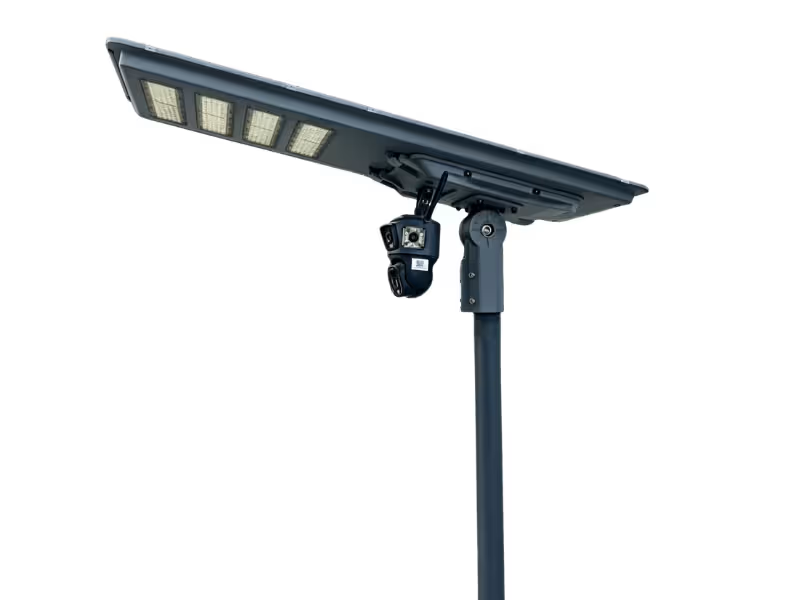
Modern smart solar street lights automatically dim, adjusting brightness based on battery capacity and time of night. This is simpler and will work well for most people, but it can cause issues when you specifically need full brightness all night long. If you have security cameras that require constant high illumination, you can usually find a workaround by purchasing a light with a constant-on mode, overriding the battery-saving dimming features.
Check for Mounting and Installation Requirements
Some properties require a specific mounting setup to maximize the light’s effectiveness. Even when you buy the brightest light on the market, poor placement will always result in subpar performance. If you can, try installing the light at the manufacturer’s recommended height to maximize coverage. Either way, you will need a sturdy mounting surface, so make sure your light comes with the appropriate brackets.
Several basic street lights only come with a bracket designed for a standard cylindrical pole. If your chosen location does not have a pole, you can get a wall-mounting adapter. These thick metal brackets are relatively cheap and give you the flexibility to bolt the light directly to the side of a brick building. But remember that the available sunlight will be limited by the building’s shadow, which will dramatically reduce your charging time.
If you want to install a heavy commercial unit, make sure your pole can support the load and withstand wind loads. Just like the light fixtures themselves, mounting poles have their own structural limits, and you will want a relatively robust one (we recommend thick-gauge steel or aluminum) to prevent it from snapping during a storm. Specialized slip-fitter mounts can also be handy for precisely adjusting the light head’s angle.
Consider Security Features
It is vital to secure your outdoor lighting, as it serves as a primary deterrent to trespassing and vandalism. Early standard solar lights simply turned on at dusk and stayed on until the battery died. The minimum standard to look for in a modern security light today is a built-in motion sensor, typically utilizing PIR (Passive Infrared) technology. It offers incredibly reliable detection and dramatically saves battery life by only ramping up to full brightness when movement is detected.
Premium solar street lights boast several features designed to address the weaknesses of basic outdoor lighting. For example, some models feature integrated flashing alarm lights that trigger when someone approaches too closely, scaring away potential intruders. High-end models also make it much tougher for thieves to steal the unit itself by using specialized anti-theft screws and heavy-duty locking brackets.
Security is not just about keeping intruders away; it is also about securing the internal components from the environment. You must ensure your light has a high IP (Ingress Protection) rating, such as IP65 or IP67. This guarantees the internal battery and delicate wiring are completely sealed against heavy rain, snow, and dust storms.
No security setup is perfect, so you should make sure your light is installed high enough to be out of easy reach. If your light offers a low-mounting option, we advise against it for security purposes, as anyone can easily smash the sensor. Another feature to look for is a tough polycarbonate lens covering the LEDs, protecting the fragile diodes from thrown rocks or flying debris.
Check Out the Control Options
While older solar lights tend to have a simple on/off switch, you must manually press before installing them high up on a pole; most new advanced systems offer remote controls. It is worth checking the included remote to make sure it has all the features you want. We suggest reading the instruction manual closely to get a feel for how the timer modes work and to identify potential operational quirks.
The latest smart solar lights boast Bluetooth apps that show your battery percentage and charging status at a glance. You may find the option to customize the dimming schedule hour by hour. Many also include radar sensitivity adjustments to prevent small animals from constantly triggering the motion sensor. Some companies charge extra for these advanced smart controllers, so keep an eye out.
Consider the convenience of having remote access to a light mounted 20 feet in the air. Built-in system diagnostics will monitor your charging input in real time to detect panel shading issues and flag them immediately. Some can automatically alert you if the battery health drops below a certain threshold.
While apps and remote controls can be convenient, it is also important to consider simplicity. Sometimes a basic physical remote is more reliable than a glitchy smartphone app. It is important to read the reviews and consider whether you really need Bluetooth connectivity for a simple driveway light. Some heavy-duty lights from manufacturers completely skip the app and rely entirely on brilliant, pre-programmed automated controllers that require zero setup.
Prioritize Energy Efficiency
Energy management is an underappreciated feature worth exploring, particularly if you live in a region with long, cloudy winters. Imagine buying a massive, expensive streetlight that shuts off at midnight just because it was slightly overcast that afternoon.
With advanced MPPT (Maximum Power Point Tracking) controllers, the light intelligently prioritizes charging efficiency. You might set the light to operate at only 30% brightness for the first 6 hours, ensuring it has enough stored energy to last until dawn. Some high-end controllers enable the solar panel to extract every possible drop of electricity from weak, diffuse winter sunlight to ensure the most reliable performance possible.
Common Terms, Explained
There is a lot of jargon you will run into when shopping for a solar street light. Here is a quick explanation of some of those technical terms.
Lumens
Lumens measure the total quantity of visible light emitted by a source. Instead of relying on wattage to guess how bright a light is, look at the lumens; a higher lumen count means a much brighter light.
MPPT Controller
This pops up as a plus on many premium solar lights, but what does it mean? MPPT stands for Maximum Power Point Tracking. Basic controllers waste a lot of the solar panel’s energy, but MPPT controllers intelligently regulate the voltage to extract the maximum possible power from the sun.
PIR Sensor
Each motion-activated light relies on a sensor to detect movement. PIR stands for Passive Infrared, a technology that detects the heat signature of a person or car moving across its field of view, preventing false alarms from blowing leaves.
Monocrystalline
An exciting and highly efficient solar panel technology, monocrystalline panels are made from a single continuous crystal lattice. If you imagine solar cells as sponges soaking up water, monocrystalline cells are the thickest, most absorbent sponges available, working beautifully even in low light.
IP Rating
This refers to the Ingress Protection standard of your light. For the best performance outdoors, you want at least an IP65 rating, meaning the casing is completely dust-tight and highly resistant to jets of water from any direction.
LiFePO4
Lithium Iron Phosphate (LiFePO4) is a highly stable and efficient battery chemistry used in modern solar lights. Being able to withstand thousands of charge cycles and extreme temperature fluctuations makes it vastly superior to older lithium-ion or lead-acid batteries.
Color Temperature
Measured in Kelvin, this dictates the visual color of the light output. Lower numbers like 3000K look warm and yellow, while higher numbers like 6000K look incredibly bright and blue.
Dusk-to-Dawn
This is a standard feature designed for convenience: the light automatically turns on when the sun goes down and turns off when the sun rises, leaving it entirely hands-free so you never have to remember to flip a switch.
Final Takeaways
Your maximum illumination is ultimately determined by the lumens and battery capacity, but choosing a high-efficiency solar panel brings massive benefits for consistency throughout the winter.
Always check the required installation height and mounting bracket compatibility for any street light you are considering.
Modular systems can ensure greater lighting coverage and larger battery storage than all-in-one models, but they are not always strictly better for a standard homeowner. Much depends on the specific layout of your property and your budget.
The minimum specs we recommend are monocrystalline solar panels, LiFePO4 batteries, and motion-sensing capabilities if you want a system that will genuinely last for years without issue.