
If you manage municipal infrastructure, you’ve seen the impact of street lighting on your monthly electricity consumption. But just how much electricity do those thousands of lights use? Street lights are a major operational expense for any city, and understanding their electrical demands is the first step toward managing costs and improving efficiency. In this article, we’ll break down the typical voltage, current, and wattage that different types of city street lights pull from the grid, giving you the insights needed to make smarter energy decisions for your community.
Key takeaways
- On average, a traditional street light uses between 120 and 277 volts, drawing 1 to 2 amps.
- A single 100-watt street light running for 12 hours a night uses approximately 36 kilowatt-hours of electricity per month.
- It costs an average of $5 to $15 per month to power a single street light, amounting to thousands in annual costs for a city.
- The best way to save on electricity is to upgrade to LED or install off-grid solar street lights.
How Much Electricity Do City Street Lights Use?
Generally, traditional city street lights connected to the grid operate at about 100 to 250 watts (W), but this can vary by light type and age. Most high-pressure sodium (HPS) street lights use between 1 and 2 amps and connect to a 120V or 240V circuit. Modern LED equivalents often use significantly less power to produce the same amount of light.
How many hours the street lights operate has the biggest impact on how much electricity they use over time. On average, a city street light runs for about 12 hours per night. Assuming a standard 100W light fixture is used:
- A 100W light running for 12 hours uses 1.2 kWh of electricity daily.
- Extending that to a week’s worth of operation, that’s 8.4 kWh per week.
- Monthly, that’s an average usage of about 36 kWh of electricity per light.
Different types of street lights use different amounts of electricity. Assuming a street light runs for 12 hours every night (4,380 hours per year), here’s how much electricity you’ll use over the course of a year with different fixture wattages:
| Light Wattage | Yearly Hours of Operation | Yearly kWh of Electricity |
|---|---|---|
| 75 W | 4,380 | 328.5 kWh |
| 100 W (average) | 4,380 | 438 kWh |
| 150 W | 4,380 | 657 kWh |
| 250 W | 4,380 | 1,095 kWh |
| 400 W | 4,380 | 1,752 kWh |
We’ll mostly refer to the electricity used by street lights in this article in kWh. The reason is simple: your utility bill is measured in kWh, and you’re charged based on the kWh your city uses per month!
Types of Street Light Systems
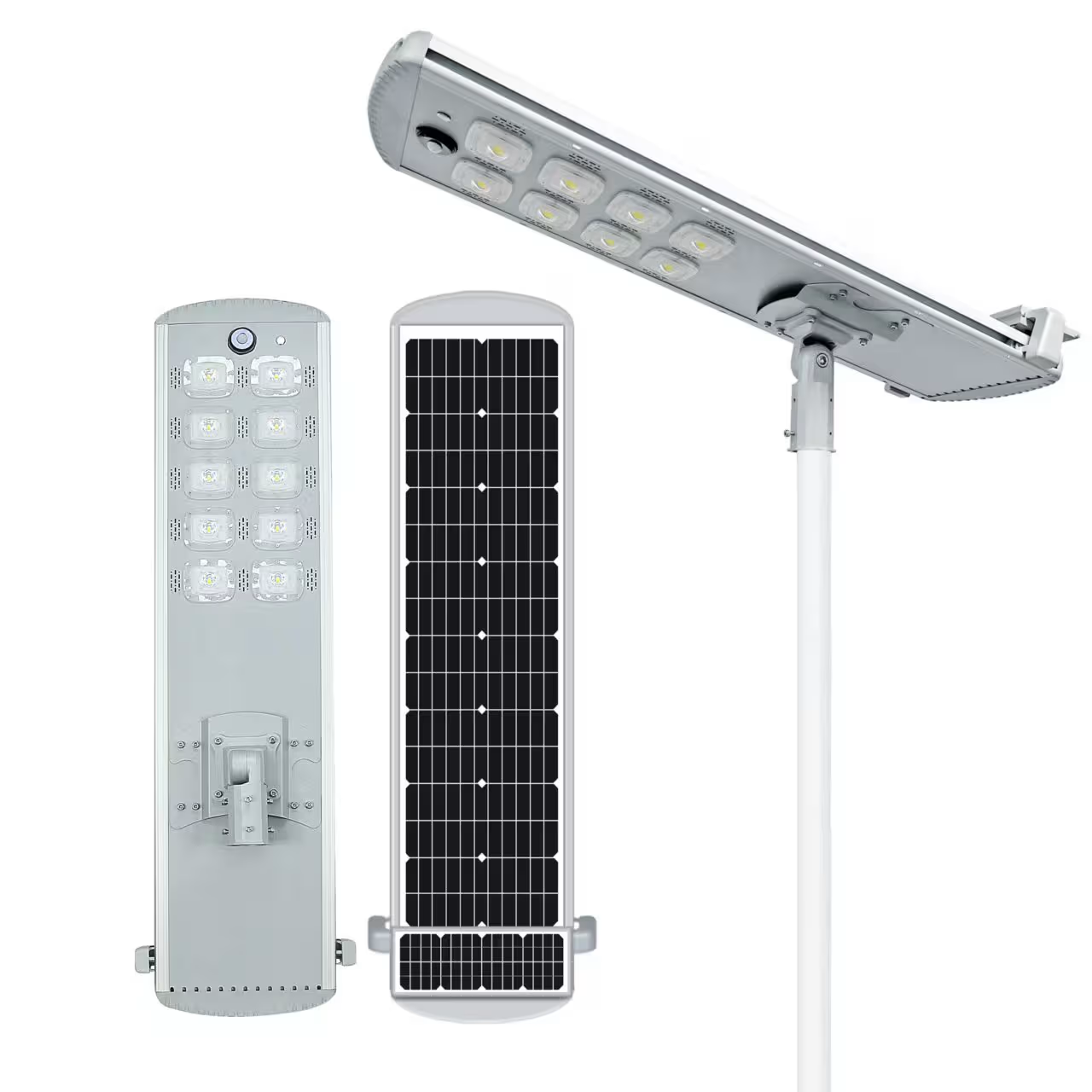
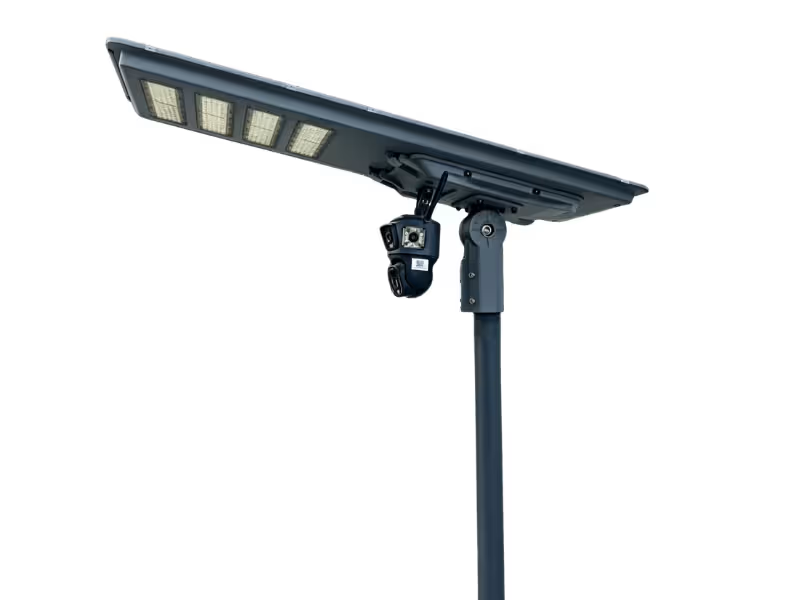
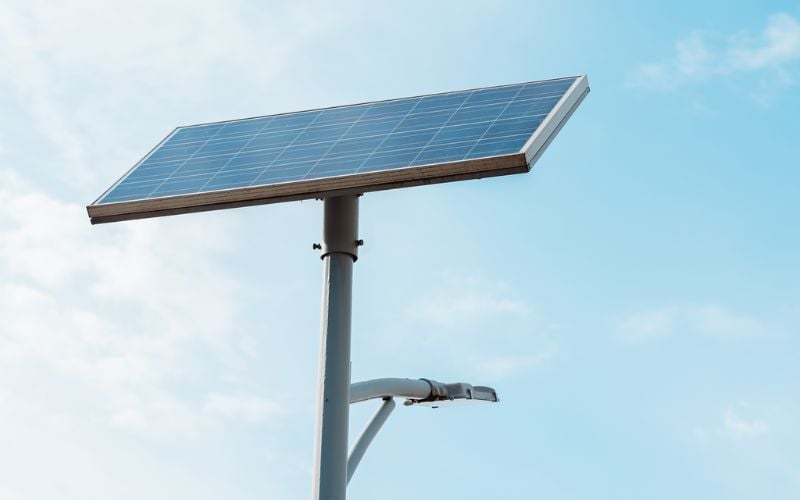
Several types of street light systems are used in cities today, each with different electrical characteristics. The most common are high-pressure sodium (HPS), metal halide, and increasingly, light-emitting diode (LED) systems. HPS lights have been the standard for decades, known for their yellowish glow. Solar-powered street lights are also emerging as a popular off-grid alternative, operating independently of the main electrical network.
The voltage and current requirements differ significantly between these systems. HPS and metal halide lights typically run on higher voltages (120V, 240V, or 277V) and draw more current to power their ballasts and lamps. An old 250W HPS light might draw over 2 amps at 120V. In contrast, an equivalent LED fixture might only use 75W, drawing less than 1 amp. Solar street lights operate on low-voltage DC systems (typically 12V or 24V), with current managed by a charge controller between the solar panel, battery, and light.
Energy efficiency and lifespan are where modern systems truly shine. LED street lights are vastly more efficient, converting more electricity into light and less into wasted heat. They can last for over 100,000 hours, significantly longer than the 24,000-hour lifespan of HPS lights. Solar street lights offer the ultimate efficiency by using zero-grid electricity, though their initial hardware costs are higher. Upgrading from HPS to LED can cut a light’s energy consumption by 50-70%.
Understanding Voltage, Current, and Power in Street Lights
There are many terms you can use to describe how electricity flows and is used by lighting fixtures. We’ve already mentioned most of them – here are a few definitions to keep things straight:
- Volts (V): Volts (short for voltage) are measures of electrical pressure. Put simply, voltage is the force pushing electricity through a circuit.
- Amps (A): Amps (short for amperes) are a measure of electrical current. Put simply, amps are the volume of electricity flowing through a circuit.
- Watts (W) and kilowatts (kW): Multiplying volts x amps gets you watts (or wattage). Put simply, watts are the rate of electricity consumption at any given moment. A kilowatt is just 1,000 watts.
- Kilowatt-hours (kWh): Lastly, kilowatt-hours are how your electric bill measures your total energy usage. Simply put, kilowatt-hours are a measure of electricity consumption over a period of time.
You can think of all of these terms like water flowing through a pipe. Voltage is the water pressure, amps are the amount of water flowing past any point, and wattage is the overall rate of water flow through the pipe. A kilowatt-hour would be the total amount of water that flowed through the pipe in one hour.
For a street light, a higher voltage doesn’t necessarily mean it uses more power. For example, a 120W LED light could run at 120V and draw 1A of current (120V x 1A = 120W). The same 120W light could also be designed to run at 240V, in which case it would draw only 0.5A (240V x 0.5A = 120W). Power consumption (wattage) is the most important factor in determining energy use.
Cost of Powering City Street Lights
When you get your monthly utility bill, you only get to see the total amount you’re charged, not how much each street light contributes to your final bill. Based on a wattage of 100 W for an average street light (amounting to 36 kWh/month if it runs 12 hours a night) and using state average electricity rates, here’s how the cost to run a single street light pans out over the course of a month and a year:
| State | Average Electricity Rate | Cost per Month (per light) | Cost per Year (per light) |
|---|---|---|---|
| California | 22.00 ¢ / kWh | $7.92 | $95.04 |
| New York | 20.59 ¢ / kWh | $7.41 | $88.92 |
| Texas | 12.56 ¢ / kWh | $4.52 | $54.24 |
| Florida | 12.21 ¢ / kWh | $4.40 | $52.80 |
| Virginia | 12.58 ¢ / kWh | $4.53 | $54.36 |
| US Average | 14.19 ¢ / kWh | $5.11 | $61.32 |
Note: Average electricity rates are based on 2021 data from the U.S. Energy Information Administration (EIA).
At face value, $60 a year per light might not seem like much. However, when a city has 10,000 street lights, that cost balloons to over $600,000 annually. This is where energy efficiency becomes critical. Switching that 100W HPS light to a 40W LED fixture would reduce the annual cost to just $24.53 per light, saving the city over $350,000 a year. Solar-powered lights eliminate electricity costs entirely, offering even greater long-term savings after the initial hardware investment is recouped.
Frequently Asked Questions About City Street Lights
What is the best time to operate street lights for energy efficiency?
The most efficient systems use photocells to turn on only at dusk and turn off only at dawn. Advanced “smart” lighting systems can also implement dimming schedules, reducing brightness during low-traffic hours (e.g., 1 AM to 4 AM) to save significant energy without compromising safety.
What size battery is needed for solar-powered street lights?
The battery size depends on the light’s wattage and the desired autonomy (the number of nights it can run without sunlight). A typical 40W solar street light might use a 12V, 100Ah lithium battery, which provides enough storage for 3-4 nights of continuous operation.
How many solar panels are required to power a street light?
This depends on the panel’s wattage and the geographic location (amount of daily sunlight). A 40W street light in a sunny location might only need a single 120W solar panel. In a cloudier region, a larger 150W or 180W panel might be required to ensure the battery stays fully charged.
How can cities save money on street lighting?
The most effective way is to upgrade outdated HPS or metal halide fixtures to energy-efficient LEDs. Implementing smart controls with dimming schedules offers further savings. For new installations or areas without grid access, investing in solar street lights eliminates all ongoing electricity costs.