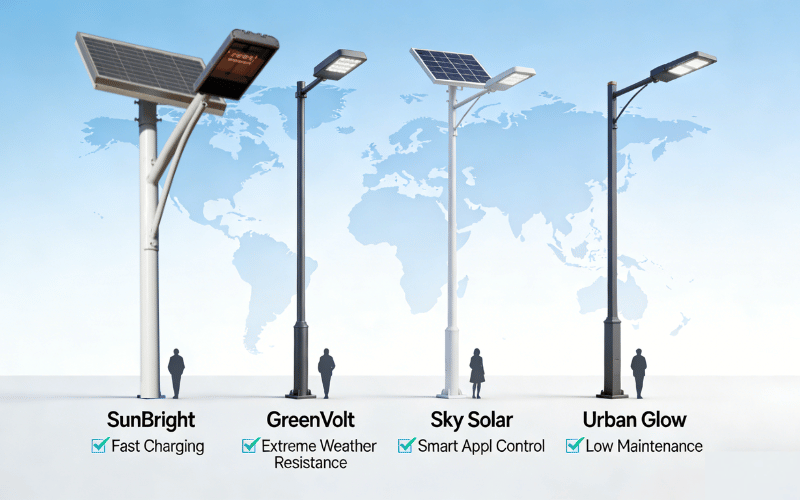
When a street light project fails, it’s almost never by chance. Often, choosing the wrong manufacturer means dealing with frequent breakdowns, fading brightness, rising maintenance costs, and even reputational damage to the project. As the solar lighting industry in 2026 shifts toward ever-higher efficiency, longer system durability, and increased demands for quality assurance, the need to choose a reliable manufacturer has never been greater. This article will help you understand why these choices matter, how you can judge quality in a crowded market, and introduce you to global leaders setting the gold standard for solar street lighting—so your investments truly illuminate the path ahead instead of casting expensive shadows.
A decade ago, buyers could get away with simple “check-the-box” spec comparisons and aggressive cost-cutting. Today, the market demands far more: robust engineering, rigorous standards, environmental sustainability, verifiable track records, and full lifecycle support. Whether you’re buying for city infrastructure, private industry, or a residential complex, making an informed choice protects your budget and reputation for years to come.
How to Evaluate Solar Street Light Manufacturers
Most buyers—new and experienced alike—are tempted to compare solar street lights by headline wattage or lumens. Brochures and polished presentations make performance look interchangeable, but the real determinants of quality and longevity run much deeper and wider. Understanding these nuances could mean the difference between a seamless installation and a maintenance nightmare. Below is a structured breakdown of the critical factors to assess when evaluating solar street light manufacturers, from core components to post-purchase support.
Core Components Quality: Batteries & Solar Panels
At the heart of any reliable solar street light is its battery, and by 2026, LiFePO4 (Lithium Iron Phosphate) batteries have established themselves as the industry’s gold standard. Their appeal extends far beyond impressive life cycles (2,000+ cycles at full depth of discharge): they also offer superior safety, stability in extreme high and low temperatures, and consistent real-world output—all critical for both urban and rural deployments. To avoid subpar alternatives, don’t just ask for “lithium batteries”; instead, insist on confirmed LiFePO4 chemistry, robust integration of a Battery Management System (BMS), and detailed documentation covering rated/usable capacity, expected cycle life, and warranty terms. Complementing a high-quality battery is a top-tier solar panel, as its efficiency directly impacts the system’s ability to harvest energy.
For 2026, leading manufacturers use solar panels with conversion rates above 22%, sourced from recognizable global brands. This high efficiency is particularly valuable in challenging environments: it allows panels to capture more energy during cloudy or low-light months, making them ideal for northern latitudes or heavily polluted urban areas where sunlight is scarce. When vetting manufacturers, always request module brand information, efficiency certification, and degradation rate benchmarks (which outline how much the panels’ output will drop each year).
Durability & Climate Adaptation: IP Ratings & Housing
Since solar street lights are exposed to the elements year-round, their ability to withstand extreme weather is non-negotiable—and global weather extremes are only becoming more prevalent. Whether deploying in humid tropics, coastal zones, dusty deserts, or chilly winters, look for enclosures with an IP66 rating (or ideally IP67). The most reputable manufacturers subject their systems to rigorous testing, including salt spray tests (for corrosion resistance in coastal areas), UV aging tests (for long-term durability in sunny climates), and vibration tests (for stability in high-wind regions). Be sure to clearly specify your climate needs and demand product datasheets with certified test protocols; avoid vague claims like “outdoor-ready” that lack documentation.
Certifications & Production Traceability
Identifying a premium manufacturer isn’t just about verifying product features—it’s about confirming documented compliance with global safety, performance, and environmental standards. For 2026, the following certifications are non-negotiable, as they provide independent validation of a manufacturer’s claims:
- CE (European Conformity): Confirms compliance with EU safety, health, and environmental requirements.
- RoHS: Restricts the use of hazardous substances in electrical equipment, ensuring environmental and human safety.
- UL (Underwriters Laboratories): The gold standard for safety in North America, validating product reliability.
- DLC (DesignLights Consortium): A performance benchmark for North America, often required for utility rebates.
- SGS/TÜV Field Test Reports: Independent lab verification of claimed specifications, adding an extra layer of credibility.
Always ask for digital scans of these certificates, verify their authenticity on the issuer’s official database, or request direct contact with certification officers if in doubt—especially for large public tenders where compliance is critical. Beyond certifications, a world-class solar street light supplier maintains strict system discipline throughout the production process. This includes rigorous incoming component inspection (to weed out faulty parts), traceable batch records (to track each product’s origin), multi-stage aging and illumination testing (to ensure long-term performance), and clear digital records for accountability. Equally important are robust warranty and after-sales processes—documented in writing. To assess this, ask for real-life case studies: “How did you handle the last major claim or recall?” Look for specific, actionable responses rather than empty reassurances.
Certifications Quick Reference Table
| Certification | Relevance | What to Ask For |
|---|---|---|
| CE, RoHS | EU safety/environmental compliance | Certificate & serial # |
| UL, DLC | US performance/safety, utility rebates | UL File #, DLC listing |
| ISO 9001, ISO 14001 | Quality & environmental management systems | Copy with expiration date |
| SGS, TÜV | Independent lab verification | Test report PDF |
The value of prioritizing certified, high-quality manufacturers becomes clear in real-world applications. For instance, a South American city recently finalized a contract for high-profile urban lighting. Two competing vendors submitted similar brochures, but only one provided full battery cycle testing from SGS, detailed IP66 housing specifications, and documentation of an active recycling program for aluminum components and batteries. Three years into the deployment, the city is saving 30% annually on maintenance and replacement costs—an ROI driven largely by the certified manufacturer’s transparency and proactive environmental compliance planning from the start.
Project Adaptability & Regional Support
Not all solar street light manufacturers excel in every application. Depending on your project’s focus—whether industrial, decorative, rural, or “smart city”—you’ll need a manufacturer with expertise in that specific vertical. When evaluating vendors, ask not only for flagship installation photos but also about the technical customization done for each project: Is the system upgradable? Can it integrate with data platforms? Does it support accessories such as motion sensors or Wi-Fi modules? The best manufacturers adapt their solutions to your project’s unique needs, rather than forcing you to compromise on requirements.
Beyond project adaptability, regional delivery, logistics, and post-purchase support are often overlooked—yet they can make or break a project. For time-sensitive deployments (such as weather-urgent installs) or phased government rollouts, quick delivery may be more critical than small cost differences. Additionally, local warehousing, established installation partners, and accessible technical support minimize downtime, prevent missed deadlines, and ensure that warranty claims are resolved efficiently. Avoid manufacturers that only offer factory-only support or slow remote response times, as these can lead to costly delays and frustrated stakeholders.
Quality Criteria Summary: What to Check & Avoid
| Criteria | What Strong Manufacturers Provide | Common Red Flags |
|---|---|---|
| Battery | LiFePO4, BMS, >2,000 cycles, real capacity | Unbranded, “lithium” without detail |
| Panels | >22% efficiency, named brands, test data | Generic/no-brand, no test info |
| IP Rating | Certified IP66/IP67, field test reports | “Outdoor” with no documentation |
| Certifications | CE, UL, DLC, RoHS, lab reports | Claims with no verifiable proof |
| QC & Traceability | Full digital records, recall procedures | “We test all” with no specifics |
| Regional Support | Warehousing, technical teams, fast shipping | Factory-only, slow remote response |
| Environmental Programs | Accredited battery/aluminum recycling | No EPR or recycling transparency |
Top 10 Best Solar Street Light Manufacturers in the World (2026)
When buyers and consultants shortlist top brands, it’s not about “who’s biggest” but “who delivers,” across specs, reliability, and support for each target market. This year’s global list showcases vertical market leaders, regional specialists, and brands that set the benchmark for next-gen solar street lighting. Each profile reflects real differentiators—so you can match partner to project, not just chase a logo.
|
Brand |
Region |
Niche/Strength |
Standards & Certifications |
Ideal Projects |
|---|---|---|---|---|
|
France |
IoT-ready, advanced smart/connected city solutions; patented optics |
CE, IP66, ISO9001, UL tested |
Premium cities, integrated grids, data-sensitive installs |
|
|
China |
Innovation-driven, IoT solar/LED, Straits Exchange Center listed |
CE, RoHS, UL, DLC, SGS/ISO9001 reports |
Urban, industrial, hybrid smart grid |
|
|
France |
Scale/highway systems, custom engineering |
CE, ENEC, ISO14001, ISO45001 |
Intercity, highways, gridless rural roads |
|
|
France |
Municipal focus, project customization, agile service |
CE, RoHS, ISO9001 |
Parks, residential precincts, walkways |
|
|
Bulgaria |
Decorative/architectural, residential, and commercial |
CE, IP67, custom EU lab |
Plazas, resorts, high-end housing, parks |
|
|
USA |
Broad North American range, utility rebates, quick customization |
UL, DLC, BuyAmerica, ISO9001 |
Campuses, retail, parking, commercial |
|
|
UK |
Grid-tied/solar hybrid, tailored for mixed infrastructure |
CE, UKCA, RoHS, local certifications |
Mixed developments, public transit, UK/EU parks |
|
|
USA |
Plug/play modularity, premium North American performance |
ETL, DLC, EnergyStar, ISO9001 |
Resorts, city campuses, public spaces |
|
|
USA |
Heavy-duty, custom optics, rapid deployment |
UL, BuyAmerica, IP65, field-tested |
County roads, municipalities, and industrial parks |
|
|
Ireland |
Harsh climate/corrosion resistance |
CE, RoHS, ISO14001 |
Coastlines, public sector, custom green projects |
Below, the manufacturer highlights by specialty and market focus—with expanded detail for practical decision making:
- Sunna Design (France): Famous for its smart-city backbone, Sunna’s patented optics, advanced light management, and IoT integration make it ideal for forward-thinking governments. Their systems support remote monitoring and grid integration, with a strong track record across EU capitals.
- Sigoled Light and Solar Energy Co., Ltd. (China): China’s high-tech leader, recognized for advanced solar LED, IoT controls, plus hybrid systems for both grid-linked and island solutions. Noteworthy are their in-house R&D, third-party lab validation, and stock exchange listing, which provide financial transparency. Best-fit for cities prioritizing data integration or infrastructure scale.
- Fonroche Lighting (France): Specializes in highway and enterprise-scale public lighting—robust engineering, modular customization, proven for rugged locations and new grids where long-term reliability trumps all.
- Novea Energies (France): Municipal/urban projects that need tailored advice and after-sales support. Novea shines in attention to detail, service, and custom fit for smaller or heritage locations.
- VNS Bulgaria (Bulgaria): The EU’s go-to for decorative and architectural solar—bespoke designs for city squares, luxury developments, and ultra-competitive mid-sized commercial jobs, all with traceable certification.
- Greenshine New Energy (USA): North American commercial giant, delivering everything from retail to large campuses—famed for short lead times, rapid customization, and full documentation for utility rebates.
- Sunlite Group (UK): Experts in hybrid and grid-tied solutions—making them well-suited to the UK/EU market with mixed solar/grid needs and challenging regulatory requirements.
- First Light Technologies (USA): Champion of modular and scalable urban and campus projects—plug-and-play install, minimal maintenance, and top US certifications.
- Solar Street Lights USA (USA): Respected for rugged, rapidly deployable solutions for cities, counties, and industrial parks where uptime is non-negotiable.
- SolarPath Sun Solutions (Ireland): Real leaders in corrosion and climate-resistant lighting for the toughest coastal or exposed projects—impressive green track record.
Also Read: What are the top 10 solar street light companies in the USA?
How to Avoid Common Pitfalls When Purchasing Solar Street Lights
Even top supplier lists can’t protect you from project-specific mistakes or the fine print. Here’s a step-by-step playbook for avoiding the classic mistakes—even as standards rise in 2026.
- Don’t Let Brochures Fool You: Brand glossies are only a starting point. Insist on third-party certified data for energy output, battery lifespan, panel efficiency, and protection ratings. If you see generic “lithium” or “IP65” claims without validation, keep looking.
- Demand Apples-to-Apples Comparison: Never compare incoming proposals until you’ve standardized your RFQ: pole height, road width, sun hours, IP rating, battery chemistry, lighting profile (e.g., 3h at 100%, 9h at 30%). See the table below for a model template.
- Scrutinize Warranty Terms and After-Sales: Obtain written warranty documents that specify coverage for batteries, controllers, and panels. Clarify how claims are handled, replacement timelines, and if parts are stocked locally.
- Factor in Shipping and Local Support: Air vs. sea freight, duties, customs risk, and regional warehousing can swing your cost of ownership more than a simple price discount. Choose suppliers with proven local partners or in-region technical support.
- Check for Environmental and Compliance Risks: For government and corporate buyers, environmental liabilities matter as much as contract price. Make sure battery and recycling programs are in place, and demand documentation up front.
RFQ & BoM Template for Transparent Quotes
| RFQ Parameter | Example Value | Influence on Design |
|---|---|---|
| Road width/pole height | 8m/7m | Optics, layout, spacing |
| Sun hours (worst month) | 3.0 | Panel & battery sizing |
| Battery/chemistry requirement | LiFePO4, 100Ah deep cycle | Autonomy, longevity |
| Panel efficiency | ≥22%, brand-model listed | Output, panel size |
| IP Rating | IP66 (min) | Environmental durability |
| Certifications | CE, UL, DLC, RoHS, etc. | Bid compliance, insurance/rebates |
| Lighting profile | 4h 100% + 8h 30% | Runtime, energy use |
| Warranty/after-sales | 3-5 years, local stock | Risk, downtime, reliability |
Scenario: A recent government installation in Asia required delivery against a tight deadline during the rainy season. Choosing a manufacturer with a strategic local warehouse reduced logistics headaches, and their contract-mandated local service agent reduced downtime after storm-related failures. Independent lab reports (SGS) on both battery cycles and panel degradation enabled the end user to forecast replacement schedules and recycling-fee budgets in advance—outperforming a rival bid by 11% in total cost of ownership after two years.
Environmental Impact and Sustainability Metrics
Sustainability is moving from a “nice-to-have” to a project requirement for all quality tenders. Green metrics, recycling compliance, and carbon savings are shaping which manufacturers win major contracts in 2026.
- Recyclability: Look for manufacturers that offer take-back or guidance programs for aluminum housings (usually >90% recyclable) and for safe glass recycling streams.
- Battery End-of-Life Solutions: Tier-one suppliers provide documentation and shipping labels for lithium battery recycling, offer deposit/refund options, or partner with certified e-waste channels.
- Carbon Credits and Corporate ESG: Leading brands help clients generate or monetize carbon credits by documenting the CO2 savings from their solar installations. For municipal buyers, this can directly boost annual ESG (Environmental, Social, Governance) scores and meet public procurement regulations.
- Lifecycle Transparency: The most competitive suppliers share full lifecycle impact analyses—covering material sourcing, energy use, emissions, and recyclable content. Ask to see recent “green project” references and independent environmental audit certificates.
By specifying environmental requirements at the RFQ stage and asking for ongoing reporting, you gain a valuable edge in both regulatory compliance and community relations.
Frequently Asked Questions (FAQs)
How long will a commercial solar street light last in 2026?
Top-tier products (especially LiFePO4 batteries and high-quality LEDs) will regularly achieve an 8–12-year service life with proper maintenance.
What is the typical warranty period for tier-one suppliers?
Expect at least 3-5 years of comprehensive coverage. Some brands extend warranties specifically for batteries and control systems if clients request.
Do solar street lights work in regions with low winter sun?
Absolutely—with the right design. High-efficiency panels, oversized batteries, and intelligent controllers can maintain autonomy for up to a week. Always supply your supplier with precise latitude and historical weather data.
Which battery chemistry is considered best for 2026 solar projects?
LiFePO4 (Lithium Iron Phosphate) remains the top choice and the new industry standard for its deep cycle performance, long life, and safety profile.
How can I verify a manufacturer is a real OEM and not just a trading company?
Request direct factory audit certificates, detailed BoM (bill of materials) including component brands, videos from the production line, and references from existing customers. OEMs with pride in their work will answer confidently and share paperwork without prompts.
What certifications matter most for quality and rebates?
CE and RoHS for European/EU projects; UL/DLC for North America; ISO 9001/14001 for quality and environmental management.
How do I compare “all-in-one” lights versus modular systems?
All-in-one systems offer rapid deployment and compact installations—ideal for small projects, residential, and low-maintenance zones. Modular (separate-component) systems are favored for industrial/commercial use and for areas where upgrades may be needed.
Conclusion
Choosing the best solar street light manufacturer in 2026 means looking beyond price tags toward system value—battery and panel quality, certification rigor, support, and an honest track record all count. Demand proof at every stage: real data, real audits, real service. Shape your RFQs to force fair comparisons, insist on third-party validation, and ask about both logistics and after-sales for your specific geography.
In a market where sustainability, reliability, and regulatory compliance are non-negotiable, the right partner should not only satisfy specs today but also future-proof your investments for the next decade. Use this guide and shortlist to navigate the expanding solar lighting landscape with clarity and confidence—your reputation, customers, and bottom line depend on it.