
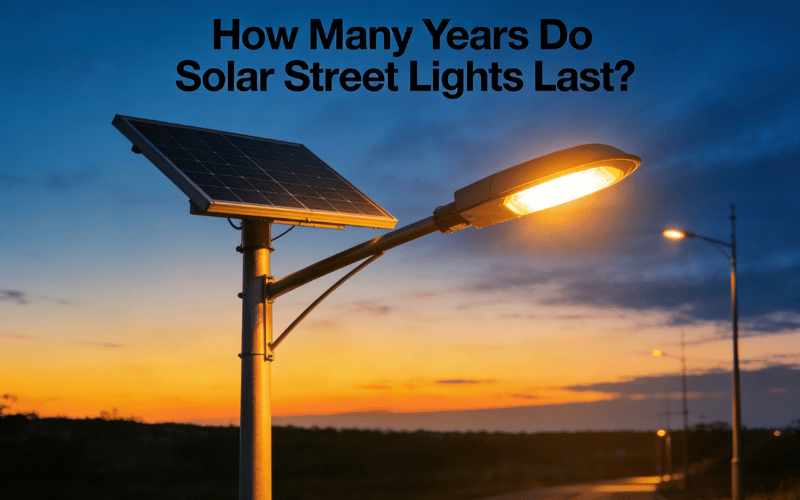
As solar street lights become more popular for sustainable outdoor lighting, many project managers and city planners want to know: How long do they last? While the lifespan varies by component and environmental factors, modern solar street lights are designed to provide reliable performance for years, often exceeding the longevity of traditional grid-powered lighting.
Solar Street Lights: The Basics
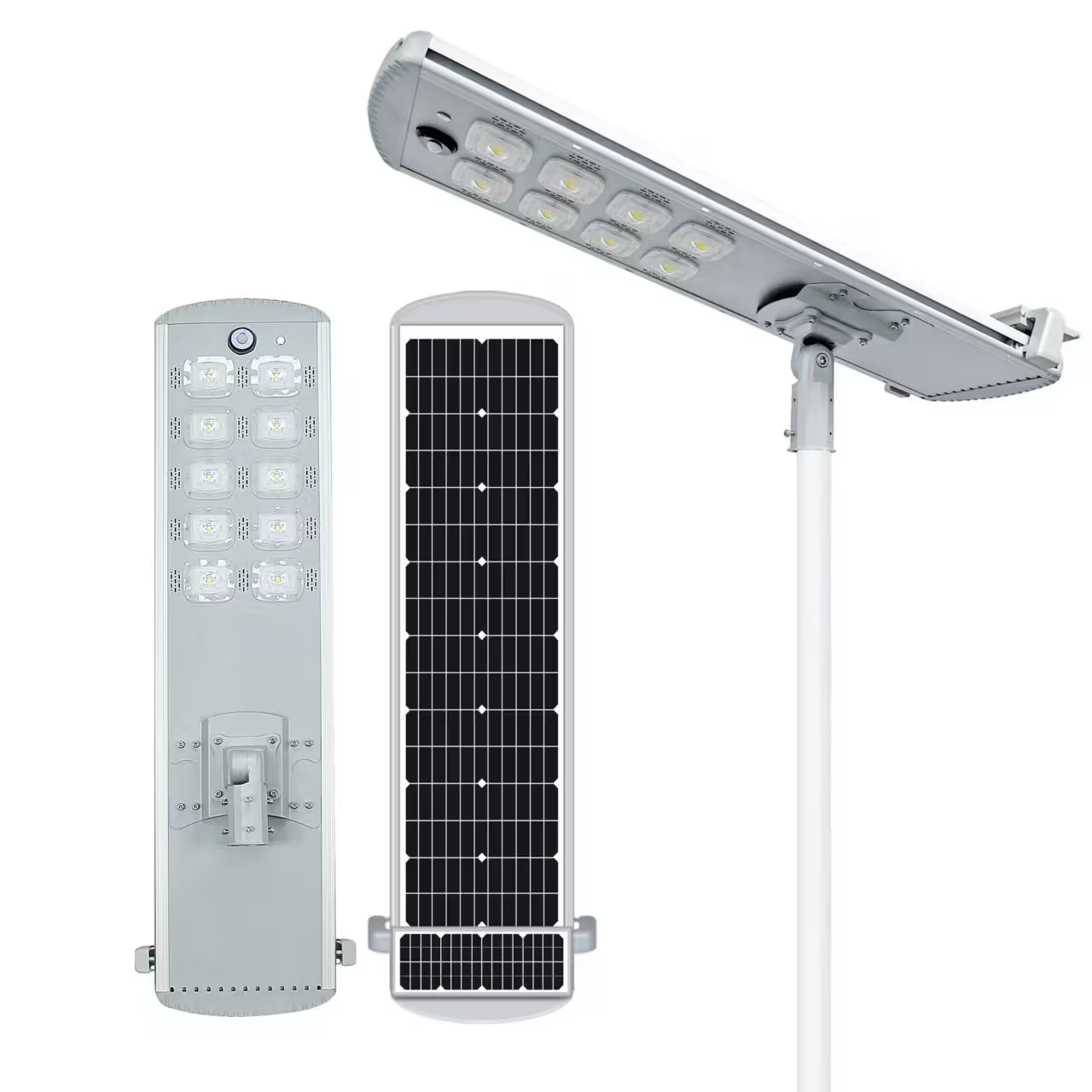
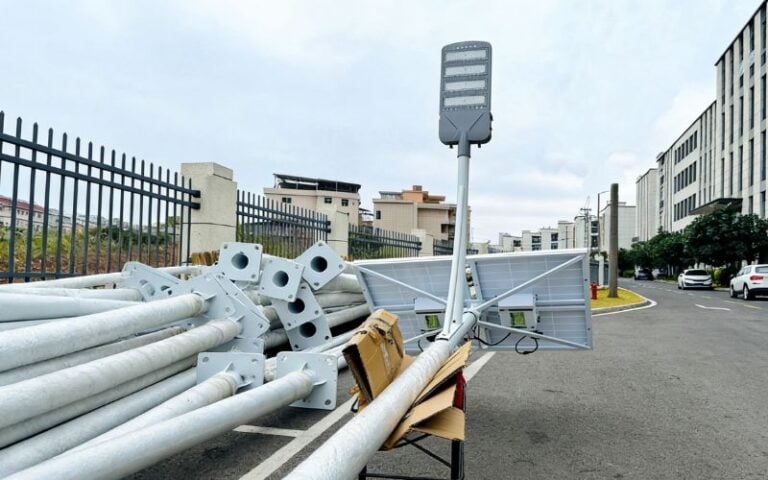
Solar street lights are powered by photovoltaic (PV) panels, which are more efficient and durable than ever before. A complete system consists of the solar panel, a rechargeable battery (often lithium-ion), the LED fixture, and a charge controller. The controller manages the flow of energy, ensuring the battery charges efficiently during the day and powers the light effectively at night.
Because solar lights are powered by their own self-contained energy system, they are far more straightforward and efficient than traditional lights that require trenching and connection to the electrical grid. As solar technology has decreased in cost significantly over the last few decades, experts believe that solar lighting will soon be as cheap to install as conventional lighting.
How Do Solar Street Lights Degrade?
Solar street light components typically degrade due to temperature, cycles, and time. Storage and operating temperatures significantly impact battery longevity; in general, very hot climates negatively affect the lifespan of a solar battery. As the battery goes through charge cycles—discharged at night and charged back up during the day—it slowly loses its maximum potential. However, simply not using the light does not mean it will last forever: calendar degradation is the battery losing life over time.
Recent findings on battery performance in real-world conditions have shown that innovative management systems can significantly slow degradation. Unlike simple consumer solar lights, commercial-grade systems use advanced controllers that prevent overcharging and deep discharging, dramatically extending the battery’s operational life. Your solar street light is most likely to experience temperature or calendar degradation over physical wear.
How Long Do Solar Street Lights Last?
Solar street light systems typically last 15–25 years, depending on climate, component quality, and maintenance practices. Most manufacturers guarantee the solar panel for 20-25 years, the battery for 5-8 years, and the LED fixture for over 50,000 hours of use. High-quality lithium batteries often come with warranties for 5-7 years.
As solar component manufacturing becomes cheaper, companies can build systems with larger panels and higher-capacity batteries, which, in turn, increase their autonomy and reliability. Additionally, improved technology reduces battery and LED degradation, meaning that over time, their maximum potential stays closer to their original state.
These improvements suggest that manufacturers can optimize their charge controllers and operating software to further extend component longevity based on actual weather patterns and usage.
Because newer batteries already have significantly longer cycle life, they will still maintain better performance than batteries from just a few years ago. Finally, because solar systems are modular, you rarely need to replace the entire fixture as it degrades. Instead, you can save money by simply replacing the battery pack when it reaches the end of its life.
How Does Solar Street Light Longevity Compare to Traditional Street Lights?
Solar street lights now last as long as, or longer than, traditional street lights. Recent studies show modern solar lights can reach lifespans of 15–20 years before central component swaps, often matching or exceeding the average lifespan of high-pressure sodium or metal halide fixtures, which require frequent bulb and ballast replacements.
On average, a high-quality lithium solar battery only degrades at a rate of 2-3% of maximum capacity per year. This means the average solar street light system could potentially last over a decade before needing a battery replacement, far outlasting the re-lamping cycle of a typical traditional light. This significant increase in expected longevity makes the value proposition of solar lighting even more compelling.
|
Aspect |
Solar Street Lights |
Traditional Street Lights |
|---|---|---|
|
Average lifespan |
15–20 years (fixture & panel) |
10–15 years (fixture housing) |
|
Component durability |
Panels last 20+ years; batteries 5-8 years |
Bulbs/ballasts need replacement every 3-5 years |
|
Maintenance needs |
Low maintenance (panel cleaning, battery swap) |
Higher maintenance (bulb changes, electrical repairs) |
|
Reliability trend |
Improving rapidly with better battery tech |
Mature technology, but prone to grid outages |
|
End-of-life factors |
Battery health and replacement cost |
Ballast failure, wiring issues, bulb burnout |
And the future looks even brighter: some manufacturers are already promising greater efficiency and longer battery life, with some new battery chemistries aiming for a 10-year lifespan.
How to Extend the Lifespan of Solar Street Lights
While solar street lights are already durable, there are specific actions owners can take to extend the system’s lifespan further. These include:
Follow Manufacturer Guidelines
First, it is essential to follow your light’s specific guidelines for optimal performance and to keep the system’s programming up to date. Because each manufacturer may use different battery chemistries and management systems, each will have its own set of optimal operating instructions.
Maintain Moderate Temperatures
Systems with well-ventilated battery enclosures retain battery life better by maintaining lower operating temperatures. In general, installing and operating your solar lights in areas with good airflow is an effective way to extend battery life. Even if you live in a warmer climate, ensuring the battery isn’t in a sealed, unventilated box helps.
Clean the Solar Panels
While occasional cleaning is all that’s needed to keep the panel free of heavy dust, pollen, or snow, it will ensure the battery charges efficiently. An inefficient charge can strain the battery over time. Luckily, rain is often enough to keep panels clean, but an annual check-up can help ensure optimal performance and less battery degradation.
The Second Life of Solar Street Light Components
One of the most exciting aspects of solar lighting for eco-conscious consumers is that its components can still serve a sustainable purpose after replacement. Even as they lose efficiency for lighting (usually at 70-80% of their maximum charge potential), these powerful batteries retain enough life to be used for smaller, secondary energy storage applications.
Some manufacturers even collect or buy back used batteries to sustainably power other projects or ensure they are properly recycled. You can feel secure in knowing that the sustainability of your solar light continues long after its components are replaced.
Solar lighting systems continue to decrease in cost, provide more light per watt, and retain longer lifespans. Experts already suggest that solar components will outlast traditional lighting systems, and the technology continues to improve. It’s all good news: Your solar street light will serve your needs for years to come, and its parts can even be sustainably recycled after their life powering your light.
About SigoStreetLight
SigoStreetLight is the comprehensive solar lighting platform for projects of all sizes to build, run, and scale their renewable energy lighting. Trusted by municipalities, developers, contractors, and more, we’ve delivered solar lighting solutions for global businesses that illuminate countless communities!
Learn about our solar street light products, explore our lighting solutions, and contact our team today
Sources