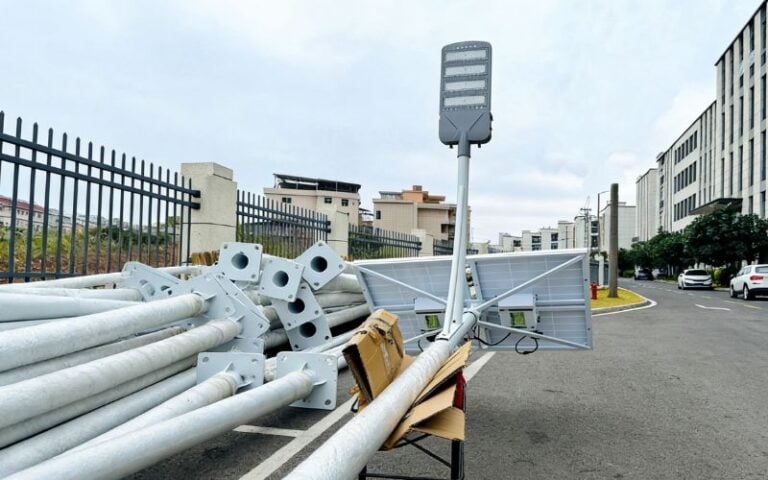

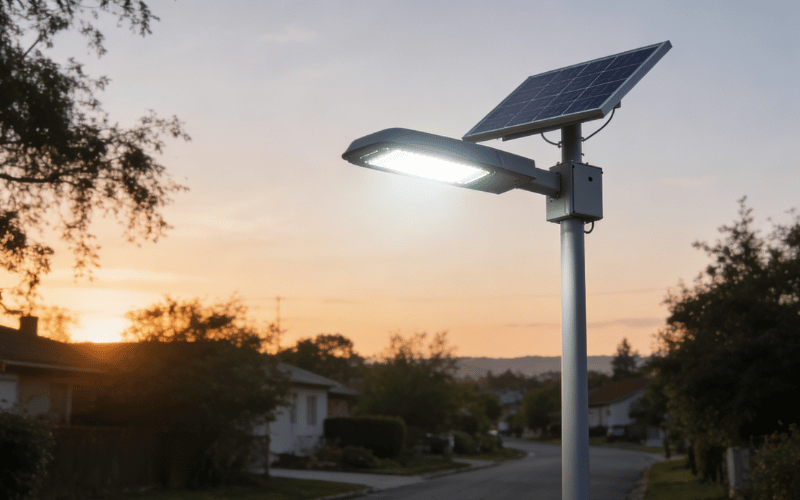
Solar street lights are becoming a common sight in neighborhoods, parks, and along roadways. They represent a smart, sustainable way to illuminate our public spaces. As this technology grows in popularity, some interesting questions arise. One of the most common questions is whether these lights can function without the batteries that store their power. It seems like a simple “direct supply” model could work, but the reality is more complex. Let’s explore why batteries are a critical part of a reliable solar lighting system.
Why Can’t Solar Panels Be Directly Connected to Street Lights?
It might seem logical to connect a solar panel directly to a light. Fewer parts, simpler wiring—what could go wrong? Unfortunately, this direct connection can cause significant damage and degrade performance. The sun’s intensity is not constant, and a direct link between the panel and the light (or a battery, for that matter) creates serious issues. It can push voltage far above safe limits during peak sun and allow current to flow backward at night, which shortens the life of the system’s components.
I often see this problem in small, DIY garden lighting projects. A standard 12-volt solar panel can produce 18-22 volts in strong sunlight. If this is fed directly to a 12V battery, it causes overcharging. The battery overheats, its internal components degrade, and its lifespan is drastically reduced. At night, the panel’s voltage drops below the battery’s, causing electricity to flow back into the panel. This slow, hidden discharge drains stored energy and generates unnecessary heat.
Here are the key problems with a direct connection:
- Overcharging: Excess voltage from the panel damages the battery, whether it’s a traditional lead-acid or a modern lithium iron phosphate (LiFePO₄) model. This leads to corrosion, electrolyte loss, and potential failure.
- Reverse Current: At night, power drains from the battery back into the solar panel. While the loss each hour is small, it adds up daily and prevents the light from lasting through the night.
- Inefficient Charging: Without an intelligent controller, the battery doesn’t receive a proper staged charge. After a few cloudy or rainy days, it won’t have enough power to run the light effectively because the charging process was not optimized.
A dedicated charge controller is the essential “smart gate” between the panel and the battery, preventing these problems.
The Role of Charge Controllers in Solar Street Light Systems
A charge controller is the brain of a solar street light. Its primary job is to regulate the voltage and current coming from the solar panel to the battery, ensuring the battery is charged safely and efficiently. It also prevents the reverse current flow at night, protecting the battery from being drained.
The standard wiring layout for any reliable solar power system is straightforward: the solar panel connects to the charge controller, the controller connects to the battery, and the battery (often via the controller’s load terminals) powers the light. When setting up the system, it’s crucial to connect the battery to the controller first. This allows the controller to detect the system’s voltage (e.g., 12V or 24V) before the power from the solar panel is introduced.

By managing the flow of energy, a charge controller provides staged charging, which optimizes battery health and longevity. It protects against overcharging, deep discharging, and reverse current, making the entire system more reliable. For systems used in Sigostreetlight projects, the controller is typically housed in a sealed box near the battery, with appropriately sized cables to minimize voltage drop and maximize efficiency.
|
Component |
Role |
Notes |
|---|---|---|
|
Solar panel (PV) |
Source of DC power |
Must be sized to generate enough power, even during shorter winter days. |
|
Charge controller |
Protect and optimize |
Acts as the system’s brain, protecting the battery and managing energy. |
|
Battery |
Store energy |
Chemistry (lead-acid vs. LiFePO₄) is chosen based on budget and desired lifespan. |
|
Load (lamp/driver) |
Use energy |
The lamp and its driver must match the system’s voltage and current. |
|
Protection |
Safety |
Fuses and breakers are essential for protecting the PV and battery leads. |
PWM vs MPPT Controllers: Which One to Choose?
When selecting a charge controller, you will encounter two main types: Pulse Width Modulation (PWM) and Maximum Power Point Tracking (MPPT).
PWM controllers are the simpler and more affordable option. They work by gradually reducing the power delivered to the battery as it approaches full charge. They are a good choice for smaller systems with stable sunlight conditions, where the solar panel’s voltage closely matches the battery’s voltage.
MPPT controllers are more advanced and more expensive. They actively track the solar panel’s maximum power point, which fluctuates with sunlight and temperature. By doing so, they can harvest 15–30% more energy from the panel compared to a PWM controller. This makes them ideal for larger systems, areas with variable weather, or when the panel voltage is significantly higher than the battery voltage.
When I prepare a bid, I often present both options. The choice comes down to a simple trade-off: PWM saves money up front, while MPPT delivers better performance, longer battery life, and greater reliability, especially in bad weather.
|
Feature |
PWM Controller |
MPPT Controller |
|---|---|---|
|
Cost |
Low |
Higher |
|
Energy Gain |
Basic regulation |
15–30% more energy |
|
Best Use |
Small kits, stable sun |
Larger loads, unstable weather |
|
Panel Voltage |
Must match battery voltage |
Can step down higher voltages |
Matching Voltage and Current for Optimal Performance
Building a reliable solar street light system depends on choosing parts that work together harmoniously. Matching the panel, controller, and battery voltages and currents is essential. Using mismatched components is a recipe for failure, even with a high-quality controller.
Here is a step-by-step guide to matching your components safely:
- Start with the battery voltage. This is the foundation of your system, typically 12V, 24V, or 48V.
- Choose a compatible solar panel. The panel’s voltage (Vmp and Voc) must be compatible with the controller and battery system.
- Size the charge current. A quick way to estimate the charge current is to divide the panel’s wattage by the battery’s voltage (e.g., a 200W panel on a 12V system produces about 16.7A). Ensure your controller can handle this current.
- Account for cold weather. A panel’s open-circuit voltage (Voc) increases in the cold. Make sure your controller’s maximum PV input voltage can handle this potential spike.
- Set low-voltage disconnects (LVD). This feature on the controller prevents the battery from being depleted too deeply, a common cause of premature battery failure.
I once consulted on a coastal site where the client had connected a 24V lamp to a 12V panel with no controller. The light flickered and failed within two weeks. We fixed it by installing two panels in series (to create 24V), adding an MPPT controller, and setting proper cutoffs. The system stabilized immediately. The lesson is clear: match your voltages, use a controller, and check your numbers before installation.
|
Battery Nominal Voltage |
Typical Panel Voc (Cold) |
Controller Type |
Quick Current Math (Panel W ÷ V) |
|---|---|---|---|
|
12 V |
18–22 V |
PWM or MPPT |
200 W ÷ 12 ≈ 16.7 A |
|
24 V |
36–44 V |
MPPT preferred |
300 W ÷ 24 ≈ 12.5 A |
|
48 V |
72–88 V |
MPPT |
600 W ÷ 48 ≈ 12.5 A |
Can Solar Street Lights Work Without Batteries?
So, can solar street lights work without batteries? The simple answer is no. A solar street light needs to work at night, when the sun is not shining. Without a battery, there is no way to store the energy collected during the day for use after dark. Batteries are essential for providing reliable, consistent illumination.
Furthermore, a well-designed system with a battery and a charge controller operates more efficiently and lasts much longer. The battery provides a stable power source for the light, while the controller protects the battery from the solar panel’s fluctuating output. Attempting to run a light directly from a panel will only lead to poor performance and damaged components. For a solar street light to function as intended, a battery is not just an accessory—it’s a necessity.