
When it comes to solar street lights, many people assume that higher wattage automatically means a brighter light. In reality, the situation is much more complex. Let me help clear up some confusion.
The brightness listed for many solar street lights, especially on retail sites, often focuses on wattage instead of lumens. The actual brightness depends on multiple factors working together.
Having worked on countless projects over the years, I often see customers surprised when a high-wattage light doesn’t perform as expected. Many solar lights are marketed with high wattages, but what truly matters is the lumen output, the LED chip’s efficiency, and the battery’s health. A well-designed 30W light can easily outperform a poorly designed 50W one. This doesn’t mean wattage is useless; it just means it’s not the whole story.
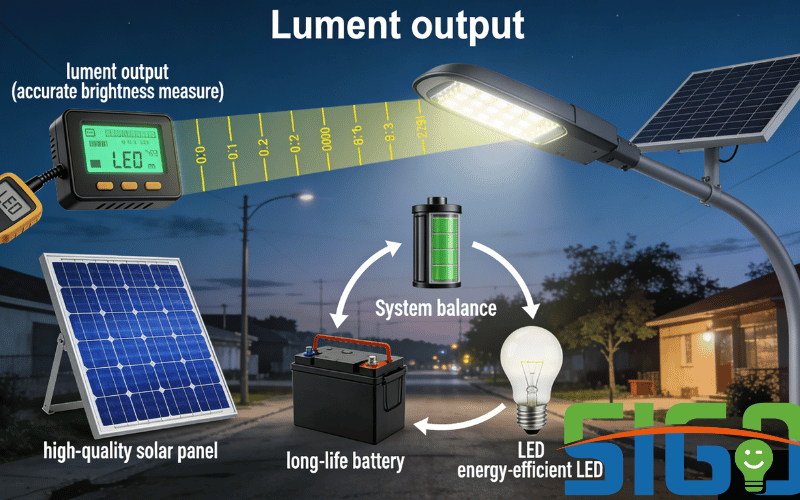
What I always tell clients is that focusing solely on wattage can be misleading, especially for projects that require consistent, reliable illumination. What you actually need to focus on is the lumen output (the accurate measure of brightness), the quality of the components, and how the entire system is balanced.
How Does LED Wattage Impact Brightness?
The short answer is: wattage is only part of the story. Many online listings for solar lights display inflated wattages. For example, you might see a light advertised as 100W, but its actual power consumption might only be 10-15W.
Advertised wattage is often misleading, with actual power consumption being significantly lower. Lumens, not watts, are the accurate measure of brightness.
It’s crucial to understand that wattage measures energy consumption, not brightness. The actual light output is measured in lumens. A high-efficiency 10W LED can be brighter than a low-efficiency 15W LED. This discrepancy is common in consumer-grade lights designed for small-scale use, not for professional lighting installations.
If you want to install solar street lights that provide sufficient illumination for streets or parking lots, it is better to work with a specialized supplier like Sigolight. We have spent over a decade customizing solar lighting systems for large projects, so we understand real-world performance needs. For robust solutions, you need to check the verified lumen output and the system’s ability to last all night.
For example, a light advertised as 100W might actually deliver only 10-15W of power. The lumen output, a better measure of brightness, will typically be around 1,500 lumens for a high-quality 15W light. This is great for a residential driveway but insufficient for a public street.
Here’s a quick comparison to illustrate the difference:
|
Advertised Wattage |
Actual Power (Approx.) |
Typical Application |
Lumen Output (Approx.) |
|---|---|---|---|
|
50W |
5-10W |
Garden/Pathway |
800-1,200 lumens |
|
100W |
10-15W |
Driveway/Yard |
1,500-2,200 lumens |
|
200W |
15-25W |
Small Parking Area |
2,200-3,500 lumens |
This table clearly shows the typical gap between advertised and actual power, and the resulting brightness. While a light might claim to be 200W, it often isn’t powerful enough to light up a large area effectively.
The Role of Solar Panel Efficiency in Brightness
I’ve noticed that many people overlook the solar panel when diagnosing why a light is dim, but it’s just as crucial as the battery or LED.
An inefficient or undersized solar panel cannot fully charge the battery, resulting in reduced brightness and a shorter runtime.
I’ve seen this happen many times, especially in regions with frequent cloudy weather. If the solar panel isn’t efficient enough to capture adequate energy on overcast days, the battery won’t have enough power to keep the light at full brightness all night. Over time, this constant undercharging degrades the battery and permanently dims the light.
In my experience, this is often a sign of a poorly designed system. I recommend clients ensure their solar panel is appropriately sized for their geographic location and the power needs. Using high-efficiency monocrystalline panels can make a significant difference, as they perform better in low-light conditions than polycrystalline panels.
|
Panel Quality |
Charging Performance (Cloudy Day) |
Impact on Brightness |
|---|---|---|
|
High-Efficiency |
Moderate charge |
Maintains brightness for longer |
|
Standard-Efficiency |
Low charge |
Noticeable dimming after a few hours |
|
Low-Quality/Undersized |
Minimal to no charge |
Light is very dim or fails to turn on |
This table provides a simple guide to how panel quality affects brightness. I always remind my clients that investing in a high-quality, correctly sized solar panel is essential for reliable, long-term performance.
How Battery Capacity and Charge Levels Influence Brightness
I’ve noticed that many people don’t realize that even a high-quality LED will appear dim if its battery is undersized or not fully charged.
As a battery’s charge decreases, its ability to deliver consistent power drops, resulting in a lower light output and reduced brightness.
I’ve seen this happen many times with both residential and commercial projects. If the battery capacity is too small for the LED’s power draw, it will deplete quickly, and the light will dim, especially toward the end of the night. A system can’t maintain full brightness if its energy storage is insufficient.
In my experience, this is often a sign of an imbalanced system. I recommend that clients ensure their battery capacity is sufficient to support the light for at least a few nights without a full recharge. For longevity, I always recommend high-quality LiFePO4 batteries, as they maintain performance across many charge cycles and across a wide temperature range.
|
Battery Charge Level |
Light Output |
Expected Performance |
|---|---|---|
|
100% |
Full Brightness |
Light operates at maximum potential |
|
50% |
Reduced Brightness |
Noticeable dimming, especially on high-power lights |
|
Below 20% |
Very Dim or Off |
System enters power-saving mode or shuts down |
This table provides a simple guide to the relationship between battery charge and brightness. I always remind my clients that proper battery sizing is just as important as the LED itself for keeping solar lights operating effectively and reliably.
The Effect of Dimming Methods on Brightness
For most project-based solar street lights, there is usually a nominal power. This represents the maximum power the light can reach. Dimmer functions are often employed to help manage energy usage, especially in areas with limited sunlight or where power conservation is essential.
Solar street lights often include dimming features such as motion-sensing or time-based dimming, reducing power use when it’s not needed.
I often use the example of 30% motion dimming to explain dimming methods. When no motion is detected, the light dims to about 30% of its full power. But once motion is detected, it brightens up to its full power. This type of system helps conserve battery life while ensuring that areas are adequately lit when necessary.
Some solar street lights also use time-based dimming, where the light operates at full brightness for a few hours at the start of the night and then dims down later. This method is commonly used in residential areas where only a certain amount of light is needed after midnight. The energy-saving feature is key to ensuring that the solar light can last all night long, even when the available sunlight during the day is limited.
Here is an example table comparing different dimming methods:
|
Dimming Method |
Power Consumption |
Ideal Use |
|---|---|---|
|
Motion Dimming (30%) |
30% of Nominal Power |
Areas with frequent foot or vehicle traffic |
|
Time-Based Dimming |
Full Power Initially, then Dims |
Residential areas or low-traffic areas |
|
No Dimming |
Full Power all night |
Commercial or high-traffic areas |
In my experience, the proper dimming method depends mainly on the type of area you’re illuminating. For example, a busy street would benefit from full brightness throughout the night, while a park or residential area might do well with motion or time-based dimming to conserve power.
Environmental Factors That Affect Brightness
When it comes to solar street lights, many people assume performance is guaranteed once the light is installed. In reality, the surrounding environment plays a huge role. Let me help clear up some confusion.
Environmental factors like weather, shade, and dirt on the panel can significantly reduce charging efficiency, leading to dimmer light output.
Having worked on countless projects over the years, I often see customers frustrated when a perfect light underperforms due to site conditions. Many people don’t realize that a panel covered in dust or positioned in the shadow of a tree for part of the day will not charge the battery effectively. This doesn’t mean the light is faulty; it just means its ability to generate power is compromised by its surroundings. These issues are often overlooked during initial planning.
What I always tell clients is that a site assessment is crucial for reliable performance. You need to consider seasonal sun paths, potential obstructions, and local weather patterns. A solar light’s brightness is directly linked to the amount of sunlight it receives, and the environment dictates that.
Conclusion
Understanding what truly affects the brightness of solar street lights is critical for ensuring your project performs as expected. If you need expert advice on designing a balanced and reliable solar lighting system, Sigolight is always here to assist you.